Hurun Benelux Unicorn Index 2026
This report is part of the Hurun Global Unicorn Index 2026 — the definitive, real-time ranking of the world’s 1,603 most valuable startups across 52 countries and 299 cities.
HURUN BENELUX UNICORN INDEX 2026
Comprehensive Research Report
The Quiet Overachiever of European Tech
19 unicorns. €47.8 billion. More than 45,000 employees. Over €5 billion of annual sales. Luxembourg joins the board.
WHY UNICORNS MATTER
Unicorns are a leading indicator of innovation capacity, capital formation, and talent concentration. Countries with more unicorns tend to have higher productivity growth, stronger R&D output, and more resilient economies. The 1,603 global unicorns identified in the Hurun Global Unicorn Index 2026 are collectively worth US$8 trillion — more than three times the combined GDP of the Benelux Union itself (US$2.3 trillion on IMF 2026 estimates), and roughly the GDP of France and Germany put together. Each unicorn represents thousands of high-skilled jobs, hundreds of millions in tax revenue, and a multiplier effect that ripples through the broader economy. They are not merely a scoreboard of private wealth creation — they are a thermometer of economic dynamism.
The Benelux’s 19-strong unicorn cohort tells a story that no single-country report can. The Netherlands and Belgium are two of Europe’s oldest trading nations, and their startup ecosystems have grown up intertwined: the only founder with two Benelux unicorns, Ali Niknam, built one in Amsterdam and one in Ghent. Belgium has quietly produced seven — more than Sweden. The Netherlands has re-priced its 2021-bubble champions honestly and kept building. And Luxembourg, Europe’s richest country per capita, finally has one — OCSiAl, the first since Skype. Benelux is where Europe’s ‘graduation’ problem has its most encouraging answer: Adyen, argenx and Elastic prove that companies founded here can go public and stay worth tens of billions.
“Benelux is the quiet overachiever of European tech: 19 unicorns worth €48 billion from 30 million people — a better strike rate than France or Germany. Odoo, built by a student and profitable long before outside money arrived, is the company every ecosystem claims to want and few produce.” — Rupert Hoogewerf, Chairman and Chief Researcher, Hurun Research Institute
Nineteen unicorns — level with Singapore and ahead of Israel: two of the most celebrated startup nations on Earth, matched by three small countries most global investors still fly over.
FOR OUR READERS
This report is part of the Hurun Global Unicorn Index 2026 — the definitive, real-time ranking of the world’s 1,603 most valuable startups across 52 countries and 299 cities. The Hurun Index is the only list that uses a single, comparable definition of a unicorn everywhere in the world: unlisted companies founded in 2000 or later, valued at US$1 billion or more. This Benelux report takes that same global standard and applies it to the three countries of the Benelux Union — the Netherlands, Belgium and Luxembourg — treating them as what they have been since 1958: a single economic laboratory of 30 million people.
This report is targeted at multiple audiences, each with a different role to play in the Benelux unicorn ecosystem:
• For young entrepreneurs across the Netherlands, Belgium and Luxembourg: these 19 companies are your proof that the Low Countries can produce global champions. From Fabien Pinckaers writing the first lines of Odoo as a UCLouvain student in 2002 to Willem Delbare, Roeland Delrue and Felix Garriau taking Aikido Security from founding to unicorn in three years, the Benelux ecosystem rewards patience, product craftsmanship and commercial discipline. Jonas Dhaenens founded Combell at sixteen. Jitse Groen founded Just Eat Takeaway from his student room in Enschede. You do not need permission — or a Paris address — to build something extraordinary.
• For international investors — from Silicon Valley venture capitalists and New York family offices to London growth funds, Singaporean asset managers and Gulf sovereign wealth funds: Benelux is the most efficiently priced startup region in Europe. There is no hype premium here. General Atlantic, Sequoia and CapitalG discovered Odoo two decades after it was founded; EQT Growth paid US$2.5 billion for Mews after watching it double in two years; Sixth Street wrote a billion-dollar cheque for Kpler’s commodity data. The region’s pension funds — ABP alone manages some €520 billion — sit almost entirely on the sidelines of venture capital, which means the best growth rounds in Europe are still open to outsiders. The companies built here — Odoo, Miro, team.blue, Wonderful, Kpler, Picnic — are international from day one because their home market is three countries and 30 million people. Benelux is not a secondary market. It is Europe’s most under-allocated primary one.
• For policymakers in The Hague, Brussels, Luxembourg City and the regional governments of Flanders and Wallonia: this report is evidence of what works and what does not. The Dutch startup visa and the 30% ruling have made Amsterdam a magnet for foreign founders — more than four in ten Dutch startup founders were born abroad. Ghent’s biotech cluster, built on VIB and UGent science, produced argenx and Ablynx. But the absence of a Bpifrance-scale state investor, the reluctance of pension capital to fund venture, and an IPO pipeline that has produced no major Benelux tech listing in two years are policy failures with measurable costs. And Luxembourg — with Europe’s highest GDP per capita, a space-resources law that was first in Europe, and only one, adopted, unicorn — remains a case study in why wealth alone does not build startups. There is, at last, movement: 2026 put a national investment institution into the Dutch coalition agreement and produced ABP’s first €1 billion venture commitment — the failures are named, if not yet fixed.
• For those who doubt the Benelux countries’ capacity for entrepreneurial dynamism: be proud. Nineteen unicorns from 30 million people — the Benelux 19 — is a better per-capita strike rate than France or Germany. Adyen processes payments for the world’s largest platforms from Amsterdam. argenx is Belgium’s most valuable life-sciences company at roughly US$59 billion. ASML — Europe’s most valuable technology company at US$660 billion, whatever its age — is the reason the world can make advanced chips at all. Just Eat Takeaway — founded by Jitse Groen from his University of Twente student room — grew from an Enschede start-up into Europe’s food-delivery champion before its 2025 sale and delisting, a legend of the same Twente stable that produced Booking.com. The cliché of the Low Countries as traders rather than builders is obsolete — the Benelux of 2026 builds the software, the payment rails and the data infrastructure that Europe runs on.
Everything seems to be going twice as fast this year in the global unicorn world. We have had double the number of new entrants, promotions, and deletions on the global index. The total value of the world’s unicorns surged 43% to US$8 trillion — roughly double the growth rate of last year. This is the year AI matured — two years ago it shot to the world’s attention, but this year it has scaled massively. Benelux’s version of that story is quieter but no less real: industrial AI in Mons, audit AI in Amsterdam, design AI at Framer, and a cohort of 2021 valuations finally marked to market.
It is also worth noting that Benelux entrepreneurial talent does not stay neatly inside the union. Collibra, founded in Brussels as a VUB spin-off, is now a New York company valued at US$5.25 billion. Lighthouse, founded in Ghent, is headquartered in London. Sid Sijbrandij took GitLab to the NASDAQ. And ten of the 19 active unicorns in this report — more than half — have at least one founder born abroad: Russians, Iranians, Czechs, French, Chinese, Canadians, Colombians and Ukrainians — making Benelux one of Europe’s most international founder bases. The attraction is proven; the retention is the next battle, and Sections 1, 5 and 8 take it up.
“I have tracked wealth creation for three decades, and nobody in the global venture community talks about Benelux the way the numbers deserve. Belgium’s Prime Minister calls the Low Countries the beating heart of a European emporium — the metaphor is Bart De Wever’s, from his HJ Schoo Lecture in Amsterdam in September 2025; this report supplies the numbers behind it.” — Rupert Hoogewerf, Chairman and Chief Researcher, Hurun Research Institute
2026: THE YEAR BENELUX TECH GREW UP — IN THREE BUCKETS
Homegrown Unicorns
The 2026 index was not compiled in a quiet year. On 14 January, fourteen days into the year, Aikido Security became Europe’s first reported unicorn of 2026 — from Ghent, in three years flat. February brought validation of the ecosystem’s depth at industrial scale: imec opened its €2.5 billion NanoIC pilot line in Leuven, the EIC Scaling Club declared Eindhoven’s Axelera AI a unicorn, and Techleap’s State of Dutch Tech warned, in Prince Constantijn’s words, of stagnation and limited growth the Netherlands can no longer afford. March ended with Standard Chartered’s venture arm and Ripple quadrupling Brussels’s Keyrock to US$1.1 billion.
April gave Belgium its coronation image: King Philippe’s first domestic economic mission — some forty CEOs in tow — made Odoo’s Walloon campus its very first stop. May brought the correction’s cost: Bird cut 20% of its staff. June minted Rotterdam: on 22 June — three days before the global index went to press — Nearfield Instruments closed a €330 million Series D, the largest deeptech round in Dutch history, putting Rotterdam on the unicorn map for the first time under the chairmanship of ASML’s former chief executive.
Benelux Founders Abroad
The diaspora made its own summer. CuspAI, founded by the Dutch AI professor Max Welling, priced at US$2.6 billion in July from Cambridge; General Intuition’s reported US$6 billion round in August would make a two-year-old Dutch-founded company one of Europe’s most valuable AI startups — in New York; Poolside AI’s Eiso Kant builds foundation models in San Francisco. They are not headquartered here, and that is the retention question Section 5 takes up.
Foreign Founders in Benelux
The third bucket is founders who chose Benelux. Wonderful — an Amsterdam AI-agents company founded by Israelis Bar Winkler and Roey Lalazar, eighteen months out from founding — raised US$550 million at US$5 billion on 2 September: one of the fastest unicorns in Benelux history and the frontier-scale AI company the ecosystem had been missing. Kpler, built in Brussels by two Frenchmen, re-rated to roughly US$4 billion in June. And Miro, the Perm-founded whiteboard company that made Amsterdam its co-headquarters, agreed in September to be acquired by Bending Spoons for US$1.8 billion — the year’s biggest exit and its biggest re-pricing. In the couple of months before publication, the OCC rejected bunq’s application for a US banking charter, a reminder that the gravitational pull runs both ways.
This report captures the ecosystem at that moment: nineteen unicorns, seven of them new, a first deeptech sector, a first Rotterdam entry, a first Luxembourg entry — and a diaspora worth nearly as much as the home list itself. Wonderful, Nearfield Instruments, Keyrock, Aikido Security and the Miro–Bending Spoons deal post-date the 1 January 2026 cut-off and were admitted under the report’s time-of-press policy.
EXECUTIVE SUMMARY
19 Active Unicorns | €47.8bn Total Valuation |
45 Unique Founders | 3 Countries |
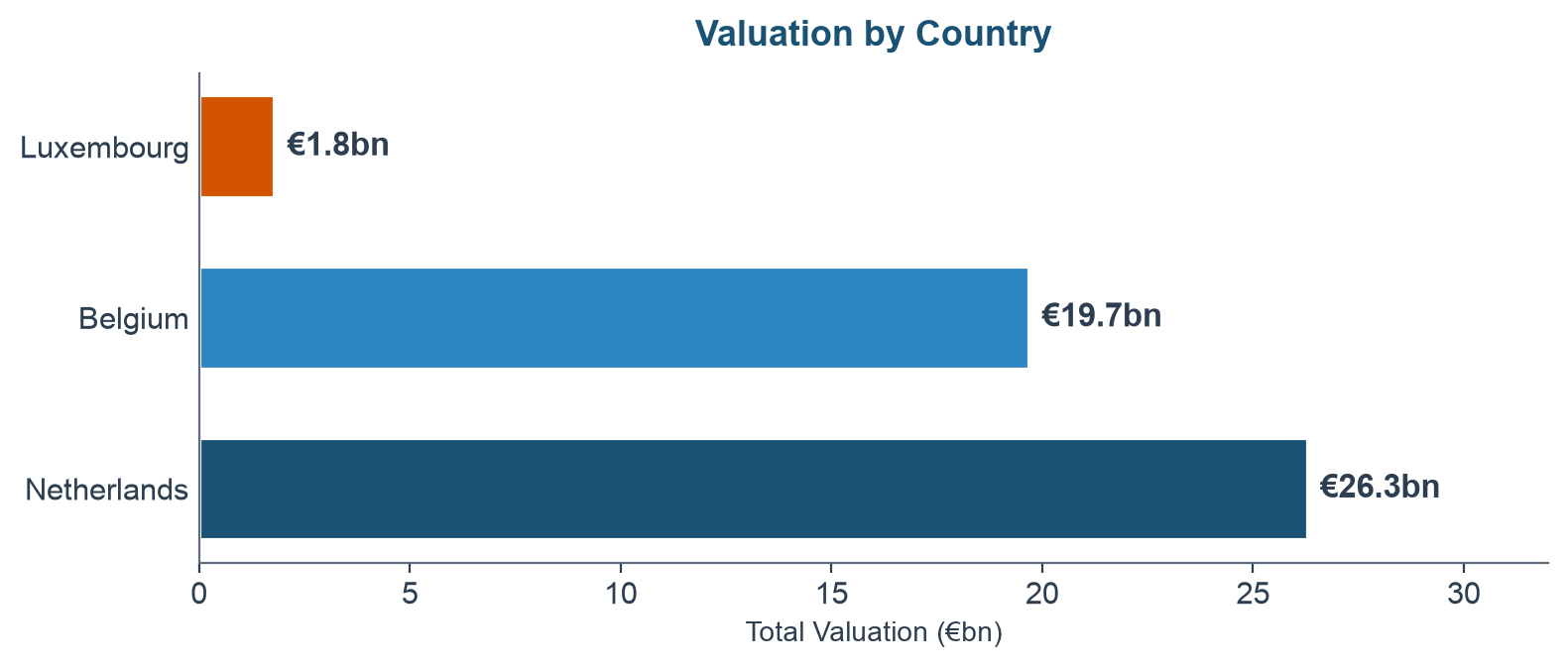
Valuation by Country (€bn)
Source: Hurun Research Institute, Benelux Unicorn Index 2026
Belgium has overtaken Sweden in unicorns. With seven active billion-dollar startups — Odoo, team.blue, Kpler, Deliverect, I-care, Keyrock and Aikido Security — Belgium now outranks the country that produced Spotify, Klarna and King, and does so with barely a tenth of the venture fanfare. That is the headline of this year’s index.
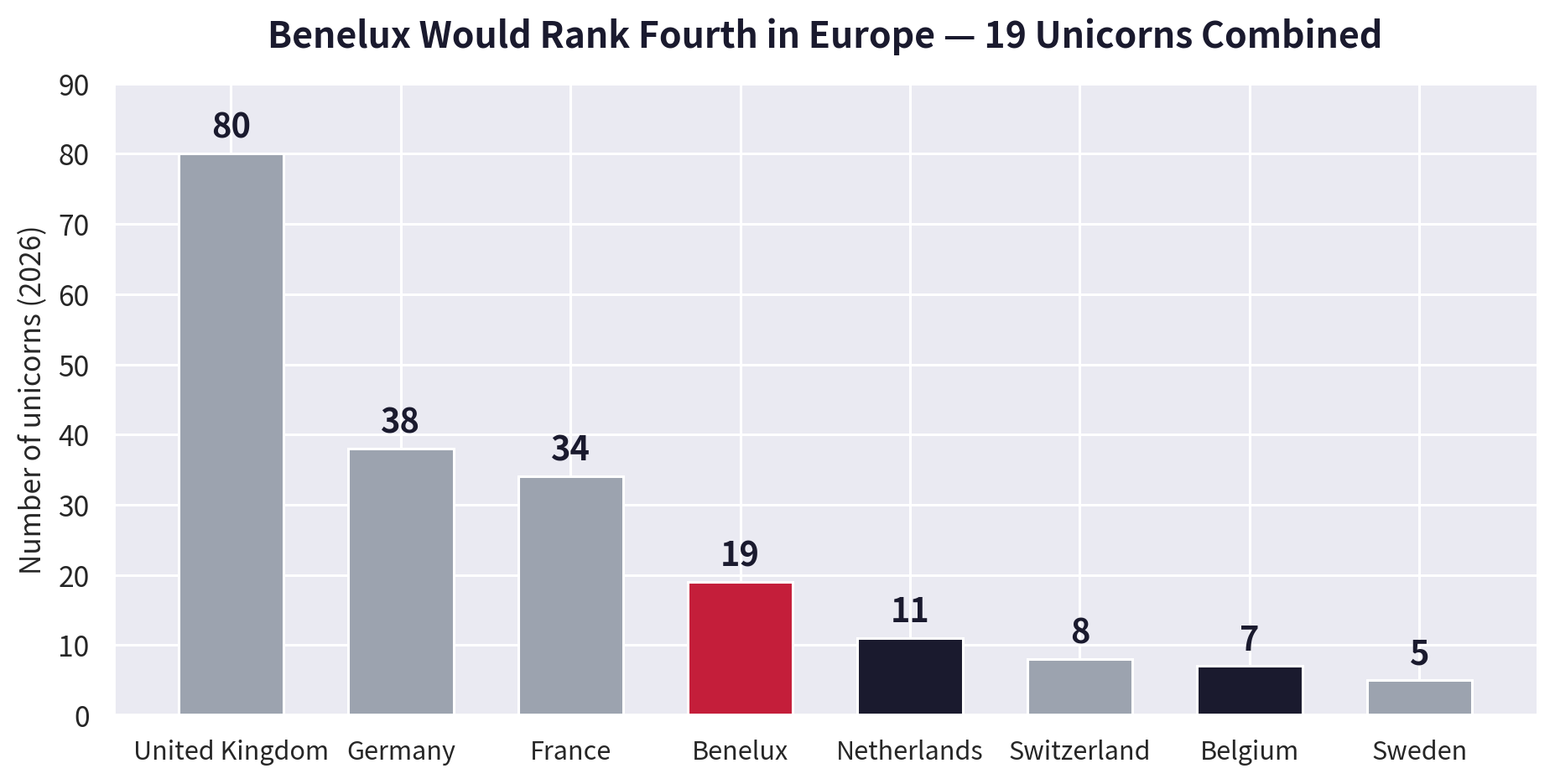
The Benelux Union now boasts 19 unicorns — private startups valued at €47.8 billion — a figure that would rank the union fourth in Europe and inside the global Top Ten if counted as one country. The Netherlands contributes 11 unicorns, Belgium seven, and Luxembourg one. Counted separately in the Hurun Global Unicorn Index 2026, the Netherlands ranks 12th in the world; Belgium’s seven places it 21st, ahead of Sweden. The story of this year’s index is not merely the count; it is a changing of the guard. Odoo, the open-source ERP champion from Louvain-la-Neuve, is the new number one. The 2021-bubble champions, Miro and Mollie, have been re-priced down by US$15.7 billion and US$3.2 billion respectively. And seven new entrants — Aikido Security, Keyrock, I-care, Framer, Nearfield Instruments, Wonderful and OCSiAl — have joined the list, Wonderful becoming one of the fastest unicorns in Benelux history at US$5 billion, eighteen months from founding.
Key findings of this report:
Metric | Value |
Benelux Unicorns | 19 (Netherlands 11, Belgium 7, Luxembourg 1) |
Total Value | €47.8 billion |
Most Valuable | Odoo at €7.0 billion |
New Faces | 7 (Aikido Security, Keyrock, I-care, Framer, Nearfield Instruments, Wonderful, OCSiAl) |
Biggest Riser | Odoo (+€2.0 billion) |
Biggest Drop | Miro (down from US$17.5bn peak to US$1.8bn; acquired by Bending Spoons, Sep 2026) |
SaaS Unicorns | 7 (largest sector, €21.0 billion) |
FinTech Unicorns | 3 (€7.2 billion) |
Amsterdam-Based | 10 unicorns (52% of the total) |
Graduates above US$5bn (post-2000) | argenx, Adyen, Elastic, Nebius |
Global Context | Part of a world record 1,603 unicorns across 52 countries |
Source: Hurun Research Institute, Benelux Unicorn Index 2026
10 of 19 unicorns have at least one founder born abroad — Benelux is Europe’s talent magnet. |
Together, the 19 employ more than 45,000 people and generate over €5 billion of annual sales — with the honest caveat that more than half of those jobs are at online grocer Picnic, mostly in warehouses and delivery vans: the least tech-looking employment a tech index has ever produced. Figures are Hurun Research Institute estimates from company disclosures, press reports and professional-network headcounts.
The rise of Odoo to the top of the Benelux ranking is the defining story of this year’s index. Fabien Pinckaers founded the company as TinyERP in April 2002, while still a student at UCLouvain, and spent two decades building an open-source ERP suite for small and medium businesses — profitably, and largely without venture capital. When CapitalG and Sequoia finally bought in via secondaries in November 2024 at €5 billion, and General Atlantic, AVP and Alkeon followed in January 2026 at €7 billion, they were not funding a startup; they were buying into Europe’s most bootstrapped unicorn, a company whose founder still controls more than half of it and whose 2025 billings of US$712 million grew 23%. King Philippe of Belgium visited Odoo’s headquarters in April 2026 — a recognition that the country’s most valuable tech company was built not in Brussels or Antwerp, but on a science park in Wallonia (the full story is Story A1 in Appendix A).
Seven new entrants joined the index this year — all profiled in Appendix A — the Wonderful arrival in September at US$5 billion as one of the fastest unicorns in Benelux history. Each tells a different story about where Benelux tech is heading. Aikido Security, founded in Ghent in 2022, became a unicorn on 14 January this year after raising a US$60 million Series B led by DST Global at US$1 billion. Keyrock, a Brussels crypto market maker, quadrupled its valuation to US$1.1 billion on 31 March 2026 in a round led by SC Ventures and Standard Chartered with Ripple participating. I-care, a predictive-maintenance pioneer from Mons with more than 1,000 staff across 16 countries, crossed €1 billion on 20 December 2025 — just inside the cut-off. Framer, the web design and AI platform built by Koen Bok and Jorn van Dijk — who sold their previous company, Sofa, to Facebook — raised a US$100 million Series D at US$2 billion in August 2025. And Nearfield Instruments, a TNO spin-off building the machines that measure chips, closed a €330 million Series D on 22 June 2026 — the largest deeptech round in Dutch history — to become Rotterdam’s first unicorn. And Wonderful, founded in Amsterdam in early 2025 by Israelis Bar Winkler and Roey Lalazar, raised US$550 million at US$5 billion on 2 September 2026, the frontier-scale AI company the index had been missing.
Geographically, the index tells two opposite stories at once. Amsterdam hosts 10 of the 19 unicorns — 52% of the union’s total — a concentration that rivals Paris’s dominance of France, though Nearfield’s June 2026 minting has finally put Rotterdam on the board. Belgium, by contrast, spreads its seven unicorns across four cities: Ghent (team.blue, Deliverect, Aikido), Brussels (Kpler, Keyrock), Mons (I-care) and Louvain-la-Neuve (Odoo). Ghent, a city of fewer than 300,000 people, hosts three unicorns plus the listed graduates argenx and Ablynx — per capita, the hardest-punching unicorn city in Europe. And Luxembourg, the third member of the union, finally contributes one: OCSiAl, the nanotube maker, is included at US$2 billion, while its best modern hope, Talkwalker, was sold to Hootsuite in 2024. Section 4.5 examines the Luxembourg story in detail.
The strongest evidence of Benelux’s maturity is not in this index at all — it is in the graduates. argenx (US$59 billion, Euronext Brussels and NASDAQ), Adyen (US$31 billion, Euronext Amsterdam) and Elastic (US$9.9 billion, NYSE) all pass the hardest test in European tech: founded in 2000 or later, gone public, still worth more than US$5 billion. Section 7 grades the full class of Benelux graduates, from Adyen’s Très Bien to Cnova’s collapse, and shows why the ability to keep winners — not just mint them — is Benelux’s real competitive advantage.
The founders behind the 19 are strikingly international. Ten of the 19 unicorns — more than half — have at least one founder born outside the country where the company is headquartered: sixteen of the 45 founders, more than a third. Miro’s Andrey Khusid and Oleg Shardin are Russians from Perm; Kpler’s François Cazor and Jean Maynier are Frenchmen building from Brussels; bunq’s Ali Niknam was born in Canada to Iranian parents and raised in Iran and the Netherlands — and is the only person to have founded two Benelux unicorns, having also founded TransIP, now part of team.blue; Mews’s Richard Valtr is Czech; Deliverect’s Zhong Xu was born in Shanghai and Jérôme Laredo in Canada; Keyrock’s Juan David Mendieta in Colombia; Nearfield’s Hamed Sadeghian came from Iran for his doctorate and stayed; Wonderful’s Bar Winkler and Roey Lalazar are Israelis who chose Amsterdam. Benelux has become Europe’s talent magnet — and the open question, as with France, is whether attraction converts into retention.
Challenges remain, and this report does not flinch from them. Growth rounds are still done in London and New York because the region’s pension giants — ABP manages some €520 billion — allocate almost nothing to classic venture capital. And the Benelux-founded diaspora abroad — GitLab, Collibra, Poolside, General Intuition and a dozen more — is worth between US$45 billion at confirmed marks and nearly US$60 billion at reported ones: a second index in exile, comparable in scale to the home list itself. There is no Bpifrance equivalent; Invest-NL is a fraction of the scale. No major Benelux tech IPO has occurred since 2024, and Just Eat Takeaway delisted in November 2025. Luxembourg’s first unicorn arrives. And the women-founder gap is stark: not one of the 19 companies has a woman among its founders — a first for the wrong reasons in the Hurun national series. Section 8 sets out what the next decade requires, and what policymakers should do about it.
“With 19 unicorns worth €47.8 billion, Benelux punches harder per capita than France or Germany — and it does so with a maturity the rest of Europe should study. It mints honestly, graduates its winners, and prices its disappointments without flinching.” — Rupert Hoogewerf, Chairman and Chief Researcher, Hurun Research Institute
GLOBAL CONTEXT
Where Benelux stands in a world of 1,603 unicorns.
SECTION 1: GLOBAL CONTEXT — BENELUX IN THE WORLD
1.1 The Global Unicorn Landscape
The Hurun Global Unicorn Index 2026 identified a record 1,603 unicorns worldwide, based in 52 countries and 299 cities, with a total value of US$8 trillion — up 43% driven almost entirely by the AI boom. The US (806) and China (381) together account for 74% of the world’s unicorns. The Benelux countries, taken together with 19, would hold 1.2% of the global total — a share that understates their weight, because the union’s graduates (Adyen, argenx, Elastic) are worth more than most countries’ entire private herds.
Rank | Country | Unicorns |
1 | United States | 806 |
2 | China | 381 |
3 | United Kingdom | 80 |
4 | India | 61 |
5 | Germany | 38 |
6 | France | 36 |
7 | Canada | 24 |
8 | Singapore | 20 |
— | Benelux (combined) | 19 |
9 | Israel | 17 |
12 | Netherlands | 11 |
21 | Belgium | 7 |
— | Luxembourg | 1 |
Source: Hurun Research Institute, Global Unicorn Index 2026
The global unicorn landscape is increasingly split into three zones: the US (806 unicorns), China (381), and the Rest of the World (416). Europe’s centre of gravity remains the UK, Germany and France — but the Benelux Union slots in immediately behind them: 19 unicorns, similar to Singapore (20) and more than Israel (17), both countries with famous startup ecosystems. The European Union as a whole hosts 131 unicorns.
The Benelux position is best understood as a ratio rather than a rank. The union holds 1.2% of the world’s unicorns from about 0.4% of the world’s population — more than three times its demographic share. Only a handful of countries beat that conversion rate — Singapore, the United States, Israel and the United Kingdom, plus small rich states such as Switzerland, Finland, Norway and Estonia — and each of them is a global financial or technology hub, or a micro-ecosystem, of a fundamentally different kind. Benelux achieves its ratio as a trading-and-engineering economy, which is precisely why its composition — B2B infrastructure, fintech, industrial intelligence — differs so markedly from the consumer-heavy lists of larger ecosystems.
1.2 Benelux’s Global Standing
Benelux outperforms every continental European peer on a per-capita basis — and it is not close. The union’s 30.3 million people have produced 19 unicorns, or 0.63 unicorns per million inhabitants. France manages 0.53, Germany 0.45; only the United Kingdom, at 1.16, does better in Europe, and the UK is a global financial centre with two and a half times Benelux’s population. Strip the comparison to the continent, and Benelux is Europe’s most productive unicorn factory per head.
Source: Hurun Research Institute, Benelux Unicorn Index 2026
The comparison that should embarrass the rest of Europe is Belgium’s. With seven unicorns — Odoo, team.blue, Kpler, Deliverect, I-care, Keyrock and Aikido Security — Belgium now outranks Sweden (6), the country that produced Spotify, Klarna and King, and does so with barely a tenth of the venture fanfare. The Netherlands, with 11, sits just outside the global top ten on its own. And the two countries’ ecosystems are functionally integrated: Ali Niknam founded TransIP (now part of Belgium’s team.blue) and bunq in Amsterdam; Hg, team.blue’s largest holder, is a London firm with deep Benelux roots; Belgian capital (Sofina) backed Brussels-founded Collibra all the way to New York.
What the Benelux list lacks in headline size it makes up in quality of construction. Its number one, Odoo, was profitable long before institutional investors arrived. Its graduates — Adyen, argenx and Elastic — are worth a combined US$99 billion on public markets (October 2026), a figure France’s listed graduate class matches only because Datadog, built in New York, counts as French. The comparisons of Sections 1.4 to 1.9 develop the point; here it is enough to say that the 19 in this report are not a ranking artefact. They are the private layer of the most complete tech economy in continental Europe, relative to its size.
“Count Benelux as one union and it is the fourth tech ecosystem in Europe — 19 unicorns, behind only the UK, Germany and France, and ahead of all of them per capita. The Netherlands gives it scale, Belgium gives it breadth, and Luxembourg gives it a warning.”
1.3 The World’s Top Unicorn Cities — Amsterdam in the Global Ranking
The Hurun Global Unicorn Index 2026 tracks unicorns across 299 cities. San Francisco extends its lead as the World Unicorn Capital with 222 unicorns, ahead of New York (141), Beijing (86), Shanghai (74) and London (60). Amsterdam, with 10 unicorns on this report’s count, sits around twentieth in the world — third in continental Europe, behind only Paris (32) and Berlin (18), and ahead of Munich (8) and Stockholm (5). Ghent, with three, is the smallest city in Europe to host three unicorns.
Rank | City | Unicorns | Change |
1 | San Francisco | 222 | +23 |
2 | New York | 141 | -1 |
3 | Beijing | 86 | +11 |
4 | Shanghai | 74 | +10 |
5 | London | 60 | +12 |
6 | Shenzhen | 44 | +7 |
7 | Palo Alto | 37 | +10 |
8 | Paris | 32 | +4 |
9 | Austin | 25 | +7 |
9 | Bengaluru | 25 | -6 |
9 | Hangzhou | 25 | +3 |
20 | Amsterdam | 10 | +1 |
Source: Hurun Research Institute, Global Unicorn Index 2026 (city table).
Two observations stand out. First, Amsterdam’s concentration is even more extreme than Paris’s: 10 of 19 Benelux unicorns are in one city — and Rotterdam only joined the active list in June 2026, through Nearfield; The Hague, Eindhoven and Utrecht still contribute none, a geography problem Section 4 examines. Second, the Belgian pattern is the mirror image: Ghent (3), Brussels (2), Mons (1) and Louvain-la-Neuve (1) give Belgium four unicorn cities, more than any continental European country except Germany. If Paris’s dominance means France’s global city ranking is, in effect, France’s, Belgium’s spread means its ranking understates its depth.
1.4 Benelux vs France, Germany and Sweden: The Per-Capita Champions
France has 36 unicorns, Germany 38, Benelux 19 — and Benelux has fewer than half the population of either. The union’s 0.63 unicorns per million inhabitants beats France’s 0.53 and Germany’s 0.45, and its €47.8 billion of private unicorn value comes with something neither large neighbour can claim: three listed post-2000 graduates above US$5 billion, all still trading on European venues or NYSE, none taken private, none in exile.
Dimension | Benelux (19) | France (36) | Germany (38) |
Population | 30.3M | 68M | 84M |
Unicorns per million people | 0.63 | 0.53 | 0.45 |
Total private value | €47.8 billion | €88 billion | €118.9 billion |
Largest company | Odoo (€7.0bn) | Mistral AI (€12.9bn) | Helsing (€16.6bn) |
Post-2000 graduates >US$5bn | 3 clean + 1 asterisk | 1 (in New York) | 4 |
Geographic pattern | NL Amsterdam-centric, Rotterdam joins; BE distributed | Extreme (nearly 89% Paris) | Berlin + Munich |
State capital | Minimal (no Bpifrance) | Very active (Bpifrance, CIR) | Moderate (KfW, Länder) |
Signature strength | B2B infrastructure, fintech, honesty in pricing | AI sovereignty, marketplaces | Defence tech, industrial AI |
Source: Hurun Research Institute, Benelux Unicorn Index 2026
Benelux has 0.63 unicorns per million people — more than France (0.53) or Germany (0.45). |
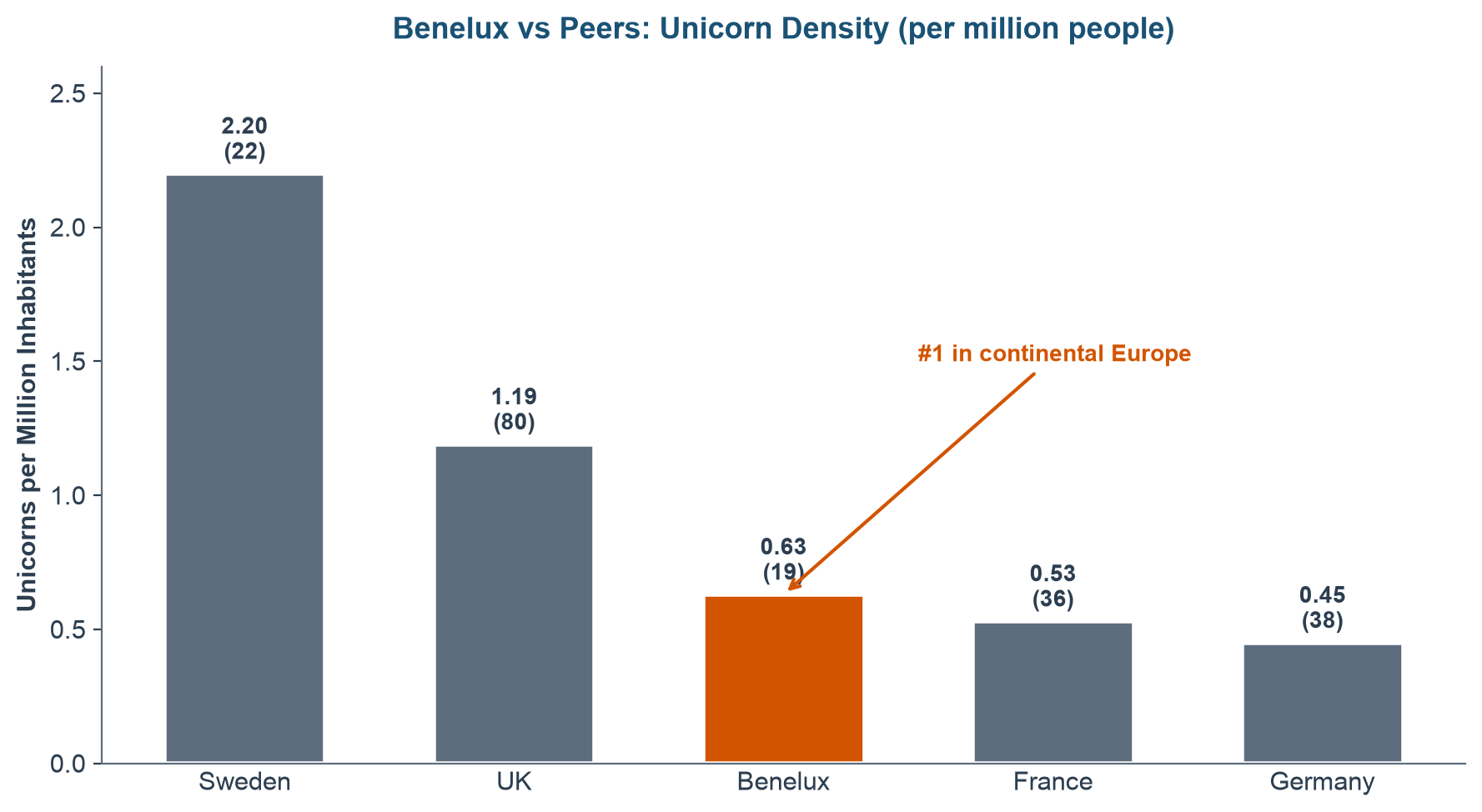
Unicorns per million people, by country. Source: Hurun Research Institute.
Source: Hurun Research Institute, France / Germany / Benelux Unicorn Indexes 2026.
The comparison flatters no one uniformly. France’s AI sovereignty play — Mistral, AMI Labs — is a frontier bet Benelux has not matched; Germany’s defence-tech wave has no Benelux equivalent either. But the Benelux portfolio is the most durable of the three: profitable SaaS, consolidating fintech, infrastructure data — companies whose valuations rest on revenue rather than narrative.
There is a complementary-engines reading that serves Europe better than the rivalry framing. France supplies frontier AI and consumer marketplaces; Germany supplies defence tech and industrial software; Benelux supplies the payments rails, the ERP backbone, the trade data and the security tooling. A European tech economy that worked would see all three compounding into each other’s stacks — and the first signs are visible: Kpler’s founders are French, Deliverect’s are Chinese-born, and the growth capital for all three countries’ champions comes from the same London and New York syndicates.
Belgium’s seven unicorns now outnumber Sweden’s six. Let that land: the country that produced Spotify, Klarna, King, Mojang and Northvolt — Europe’s most mythologised startup nation per capita — has been overtaken, in active unicorn count, by a country most venture decks still treat as the place the EU institutions are. Sweden’s value density remains far ahead (Spotify alone is a US$100 billion graduate), and its pipeline is proven; Belgium’s is new. But Odoo, team.blue, Kpler, Deliverect, I-care, Keyrock and Aikido are not an accounting quirk — they are a distributed, multi-city, multi-sector portfolio built almost without international notice.
The overtaking is the France-report-era perception breaking: as recently as the official 2025 counts, Belgium was grouped with Spain and Ireland at four unicorns, a rounding error between the Netherlands and the real players. The verified count of seven, the June 2026 Kpler re-rating, and the argenx graduate anchor tell a different story: Belgium is now the fourth most interesting tech economy in Europe, and the only one whose best year is clearly ahead of it.
“The Draghi report laments that Europe has not produced a €100 billion company in fifty years. The pipeline says otherwise: ASML came from this soil, and Adyen, argenx and Nebius are already halfway there.” — Rupert Hoogewerf, Chairman and Chief Researcher, Hurun Research Institute
1.5 Benelux vs the United Kingdom
The UK’s 80 unicorns and £242 billion of value remain in a different league — but the league tables hide a convergence. The UK’s edge is London: deep late-stage capital, the LSE, global fintech density, and a founder base more international than even Amsterdam’s. Benelux’s counter is efficiency: comparable fintech infrastructure (Adyen plus Mollie plus the Amsterdam stack versus London’s fintech row), better per-capita unicorn production than France or Germany, and graduates that actually stayed — the UK lost DeepMind to Google in 2014 and has watched Arm list in New York, while Adyen and argenx compound on Euronext.
The honest gap is capital markets. London writes the growth cheques that The Hague and Brussels cannot, which is why Mews, Framer and Aikido all raised from UK-or-US-led syndicates in the past year. Benelux does not need to beat London; it needs to stop outsourcing its upside to it. The pension-capital recommendation in Section 8 is, at bottom, a London-independence measure.
The fintech comparison alone is instructive. The UK counts roughly two dozen fintech unicorns against Benelux’s three — but Benelux graduated Adyen, which is worth more than most of London’s private fintech list combined, and Mollie’s GoCardless acquisition means the consolidation of European SME payments will be run from Amsterdam, not London. Depth versus anchor: the UK has the first, Benelux has the second, and in financial infrastructure anchors tend to absorb depth over time.
1.6 The Graduation Contrast: Benelux Keeps Its Winners
The sharpest comparison in this report is not in the private index at all. Apply the strict test — founded in 2000 or later, gone public, still listed above US$5 billion — and mainland Europe produces nineteen qualifiers. Benelux has three clean passes: Adyen (roughly US$31 billion, Euronext Amsterdam), argenx (roughly US$59 billion, Euronext Brussels and NASDAQ) and Elastic (roughly US$9.9 billion, NYSE), plus Nebius with an asterisk (roughly US$68 billion). France has one — Datadog, which passes only because it was built in New York. Germany has four. Sweden, with a third of Benelux’s population, has three.
Section 7 grades the full class; the headline here is the pattern. France’s best graduates were bought off the board — Neoen, Believe, Exclusive Networks, Talend — before they could compound publicly. Benelux’s graduates were allowed to become institutions: Adyen processed €1.39 trillion in 2025 at roughly 53% EBITDA margin and made its first-ever acquisition in April 2026; argenx grew product sales 63% in Q1 2026 and changed CEOs without missing a beat; Elastic is closing on US$10 billion. The union even attempted to absorb one graduate back into the private economy on its own terms — Bird’s €165.8 million bid for the listed CM.com, rejected and withdrawn in late 2025, was a Benelux unicorn moving to buy a Benelux graduate. The instinct, if not the execution, is what a complete ecosystem looks like.
“Brussels wants the future of AI made in Europe — and on 2 September 2026 Benelux answered: Wonderful went from founding to US$5 billion in eighteen months, headquartered in Amsterdam, not San Francisco.” — Rupert Hoogewerf, Chairman and Chief Researcher, Hurun Research Institute
1.7 The US Opportunity and Threat: The Gravity Well
For Benelux startups, the United States is simultaneously the largest market, the deepest capital pool and the strongest gravitational field. The threat list is concrete and recent — and the 2025–26 vintage adds three frontier-AI names to it: Poolside AI (Dutch co-founder Eiso Kant) is San Francisco’s, CuspAI (UvA’s Max Welling) is Cambridge’s, and General Intuition (Medal spin-out Pim de Witte) is New York’s. The standing cases: Collibra, founded at VUB in Brussels, is a New York company valued at US$5.25 billion on a stale 2021 mark. Lighthouse, founded in Ghent, is headquartered in London after KKR’s US$370 million Series C. Miro co-headquarters in San Francisco. Bird is pivoting its centre of gravity toward the US even now. Every successful Benelux company eventually faces the same question — where is the centre of the business? — and the default answer keeps drifting west.
The opportunity side is equally real. The US market rewards Benelux’s B2B strengths disproportionately: Odoo’s millions of SME users, Miro’s enterprise whiteboards, Backbase’s banking platform and DataSnipper’s audit automation all sell naturally into American mid-markets. And US capital, for all the sovereignty anxiety it triggers, has been the making of the index’s top end — the question is never whether to take American money but how to keep European gravity while spending it. Odoo’s answer (take the secondaries, keep the Walloon headquarters and the founder control) is the template; Collibra’s is the warning.
The GitLab case sharpens both sides. Sid Sijbrandij, a University of Twente master’s graduate, co-founded the all-remote DevOps platform, incorporated in Delaware, and took it to a NASDAQ debut above US$11 billion in October 2021 — a company built from day one without a physical headquarters to leave. He fought a public battle with osteosarcoma, stepped down as CEO in December 2024, and reduced his voting power below 10% in the May 2026 share conversion — a US$4 to 5 billion company that is Dutch by origin and all-remote by design. No policy failure explains GitLab; its market was always global. But each such story moves the mentor bench, the cap-table experience and the next generation’s proof of concept westward, and the cumulative effect is what Section 5 calls the retention equation.
1.8 The China Angle: Indirect but Structural
Benelux’s China exposure runs less through startups than through the geopolitics of the hardware layer. ASML — founded in 1984, a context-setter rather than a unicorn — sits at the centre of US-China chip tensions, and its export-control saga shapes the entire Eindhoven deeptech pipeline that this report counts as the region’s future: PhotonDelta’s roughly 150 photonics companies (a €1.1 billion programme anchored by €470 million of National Growth Fund money) and HighTechXL’s CERN/ESA/TNO-linked venturing are, in part, Europe’s answer to strategic-technology competition. RIFT’s March 2026 financing — an €83.1 million Series B led by PGGM with Invest-NL, alongside a €30.7 million EU Innovation Fund grant — shows the industrial-decarbonisation side of the same coin. The point was underlined in September 2025, when the Dutch state briefly took control of Nexperia, the Chinese-owned Nijmegen chipmaker — an unprecedented economic-security intervention, suspended after ‘constructive’ talks once Beijing’s retaliation hit the car industry.
For the unicorns themselves, China is mostly a market-foreclosure story: none of the 19 operates meaningfully there, and none needs to, given European and American demand. The Deliverect founders’ Chinese origins and the index’s Russian-born founder cohort are reminders that global talent flows through Benelux from everywhere — including from the two countries whose tech systems most alarm Washington. Benelux’s neutrality-by-openness is an asset in a fragmenting world; it is also, increasingly, a position that requires maintenance.
1.9 GDPR and the Regulatory Frame: The Same Sword and Shield
Benelux startups live under the same European regulatory architecture as France’s. The General Data Protection Regulation (GDPR), in force since May 2018, is the EU’s framework for data privacy and security — strict consent, breach-notification and data-portability rules on any company handling EU citizens’ data. It is both sword and shield. As sword, compliance overhead is a real cost; as shield, Miro’s collaboration data, Bird’s customer-messaging records, Mollie’s payment flows, Kpler’s provenance-grade commodity-trade data, DataSnipper’s audit automation and Aikido’s security pipeline are all compliance-adjacent products whose demand grows with every new EU rule, and a GDPR-mature Benelux company can sell to European enterprise clients who demand it while the same rules raise a barrier for non-EU competitors. The AI Act’s implementation will now test whether Europe’s regulatory-first approach protects its champions or merely slows them.
The Benelux-specific wrinkle is posture. The Netherlands and Belgium have historically been among the EU’s more pragmatic regulators — trader nations, comfortable with commerce — and both host major EU data and payments infrastructure that gives them skin in the regulatory game. When Benelux founders complain about Brussels, they do so from ten kilometres away; when Brussels regulates, Benelux companies are often the reference implementations. The union’s regulatory intimacy is an underappreciated competitive advantage, provided it is used to shape rules rather than merely survive them.
“Every Benelux founder eventually faces the American question: sell, move or compete. Odoo competed and won without moving; Adyen listed at home and became a giant; Collibra moved and became American.” — Rupert Hoogewerf, Chairman and Chief Researcher, Hurun Research Institute
SECTION 2: THE BENELUX UNICORNS
Nineteen Benelux unicorns make this year’s index — eleven Dutch, seven Belgian and one Luxembourg — together worth €47.8 billion (approx. US$52.1 billion). The ten most valuable account for €38.0 billion, 79.5% of the total: the crown jewels of the Low Countries’ startup ecosystem. The full ranking table, and the story of each of the nineteen companies — numbered A1 to A19 — are in Appendix A. What follows is the shape of this year’s list: a new number one, the risers, the new faces and the drops.
2.1 The New Number One
Odoo takes the crown at €7.0 billion (US$7.7 billion) — up €2.0 billion in a single year, the largest absolute gain on the index, achieved without a euro of primary capital: every buyer, from CapitalG and Sequoia to General Atlantic, came for old shares. Fabien Pinckaers founded the company as a UCLouvain student in 2002, still owns more than half of it, and generated US$712 million of billings last year — and he says the market still undervalues it: an internal secondary in February priced Odoo at €8.6 billion, and Pinckaers puts its worth nearer €10 billion. The full story of the Walloon champion that never moved is Story A1 in Appendix A.
2.2 Risers
Four unicorns added significant value over the past year: Odoo (+€2.0 billion), Kpler (+€1.7 billion, re-rated on Sixth Street’s US$1 billion-plus commitment), Mews (+€1.2 billion, doubling its valuation) and Picnic (+€0.5 billion). Set against the year’s two great re-pricings below, the up-moves and the down-moves are the same story: the Benelux index is being marked to reality.
2.3 New Faces
Six new unicorns joined this cycle — three Belgian, three Dutch: Wonderful (Amsterdam, €4.6 billion, straight in at number three, eighteen months from founding), Framer (Amsterdam), Nearfield Instruments (Rotterdam’s first unicorn, on the largest deeptech round in Dutch history), I-care (Mons, Wallonia’s first modern unicorn), Keyrock (Brussels) and Aikido Security (Ghent, Europe’s first reported unicorn of 2026). Together they add €10.7 billion of new value — and all six are built on technologies that did not have a Benelux unicorn five years ago. A seventh entrant, OCSiAl, gave Luxembourg its first unicorn. A further candidate, FINOM (reported US$1.35 billion), sits on the watchlist pending confirmation (Section 9). Their stories are A3, A10, A11, A14, A16, A17 and A18 in Appendix A.
“Five new faces, and not one a me-too company: Europe’s fastest cybersecurity unicorn in Ghent, a bank-backed crypto market maker in Brussels, Wallonia’s first modern unicorn in Mons, a design tool twelve years in the making, and the largest deeptech round in Dutch history in Rotterdam.” — Rupert Hoogewerf, Chairman and Chief Researcher, Hurun Research Institute
2.4 Drops
Not all valuations endure. The two largest names on last year’s list have been re-priced downward by a combined €17.3 billion — the largest absolute write-downs in the history of any Hurun national index: Miro, from US$17.5 billion to the US$1.8 billion Bending Spoons agreed to pay in September 2026 (Story A12), and Mollie, halved to approximately US$3.3 billion (Story A7). A third, Bird, carries an at-risk flag on a stale 2021 mark (Story A5). All three remain unicorns, all three remain headquartered in Amsterdam, and the re-pricing methodology follows the precedent set by the France report’s treatment of Doctolib and Vestiaire Collective.
“Miro’s re-pricing is not a demotion — it is a correction, and corrections are what mature markets do. US$17.5 billion was the price of 2021’s euphoria; US$1.8 billion is the price of 2026’s reality.” — Rupert Hoogewerf, Chairman and Chief Researcher, Hurun Research Institute
SECTOR ANALYSIS
SaaS dominates, but nine sectors now feed the index.
SECTION 3: SECTOR ANALYSIS
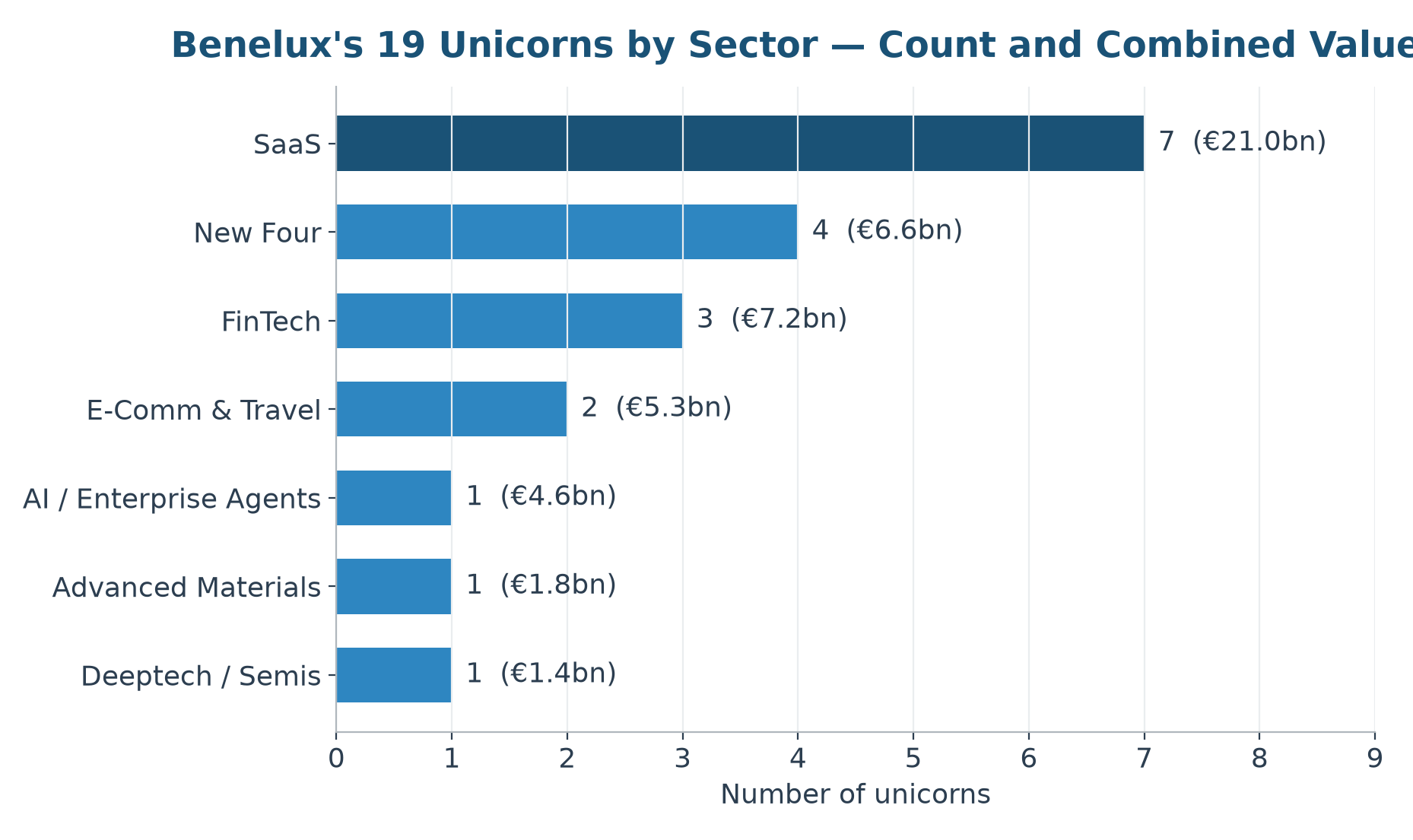
SaaS and FinTech together account for ten companies and €28.2 billion — close to three-fifths of the total value. This is the most B2B-weighted unicorn portfolio in Europe: no gaming, no consumer social, no media. What Benelux builds is infrastructure — the software, payment rails, data layers and security tooling that other companies run on.
Source: Hurun Research Institute, Benelux Unicorn Index 2026
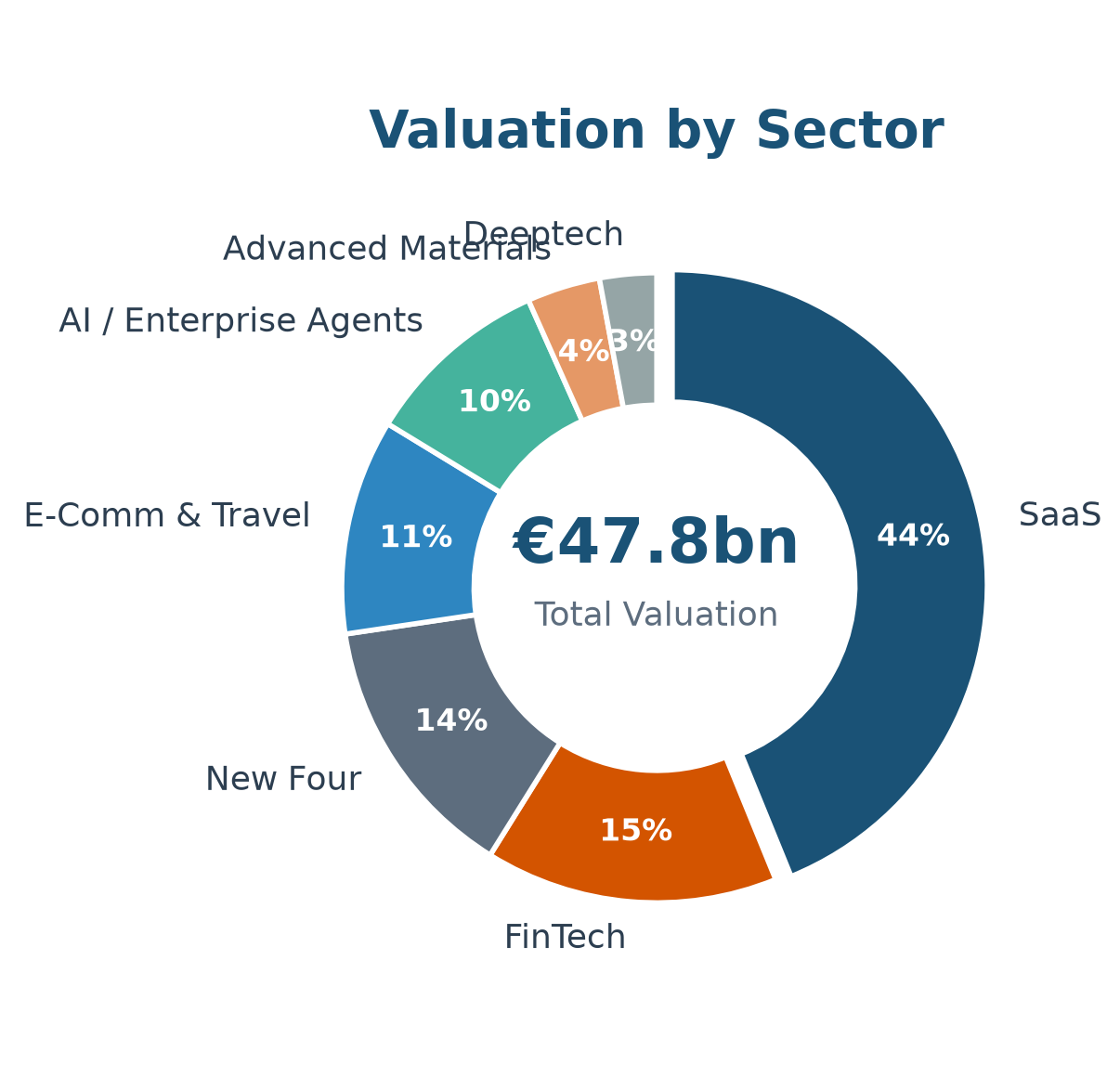
Share of index by sector. Source: Hurun Research Institute.
3.1 SaaS: The Backbone Sector
7 unicorns | €21.0 billion total value
SaaS is the Benelux index’s largest sector by count and value, and its character is distinctive: these are tools of work, not toys of consumption. Odoo runs the back office of millions of SMEs; Miro runs their meetings; team.blue runs their web presence; Bird runs their customer messaging; Framer builds their websites; Deliverect routes restaurant orders between kitchens and delivery platforms; DataSnipper automates the audit workpapers of the accountants who check everyone else.
Company | Valuation (€bn) | Sub-sector | Founded |
Odoo | €7.0 | ERP for SMEs | 2002 |
Miro | €1.65 | Visual Collaboration | 2011 |
team.blue | €4.8 | Web Hosting & SMB Services | 2019 |
Bird | €3.5 | Customer Engagement | 2011 |
Framer | €1.8 | Web Design & AI | 2013 |
Deliverect | €1.3 | Restaurant Tech | 2018 |
DataSnipper | €0.9 | Audit Automation | 2017 |
Source: Hurun Research Institute, Benelux Unicorn Index 2026
Two features distinguish Benelux SaaS from the French or German versions. First, capital efficiency: Odoo bootstrapped to dominance, DataSnipper needed only US$100 million to reach its mark, and team.blue was assembled through mergers rather than venture burn. Second, internationalisation by necessity: no Benelux home market is large enough to support a billion-dollar SaaS company, so every product here was built multilingual and cross-border from its first version. The result is a sector with unusually sober economics — and, after the Miro and Bird corrections, unusually honest pricing.
The sector’s depth reveals itself in the second tier. Deliverect’s restaurant-integration layer and DataSnipper’s audit workpaper automation are niche products that became global standards from Ghent and Amsterdam respectively — categories too small for Silicon Valley’s attention and too technical for fast followers. Framer adds the AI transition story: twelve years of design-tool craft repriced in a single August 2025 round when website creation went prompt-native. Benelux SaaS is not a theme; it is seven independent proofs that the region builds tools of work better than almost anyone.
“Benelux SaaS is Europe’s most underrated software cluster: profitable companies, modest capital, products businesses genuinely depend on. After this year’s re-pricings there is no hype in this sector — and no fantasy either.” — Rupert Hoogewerf, Chairman and Chief Researcher, Hurun Research Institute
3.2 FinTech: Amsterdam’s Second Economy
3 unicorns | €7.2 billion total value
Three fintech unicorns — all Dutch, all Amsterdam — give the city a financial-technology density matched in Europe only by London. They stack neatly into a near-complete banking architecture: Backbase provides the customer-facing layer; Mollie provides payments acceptance; bunq provides the digital bank itself. The core-banking layer, Mambu — founded in Berlin, long headquartered in Amsterdam — is now counted in Germany’s column, though its technology still sits beneath hundreds of banks worldwide. Between them sits the ghost of the sector’s listed giant: Adyen, the €28.4 billion (approx. US$31 billion) graduate whose alumni and example hover over every Dutch fintech founding.
Company | Valuation (€bn) | Sub-sector | Founded |
Mollie | €3.0 | SME Payments | 2004 |
Backbase | €2.5 | Engagement Banking | 2003 |
bunq | €1.65 | Neobank | 2012 |
Source: Hurun Research Institute, Benelux Unicorn Index 2026
The sector’s 2026 story is divergence. Mollie consolidates (GoCardless) and grows revenue 29% at half its 2021 price; bunq posted an €85 million profit in 2024 (€22 million in 2025, as it invested in expansion) — a neobank that actually makes money, carrying a July 2023 mark of €1.65 billion. The bunq story deserves a sentence of its own: Ali Niknam’s bank is profitable, founder-controlled, and patient — the anti-2021 fintech, priced before the correction and therefore never needing one.
What is missing is equally telling: no Benelux fintech unicorn serves consumers at the speculative end — no crypto casino, no BNPL giant. The region’s fintech is plumbing, and plumbing is where the durable value lives. When Adyen’s alumni finish seeding the next generation — the Bibit-to-Adyen lineage already runs through the Techleap Rise mentor bench — this sector will deepen further.
3.3 The New Four: Data, Industrial AI, Blockchain and Cybersecurity
4 unicorns | €6.6 billion total value
The most revealing sector entry on the 2026 index is a category that barely existed in Benelux five years ago. Kpler (€3.7 billion, commodity data), I-care (€1.0 billion, industrial AI), Keyrock (€1.0 billion, crypto market making) and Aikido Security (€0.9 billion, cybersecurity) are four different technologies with one thing in common: they are all Belgian, and they are all infrastructure for other people’s risk decisions — what to trade, when to maintain, how to settle, where the vulnerability is.
Company | Valuation (€bn) | Sub-sector | Founded |
Kpler | €3.7 | Commodity & Trade Data | 2014 |
I-care | €1.0 | Predictive Maintenance / Industrial AI | 2004 |
Keyrock | €1.0 | Crypto Market Making | 2017 |
Aikido Security | €0.9 | Developer-First Cybersecurity | 2022 |
Source: Hurun Research Institute, Benelux Unicorn Index 2026
That all four are Belgian is the single most important sector observation in this report. Belgium’s reputation — European institutions, logistics, chocolate — hides an engineering base (HELHa, VUB, UGent, imec) that produces exactly the kind of technical-risk companies the 2026 market rewards. All four minted or re-rated within the last twelve months. If France’s story is sovereign AI and Germany’s is defence tech, Belgium’s emerging story is infrastructure intelligence: the unglamorous data and security layers the AI economy cannot function without.
3.4 E-Commerce and Travel: The Physical-World Pair
2 unicorns | €5.3 billion total value
Picnic (€3.0 billion) and Mews (€2.3 billion) are the index’s two companies that move atoms as well as bits — groceries and hotel nights — and both are risers in a year of corrections. Picnic’s route-density grocery model is the anti-Gorillas: profitable discipline instead of blitzscale. Mews rebuilt the hotel back office as a cloud platform and now processes US$19.7 billion of annual volume. Neither depends on advertising, algorithms or attention; both sell operational superiority in industries that technology forgot for decades.
Their pairing carries a strategic point for the ecosystem: Benelux’s consumer-facing strength is not in marketplaces (France’s forte) or mobility (everyone’s 2021 folly) but in operational technology for physical businesses. The union’s geography — the densest logistics corridor in Europe, with Rotterdam’s port and Antwerp’s downstream — makes it the natural laboratory for companies that must make physical operations efficient. Picnic and Mews are what that laboratory has shipped so far.
Both companies also share a founder profile the index sees repeatedly: operators who knew the physical business before they wrote the software. Picnic’s team built route logistics for years before scaling; Valtr grew up inside a family hotel. In an era when AI demos masquerade as companies, Benelux’s physical-world pair is a reminder that the hardest moats are built in warehouses and hotel back offices, not in pitch decks.
3.5 Deeptech: The Ninth Sector Arrives
1 unicorn | €1.4 billion total value
Nearfield Instruments is a one-company sector this year — and the most important addition to this index’s sector map. Every Benelux unicorn until now has been software, finance or commerce; Nearfield sells physical instruments into the semiconductor supply chain, from Rotterdam, to the chipmakers whose fabs run the AI boom. Its presence completes the circle with the graduate chapter: ASML made the region the world’s chip-equipment capital, and the unicorn economy has finally caught up with that heritage. The pipeline behind it — PhotonDelta in photonics, QuantWare in quantum, RIFT in industrial decarbonisation — suggests the ninth sector will not stay a one-company sector for long.
Nearfield does not stand apart from the ASML ecosystem; it stands on it. The company is chaired by Eric Meurice, ASML’s chief executive from 2004 to 2013, and counts a thirteen-year ASML veteran among its early leadership. ASML, Nearfield and NXP shared a €230 million government award under the EU’s IPCEI programme in November 2023, and Samsung — an investor since 2017 — took Nearfield’s QUADRA system into mass production in 2024. This is the ASML pull in miniature: a company worth roughly US$660 billion — more than twelve times the combined value of all nineteen unicorns on this index — whose gravity holds an entire supplier and talent ecosystem in orbit, now seeding the unicorn layer as well as the listed one. The lineage runs deeper still: ASML itself was spun out of Philips in 1984, NXP followed in 2006, and Philips took a founding 27.5% stake in TSMC in 1987 — the most consequential act of corporate gardening in European industrial history, still paying dividends.
One sector is absent from this index altogether — and it is the one in which Benelux governments moved fastest in 2025–26: defence and dual-use. The NATO Innovation Fund — €1 billion, backed by all three Benelux states — is headquartered in Amsterdam, with Prince Constantijn on its board; the Dutch SecFund (€100 million, managed by BOM) began investing in 2025, and its first cohort already flies: Tective Robotics’ SkyHive drones guarded the Nijmegen Four Days Marches in July 2026, Aerlijn’s interceptors were battle-tested in Ukraine, and Amsterdam venture builder NUNC Capital is putting €20 million into Ukraine-linked defence ventures; NATO’s DIANA accelerator sits at Brainport Eindhoven; Belgium fields FNX Ventures in Liège; and Luxembourg hosts the dual-use funds Balnord and BARYON alongside an NIF portfolio company under defence contract. European defence, security and resilience startups raised a record US$8.7 billion in 2025, up 55%, and Euronext’s chief executive now calls defence ‘the sweet spot for IPOs’. None of this mints a unicorn in 2026 — Germany’s Helsing-led wave still has no Benelux equivalent — but the alliance’s 5%-of-GDP pledge was signed in The Hague, and the institutional seed layer of the 2030 index is being laid in Amsterdam, Eindhoven and Liège.
3.6 Artificial Intelligence: The Horizontal Layer
1 unicorn | €4.6 billion total value
Company | Valuation (€bn) | Sub-sector | Founded |
Wonderful | €4.6 | AI / Enterprise Agents | 2025 |
Source: Hurun Research Institute, Benelux Unicorn Index 2026
Every sector in this analysis is now an AI sector — but Benelux’s AI story is told in layers rather than headlines. France has Mistral AI and AMI Labs; Germany has Helsing and Black Forest Labs; Benelux has no sovereign frontier-model champion and, on current form, is not trying to build one. What it has instead is the application and infrastructure layer: Framer re-priced at US$2 billion when website creation went prompt-native; DataSnipper sells AI document understanding to the world’s audit firms; Aikido uses AI to find vulnerabilities before humans can; I-care’s industrial AI watches machines across sixteen countries; Kpler’s data feeds the commodity world’s models; and Nearfield sells the metrology without which no advanced AI chip can be built at all.
The frontier layer has now arrived at home. Wonderful — founded in Amsterdam in early 2025 by Israelis Bar Winkler and Roey Lalazar — raised its September 2026 round at US$5 billion, eighteen months from founding, the index’s first frontier-scale AI company, deploying model-agnostic agents across more than 35 countries. The diaspora cases remain the warning: Poolside AI (Eiso Kant), General Intuition (Pim de Witte), CuspAI (Max Welling) and Commure (Diede van Lamoen) are Benelux-founded AI companies worth billions — in San Francisco, New York, Cambridge and Mountain View. Axelera AI, the Eindhoven chip startup with more than US$450 million raised, sits on the watchlist as the likeliest next home-grown AI hardware unicorn. The strategic conclusion has sharpened: Benelux can now grow a frontier-scale AI company — the task is to keep Wonderful, and to keep the next Poolside. The capital reforms of Section 8 are, in large part, an AI-retention policy. The corporate layer has begun to act: ASML’s €1.3 billion investment in Mistral AI in September 2025 — the chip champion taking a cornerstone stake in Europe’s frontier-model champion — is the clearest sign yet that the continent’s industrial giants now treat AI sovereignty as balance-sheet business.
3.7 Advanced Materials: Nanotubes from Luxembourg
1 unicorn | €1.8 billion total value
OCSiAl — Luxembourg’s first unicorn — is the index’s sole advanced-materials entry. Its single-wall carbon nanotubes, produced in a Novosibirsk science-city spin-out now headquartered in Leudelange, are the conductive additive that makes next-generation batteries and composites possible. Carried at US$2.0bn (≈€1.8bn), it is a one-company sector for now — but a pointer to the materials depth the Benelux and Luxembourg research base can still surprise with.
Company | Valuation (€bn) | Sub-sector | Founded |
OCSiAl | €1.8 | Advanced Materials (Carbon Nanotubes) | 2010 |
Source: Hurun Research Institute, Benelux Unicorn Index 2026
SECTION 4: GEOGRAPHICAL DISTRIBUTION
The geography of Benelux unicorns is a tale of two patterns. The Netherlands concentrates: ten of its eleven unicorns are in Amsterdam — and the eleventh, Nearfield, sits in Rotterdam, the capital’s monopoly broken at last. Belgium distributes: seven unicorns across four cities, with its largest in a Walloon university town and its densest cluster in Ghent. Luxembourg, the third leg of the union, finally has one — OCSiAl.
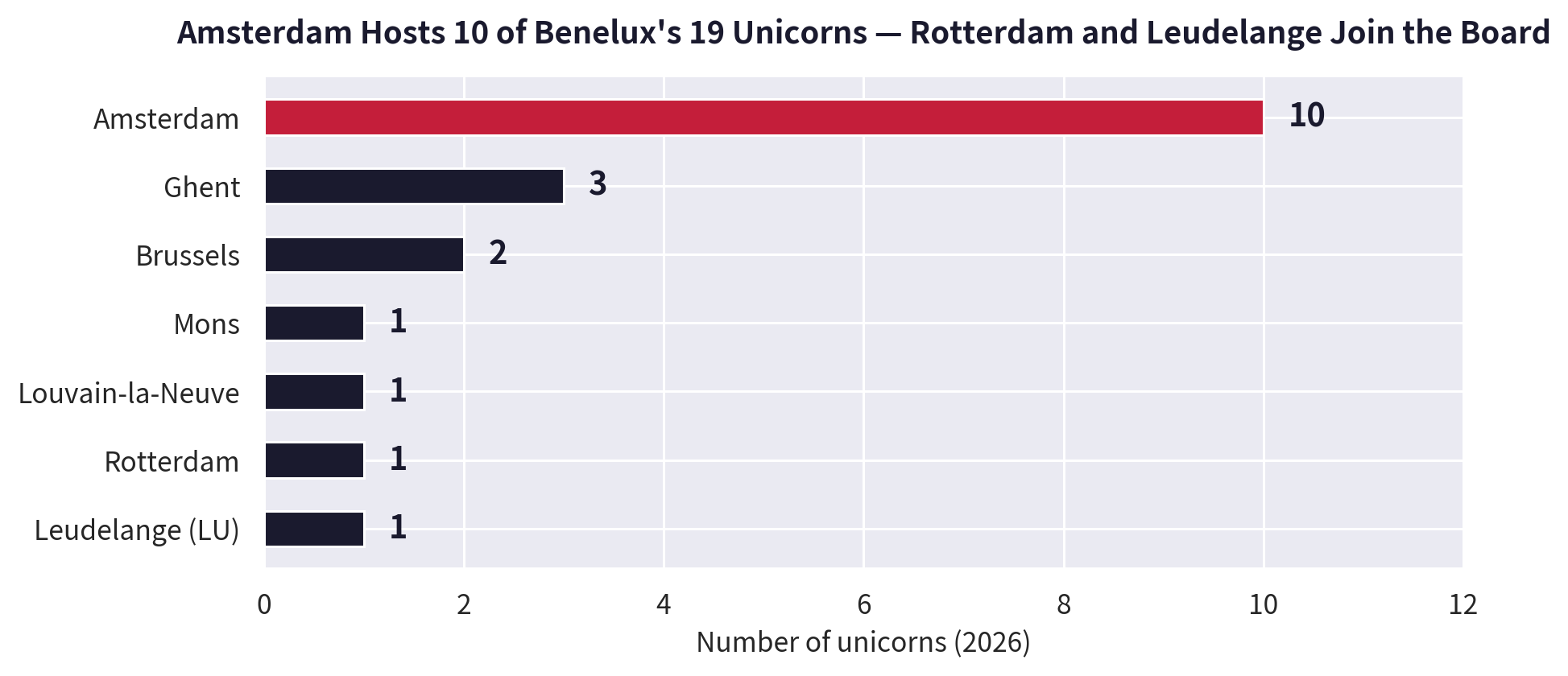
Source: Hurun Research Institute, Benelux Unicorn Index 2026
Rank | City | Unicorns | Total Value (€bn) | % of unicorns | % of value | Key Companies |
1 | Amsterdam | 10 | €24.9 | 52.6% | 52.1% | Miro, Bird, Picnic, Mollie, Backbase, Mews, Framer, bunq, DataSnipper, Wonderful |
2 | Ghent | 3 | €7.0 | 15.8% | 14.6% | team.blue, Deliverect, Aikido Security |
3 | Brussels | 2 | €4.7 | 10.5% | 9.8% | Kpler, Keyrock |
4 | Louvain-la-Neuve | 1 | €7.0 | 5.3% | 14.6% | Odoo |
4 | Mons | 1 | €1.0 | 5.3% | 2.1% | I-care |
4 | Rotterdam | 1 | €1.4 | 5.3% | 2.9% | Nearfield Instruments |
4 | Leudelange (LU) | 1 | €1.8 | 5.3% | 3.8% | OCSiAl |
Total |
| 19 | €47.8 | 100% | 100% |
|
Source: Hurun Research Institute, Benelux Unicorn Index 2026. “% of unicorns” = each city’s share of the 19 unicorns; “% of value” = each city’s share of the €47.8bn total index value.
4.1 Amsterdam: The Unicorn Capital of the Low Countries
Amsterdam hosts 10 of the 19 Benelux unicorns and 10 of the 11 Dutch entries — €24.9 billion, or 52% of the union’s total value. The concentration exceeds even Paris’s hold on France (nearly 89%, 32 of 36) in kind if not in degree: Paris at least cedes Verkor to Grenoble and Exotec to Lille, while Eindhoven, Utrecht and The Hague still contribute nothing to the active Dutch list — Rotterdam joined it in June 2026 via Nearfield Instruments. Amsterdam’s unicorn economy remains, very nearly, the Netherlands’ unicorn economy.
Amsterdam alone (€24.9bn) is worth more than all of Belgium (€19.7bn). |
The drivers are compounding. First, the graduate anchor: Adyen’s 2018 IPO made Amsterdam the proven home of a €30 billion tech company, and the city’s platform giants seeded the engineers, angels and operators of the next generation. Second, internationalisation: the 30% ruling tax break, the startup visa and an English-first business culture have made Amsterdam a magnet for foreign-born founders (Section 5.3 has the numbers). Third, the fintech stack documented in Section 3.2: once Mollie, bunq and Backbase succeeded, the next generation of financial-infrastructure founders knew exactly where to incorporate.
Unlike London’s Shoreditch or Berlin’s Mitte, Amsterdam has no single startup street: its unicorns spread from Amsterdam Oost and the Weesperpoort co-working belt, through the deeptech of Amsterdam Science Park, to the listed scale-ups of the Zuidas and the creative-tech of the Houthavens. The cluster effect is city-wide, driven by Schiphol’s reach, the 30% ruling, an English-language business culture and proximity to London and New York capital — not by a postcode.
The vulnerability is the mirror of the strength. Eindhoven — home to ASML, NXP and the Brainport deeptech cluster, with 7,000 high-tech companies and a High Tech Campus housing some 300 firms and 12,500 people — has produced no active unicorn, a gap Section 8 treats as the Netherlands’ biggest unexploited asset. The first crack appeared in June 2026: Nearfield is Rotterdam-headquartered but Brainport-bred, a TNO spin-off whose instrument programme ran in partnership with Eindhoven University of Technology. The reserve is being tapped at last. Amsterdam’s dominance is real, but a one-city ecosystem is one downturn, one housing crisis, one policy error away from stalling. France asks where its Lyon unicorn is; the Netherlands should ask where its Eindhoven unicorn is.
The pipeline beneath the city line is not empty. PhotonDelta’s photonics cluster — roughly 150 companies within a €1.1 billion programme anchored by €470 million of National Growth Fund money — and RIFT’s March 2026 financing, an €83.1 million Series B led by PGGM alongside a €30.7 million EU Innovation Fund grant, show that the next Dutch unicorns are being financed outside Amsterdam, in exactly the deeptech categories the index had lacked. The first has now arrived: Nearfield Instruments minted on 22 June 2026 — the best news the Dutch ecosystem has produced in years.
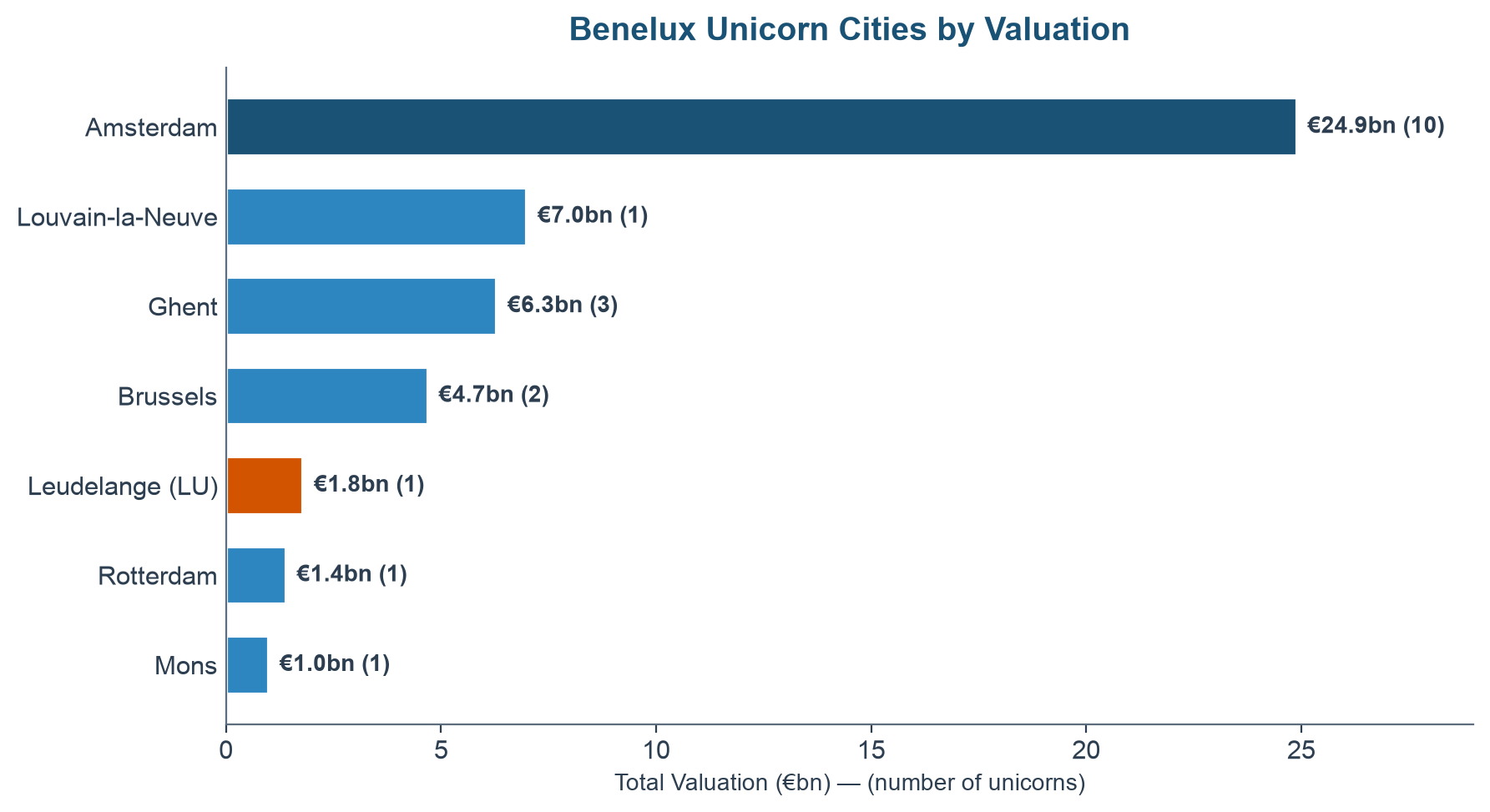
Benelux unicorn cities by total valuation (€bn). Source: Hurun Research Institute.
4.2 Ghent: The Hardest-Punching Unicorn City in Europe
Ghent, a Flemish city of fewer than 300,000 people, hosts three active unicorns — team.blue, Deliverect and Aikido Security — plus the listed graduates argenx (US$59 billion) and Ablynx (sold to Sanofi for US$4.8 billion).
The cluster has a pedigree. Ghent’s biotech corridor — built on VIB and UGent science in Zwijnaarde — produced argenx and Ablynx; its digital economy produced Combell (team.blue), Showpad (acquired by Vector Capital in 2025) and Deliverect, founded in 2018 by Zhong Xu, Jan Hollez, Jelte Vrijhoef and Jérôme Laredo to connect restaurants to delivery platforms. Aikido’s three-year sprint adds a security layer to the stack. The city’s formula is not mysterious: strong university science, a dense alumni network of exited founders, and a cost base that lets startups pay engineers without London salaries. What Ghent lacks is a late-stage capital presence — every one of its unicorns raised its big rounds from London, Paris or US investors.
Deliverect carries the city’s one caution: a January 2022 Series D at US$1.4 billion, no priced round since, and a stale-mark flag in this index. Restaurant-tech boomed with delivery and normalised with it. But Ghent’s answer to a stale mark is characteristically productive — mint a new one. Aikido did exactly that.
The city has also built itself a physical home for the next generation. The Wintercircus — a 19th-century stone circus turned car garage, abandoned for two decades and renovated for €31 million with EU, Flemish and city money — reopened in September 2024 as a 15,000 m² technology hub in the heart of Ghent: a startup campus housing more than 35 early-stage companies, the home of the Gentrepreneur student-founder programme, and a members’ collective run by Showpad co-founder Louis Jonckheere. The ambition for the building is unambiguous — a Silicon Valley of the Benelux, engineered to mint the Ghent unicorns of the 2030s.
“Ghent has always been Belgium’s most entrepreneurial town — Flemish-speaking, low-key, the quiet home of choice for the country’s most successful entrepreneurs. Three unicorns and two multi-billion-dollar biotech graduates from fewer than 300,000 people: great ecosystems are not always loud.” — Rupert Hoogewerf, Chairman and Chief Researcher, Hurun Research Institute
4.3 Brussels: The Institutional Capital’s Late Arrival
Brussels hosts two unicorns — Kpler and Keyrock — and both arrived at their current valuations within the last twelve months: Kpler re-rated to US$4 billion in June 2026, Keyrock quadrupled to US$1.1 billion in March. For a city that hosts the European Union’s institutions, NATO and a dozen multinational headquarters, the surprise is not that Brussels has unicorns but that it took so long.
The pattern, once seen, is obvious: Brussels companies sell to power. Kpler’s commodity intelligence serves traders, regulators and governments; Keyrock’s market making serves exchanges and financial institutions — SC Ventures and Standard Chartered led its round. Even the city’s famous alumnus, Collibra, founded at VUB in 2008, sold data governance to the enterprise before decamping to New York. Brussels does not do consumer whimsy; it does institutional-grade infrastructure, and 2026 is the year the market started paying for it. The open question is whether Brussels can hold what it builds — Collibra says the retention problem is real.
4.4 Flanders and Wallonia: Two Ecosystems in One Country
Belgium’s linguistic divide runs straight through its startup economy — and Flanders, the Dutch-speaking north, is the country’s unicorn engine. Three of Belgium’s seven active unicorns — team.blue, Deliverect and Aikido Security — sit in Ghent, and the listed graduates argenx and Ablynx were built on Flemish science at VIB and UGent. The Flemish formula is alumni density: Combell, Showpad, Teamleader and POSIOS produced a generation of exited founders whose angel cheques and networks now seed the next one, with imec’s Leuven semiconductor campus and Fortino’s funds behind them. The notable gap is Antwerp — Belgium’s biggest city and Europe’s second-largest port, which has no unicorn of its own; Flemish startup gravity sits in Ghent and Leuven, not on the Scheldt.
Wallonia, Belgium’s francophone south, entered this index with two unicorns from two small cities — and a coherent thesis about regional development. I-care, from Mons, built a 1,000-person industrial AI company on the engineering culture of the old coal and steel belt; its founder Fabrice Brion is a HELHa electromechanical engineer who came home from Emerson to build in his birthplace. Odoo, from Louvain-la-Neuve, grew from a UCLouvain student project into the Benelux’s most valuable unicorn without ever leaving the university science park where it started.
Two companies are not a cluster, but they are a proof: the Walloon combination of technical universities, industrial heritage and lower costs can produce world-class companies when founders refuse the gravitational pull of Brussels, Paris or Amsterdam. Wallonia’s challenge is the middle of the pipeline — it can start companies (I-care took two decades) and it can keep champions (Odoo never left), but the seed-to-Series-B conveyor belt that Ghent runs is still missing. The first Walloon venture fund of genuine scale would do more for the region than any subsidy programme. The divide’s cost is the missing middle: Flemish capital rarely crosses the language border south, Walloon founders pitch Paris before Brussels, and the regional instruments — PMV in Flanders, Wallonie Entreprendre in the south — are built not to combine. Section 8’s growth-fund recommendation is, at bottom, a bridge across that border. Wallonia has, in fact, already banked a unicorn dividend: Wallonie Entreprendre has realised some €250 million from partial exits of its Odoo stake, the Walloon parliament heard in October 2025.
4.5 Luxembourg: One Unicorn, At Last
Luxembourg has a unicorn. OCSiAl — established in Luxembourg in 2010 by four Russian scientists and industrialists, Yury Koropachinskiy, Mikhail Predtechenskiy, Oleg Kirillov and Yuriy Zelvenskiy — is the world leader in single-wall carbon nanotubes: its TUBALL additive, the first nanotube registered under the EU’s REACH regulations, makes batteries, composites and coatings conductive, and the company remains the only producer at industrial scale in Europe. Hurun Research values OCSiAl at US$2 billion, based on a series of rounds in 2021, with Rusnano and Daikin among its backers. It also has one defining graduate: Skype, incorporated in Luxembourg in 2003 and sold to Microsoft for US$8.5 billion in 2011 — the legal-entity route to an exit as large as any on this list.
“Luxembourg’s ambition to be a powerhouse in finance and digital technology is real, and the state is serious. What it lacks is not money but density — not one of the 45 unicorn founders from Benelux works in Luxembourg City.” — Rupert Hoogewerf, Chairman and Chief Researcher, Hurun Research Institute
The policy implications are Section 8’s business, but the diagnosis is simple. Luxembourg’s space-first-mover bet committed over €200 million — including stakes in Planetary Resources and Deep Space Industries, both of which failed; its startup visa and incubator scene are sub-scale; and its most promising home-grown candidates — Salonkee, OQ Technology — remain below the bar. Even its one unicorn is a company Luxembourg attracted but only partly kept. Ecosystems are built by founders, and founders need a reason to stay. The machinery is genuinely new: a ten-point action plan of March 2025 put €300 million of SNCI funds behind startups, added an investor tax credit and a stock-option regime, launched the Fit 4 Scale programme, and saw Prime Minister Luc Frieden sign a strategic partnership with Mistral AI. Attraction is now funded; retention, as Section 8 argues, is the missing half.
SECTION 5: WHAT BENELUX FOUNDERS HAVE IN COMMON
5.1 The Founder Factories: Universities and Alma Maters
Benelux unicorn founders emerge from a small set of institutions whose influence far exceeds their size. Unlike France, where the grandes écoles dominate completely, the Benelux pattern is distributed: a technical university in Enschede, a French-speaking university in Louvain, a Flemish free university in Brussels — and, above all, companies themselves.
Institution | Unicorn founders | Who (company) |
University of Amsterdam | 4 | Kaandorp (Backbase), Bok (Framer), Alblas & Bakker (DataSnipper) — the index’s most productive school |
Ghent University | 4 | Xu & Hollez (Deliverect), Delbare & Delrue (Aikido Security) — UGent spin-off Siruna is where Deliverect’s founders met |
TU Delft | 2 | Niknam (bunq), Sadeghian (Nearfield, PhD cum laude) |
UCLouvain | 1 | Pinckaers (Odoo) — Benelux’s most valuable unicorn, founded as a student project in 2002 |
HELHa (Haute École Louvain en Hainaut) | 1 | Brion (I-care) — Wallonia’s industrial engineering base |
HSE Perm (Russia) | 1 | Khusid (Miro) |
Twelve further institutions, one founder each | 12 | Erasmus (Muller, Picnic), INSEAD (Nieuwenhuys, Picnic), Groningen (Pleiter, Backbase), UCL (Valtr, Mews), Isfahan UT (Sadeghian, Nearfield), HvA (Ruyter, DataSnipper), Hult (Delrue, Aikido), CEMS (de Patoul, Keyrock), Solvay Brussels (Mendieta, Keyrock), ENSIIE (Cazor, Kpler), Namur/Leuven (Stiévenart, I-care), Vlerick (Sadeghian MBA) |
Source: Hurun Research Institute, Benelux Unicorn Index 2026
The deeper pattern is that no school dominates — and the research is now unusually complete. Of the 45 individual founders, 36 have a fully verified institution, degree and year of study (an 80% verification rate, the highest of any national Hurun index this cycle). The 19 unicorns’ 45 founders passed through more than twenty documented institutions across four continents: Erasmus (Muller), INSEAD (Nieuwenhuys), Groningen (Pleiter), UCL (Valtr), the Higher School of Economics in Perm (Khusid), Isfahan University of Technology (Sadeghian’s first degree), the Solvay Brussels School (Mendieta) and Hult (Delrue). A degree itself is optional: Jonas Dhaenens dropped out in his first year, Adriaan Mol left school without a diploma, and Robert Vis never went. France’s unicorns are built by a handful of grandes écoles; Benelux’s are built by whoever shows up — and the showing-up is global.
The University of Twente deserves its own paragraph, because its record is absurd for a campus in Enschede — with the caveat that its three legends built companies that sit outside the active index. Jitse Groen founded what became Just Eat Takeaway from his student room; Sid Sijbrandij took his master’s there before building GitLab to a US$11 billion NASDAQ debut; and Geert-Jan Bruinsma founded Bookings.nl in 1996, sold it to Priceline for roughly US$133 million in 2005, and in doing so created the engine that became Booking.com. One Dutch university, three of the most consequential foundings in European internet history. VUB tells the same story one step removed: its 2008 Collibra spin-off — Felix Van de Maele, Stijn Christiaens and Pieter De Leenheer — is Belgium’s most successful university spin-out, and it is a New York company.
5.2 The Founder Factories: Startups, Not Giants
Start with the answer: the most productive founder factories in Benelux are not its giants but its earlier startups. Not one of the 45 founders behind this index’s 19 unicorns built their career at ASML, Booking.com or Adyen — and none at Philips, Unilever, Shell, ING, Heineken, AB InBev, Solvay or UCB, the companies that defined Benelux capitalism for a century. The factories that did produce this index are smaller, younger and mostly startups themselves.
Ranked by founders produced, the bench looks like this. The Ghent restaurant-tech stable — POSIOS, and Lightspeed, the acquirer that housed it — trained three of Deliverect’s four founders. Facebook employed both Framer founders for two years after buying their first startup, Sofa. Procter & Gamble trained two of Picnic’s four founders, and Fredhopper, the Rotterdam search startup, schooled two more of the Picnic bench. The Vitamin Group, a design agency in Perm, produced both Miro founders. TransIP produced Ali Niknam — twice over, since he went on to found bunq as well. Mollie exported Adriaan Mol and René Feiner to Bird. Teamleader and Officient produced Aikido’s Willem Delbare; Showpad schooled Roeland Delrue. And TNO, the Dutch applied-science institute, spun out Nearfield Instruments. The pattern is self-reproduction: Benelux founders are minted by other founders’ companies, not by corporate academies.
What, then, of Booking.com, the region’s great informal academy? Its alumni network is real and vast — 65 alumni-founded startups worth a combined US$8 billion across 19 countries (Dealroom, September 2026) — but the dividend shows up in the wider ecosystem and the diaspora, not in this index: not one of the 45 founders is a Booking alumnus. Booking’s clearest fingerprint on the ecosystem is people rather than foundings: Gillian Tans, its chief executive from 2016 to 2019 and the first woman to lead a major Benelux tech company, now sits on the Techleap mentor bench alongside Adyen’s alumni and Ali Niknam. The giants staff the ecosystem; the startups found it.
The giants’ real contribution is leadership and gravity. ASML’s clearest mark on this index is Nearfield Instruments — chaired by Eric Meurice, ASML’s chief executive from 2004 to 2013 (a chairman, not a founder) and sharing a €230 million government IPCEI award with ASML and NXP in 2023. And behind ASML stands the original godfather of Benelux technology: Philips. The Eindhoven group’s corporate gardening spans four decades — ASML spun out in 1984; a founding 27.5% stake in TSMC in 1987, the single most consequential act of corporate gardening in industrial history; and NXP in 2006, today a US$62 billion chip giant graded in this report’s asterisk class. Philips minted no unicorn founders either — it minted the industrial landscape the founders build on. There is even a closing loop: NXP’s first chief executive, Frans van Houten, went on to lead Philips itself and now chairs Techleap, the state-backed platform mentoring the next generation.
“Not one of the 45 founders behind this index’s 19 unicorns built their career at ASML or Booking.com — two Benelux giants worth more than US$800 billion between them. The giants anchor the ecosystem; they do not mint it — the unicorns come from the second wave: Facebook, P&G, TNO and the startup bench.” — Rupert Hoogewerf, Chairman and Chief Researcher, Hurun Research Institute
5.3 The International Founder Dimension: Europe’s Talent Magnet
Here is the statistic that separates Benelux from France: ten of the 19 unicorns in this index — more than half — have at least one founder born outside the country where the company is headquartered: seventeen of the 47 founder-slots and sixteen of the 45 individual founders, more than a third of the total. Miro’s Andrey Khusid and Oleg Shardin are Russians from Perm, in the Urals — as are all four of OCSiAl’s founders, screen-investors turned industrialists from Novosibirsk, Krasnoyarsk and Tomsk. bunq’s Ali Niknam was born in Canada to Iranian parents and raised in Iran and the Netherlands. Mews’s Richard Valtr is Czech, and passed through UCL. Kpler’s François Cazor and Jean Maynier are French. Deliverect’s Zhong Xu was born in Shanghai and came to Belgium aged five for his father’s doctorate — universities and immigration working together in a single life — and his co-founder Jérôme Laredo is Canadian; Keyrock’s Juan David Mendieta was born in Colombia and graduated from the Solvay Brussels School. Nearfield’s Hamed Sadeghian came from Iran for his doctorate at TU Delft and stayed to build Rotterdam’s first unicorn. Wonderful’s Bar Winkler and Roey Lalazar are Israelis who chose Amsterdam for their AI agents company; OCSiAl’s four founders came from Russia’s Novosibirsk science scene to Luxembourg. By some estimates more than four in ten Dutch startup founders are foreign-born, a share that rivals London’s and dwarfs Paris’s.
The mechanism is policy plus culture: the Dutch startup visa (a €4,500 sufficient-funds requirement and an accredited facilitator), the 30% ruling tax break for incoming skilled workers, and an English-first business culture that lets a founder from Perm or Tehran operate at full effectiveness on day one. France attracts talent through institutions — the grandes écoles, CERN, Bpifrance — and retains it through identity; Benelux attracts it through openness and retains it through economics. Both models work; the Benelux model scales faster, and it is why Amsterdam — where, by some measures, more than half of startup founders were born abroad — has a markedly more international founder base than Paris, where foreign founders remain rare even among the country’s unicorns. Peter Wennink, who ran ASML for a decade, put the stakes plainly in May 2025: ‘If we cannot get those people here, we will get those people in Eastern Europe or in Asia or in the United States.’
5.4 Women Founders: The Gap That Remains
Of the 19 Benelux unicorns, not one has a woman among its founders. The index’s only woman founder of recent editions, Sofia Nunes — Mambu’s Portuguese co-founder, a clinical psychologist by training who retrained in human-computer interaction through Carnegie Mellon’s Madeira programme — leaves the count with Mambu’s reassignment to Germany. That is a worse record than France’s already-poor ratio, and it represents the ecosystem’s most glaring failure to capture available talent. The pipeline data offers little comfort: the region’s celebrated founder factories — the platform giants and the university spin-outs — are male-dominated at the founding level, and the venture partnerships that fund them are more so. The Dutch data now quantify the gap: State of Dutch Tech 2026 counts women-founded companies at under 9% of the ecosystem, raising some 14% less capital — ‘scandalously little’, in Prince Constantijn’s words; technology, he added, cannot be made only by white men.
“Nineteen unicorns, forty-five founders, not one woman. That is the single worst statistic in this report — an ecosystem that recruits from only half its population is competing with one hand tied.” — Rupert Hoogewerf, Chairman and Chief Researcher, Hurun Research Institute
5.5 The Benelux Founder: A Demographic Portrait
Pull the 45 individuals behind the 19 unicorns into one room and a portrait emerges. The average Benelux unicorn founder was 32 years old at founding — two years younger than the global unicorn norm of 34 (Antler, January 2026). The range is the story: the youngest were Jonas Dhaenens, 16 when he co-founded Combell in 1999, and Adriaan Mol, 20 when he founded Mollie; the oldest were Mikhail Predtechenskiy, the Russian Academy of Sciences academician who was about 53 when OCSiAl was established in 2010, and Michiel Muller, 51 when he co-founded Picnic in 2015 after a decade at ExxonMobil. Nobody checks your ID at the unicorn door.
More than half — 24 of the 45 — are verified serial entrepreneurs, and the strongest structural signal is repetition. Four of the 19 unicorns were built by teams that had already built a company together: Miro’s founders came from the Vitamin Group, Picnic’s from Fredhopper and the Procter & Gamble alumni bench, Framer’s from Sofa (sold to Facebook), and three of Deliverect’s four founders came from POSIOS, the restaurant-software startup they sold to Lightspeed. A fifth, Aikido, unites alumni of the same Ghent SaaS stable. Two founders appear twice in this index: Adriaan Mol (Mollie and Bird) and Ali Niknam (TransIP — now team.blue — and bunq). A degree is optional in a way that would scandalise Paris: Dhaenens, Mol and Robert Vis have no completed university education, while the Universities of Amsterdam and Ghent, with four founders each, are the closest thing to dominant schools.
Sixteen of the 45 — more than a third — were born outside the country where their unicorn is headquartered: the most international founder base in Europe. Two in five are technical by training or trade. And all are men — not one woman among the 45, a first for the wrong reasons in this series.
The portrait’s final dimension is speed. The average Benelux unicorn took ten years from founding to billion-dollar status (median: nine) — from Wonderful’s eighteen months — one of the fastest ascents Europe has seen — to the twenty-one years I-care needed and the nineteen each for Odoo and Backbase. The two speeds are cohorts, not accidents: the recent arrivals — Wonderful (1.5), Aikido (3), Deliverect (4), Picnic (6), DataSnipper (7) — moved at a pace the veterans never could, because the veterans bootstrapped through an era when Benelux venture capital barely existed. Speed is a modern luxury: it is what a funded ecosystem buys. The full time-to-unicorn column appears in Appendix A.
If the Benelux founder had to be captured in a single line, it would be this: early thirties, self-taught or engineer, born anywhere, and often already on their second company.
Average Benelux founder started at 32 — the global average is 34. Nobody checks your ID at the unicorn door. |
“Ten unicorns out of nineteen with a founder born abroad: Benelux is Europe’s talent magnet. But not one woman founder in nineteen.” — Rupert Hoogewerf, Chairman and Chief Researcher, Hurun Research Institute
“The average Benelux founder started at 32 and took ten years to build a billion-dollar company. Half are serial founders. They are more likely to have gone to the University of Amsterdam or the Ghent University, and half the unicorns have at least one founder born abroad. All are male.” — Rupert Hoogewerf, Chairman and Chief Researcher, Hurun Research Institute
5.6 The Diaspora: Attraction Without Retention
The Benelux story does not end at the union’s borders. Nineteen post-2000 companies built abroad by Benelux-born founders are worth up to US$65 billion at reported marks — ten active unicorns, six graduates, three near-misses — a second index in exile, comparable in scale to the home list itself. They came in three waves: the internet generation (GitLab, Tudou, Acquia), the SaaS generation (Collibra, Lighthouse, Remote) and the AI wave — the most valuable yet — of Poolside AI, CuspAI, Commure, General Intuition and XBOW. A CEO diaspora runs alongside the founders: Frank Slootman ran Data Domain, ServiceNow and Snowflake in Silicon Valley, and Werner Vogels has been Amazon’s CTO since 2005. The full diaspora table — and the stories of the founders behind it — are in Appendix C.
Why they left is consistent across all three waves: the US$100 million cheques are written in New York and London, not Amsterdam or Brussels; Y Combinator stamps the ambitious early; and the American market rewards category narratives that European investors price cautiously. Attraction without retention is a subsidy to someone else’s ecosystem — ‘tech companies are leaving, have left, or plan to leave,’ bunq’s Ali Niknam warned in March 2025; ‘you’d be crazy to stay in the Netherlands.’ The answer is not to begrudge the diaspora — France’s US$230 billion exile shows the alternative is worse — but to make the next wave stay: unlock the pension capital and rebuild the IPO pipeline (Section 8), and give the next Poolside a reason to ring the Euronext bell.
“Benelux produces the founders; America collects the companies. My researchers have counted the cost — up to sixty-five billion dollars of it. The next Poolside must have a reason to stay.” — Rupert Hoogewerf, Chairman and Chief Researcher, Hurun Research Institute
SECTION 6: INVESTORS AND THE ECOSYSTEM ARCHITECTS
The Benelux unicorn ecosystem is funded by three distinct layers: capable domestic early-stage investors in both countries, a near-absent domestic late-stage layer, and — the paradox at the system’s heart — some of the world’s deepest pools of institutional capital, sitting in Dutch pension funds, allocated to almost everything except the venture asset class on their doorstep.
“The Dutch warn of six years of stagnation — and they are right about the capital markets and wrong about the companies. Seven new entrants in one year is not stagnation; a pension system that funds none of them is.” — Rupert Hoogewerf, Chairman and Chief Researcher, Hurun Research Institute
6.1 The Capital Layer (Investors)
The Netherlands’ venture bench is deeper than its reputation. Peak, Endeit — ranked among Europe’s top four growth VCs in H1 2025 — Prime Ventures, INKEF, Forbion, henQ, Newion, Keen, SET Ventures and Innovation Industries cover seed through growth, with Invest-NL, BOM and Oost NL adding state-flavoured capital and the EIC Fund topping up deep tech. Prime Ventures wrote Takeaway’s first institutional cheque — €13 million in 2012 — and the returns from that generation now recycle through the ecosystem as angel capital and Techleap Rise mentorship.
What the bench lacks is scale at the top. No Dutch fund can independently write a US$300 million cheque, which is why Mews’s round was led by EQT Growth in London, Framer’s by Meritech and Atomico, and Aikido’s by DST Global. The domestic layer finds, validates and seeds the companies; foreigners own the growth stage. That division of labour works — until a strategic round needs a local champion and none exists. Invest-NL, the state investment arm, is a fraction of Bpifrance’s scale and mandate, and the difference shows precisely at the moment of maximum value capture.
Belgium’s investor map is smaller but battle-tested. Gimv, Sofina — which co-led Collibra’s Series G with Sequoia, all the way to New York — Smartfin (Jürgen Ingels), Capricorn (established 1993), PMV on the Flemish government’s behalf, Fortino with more than €800 million under management, Qbic, imec.xpand (€300 million, anchored to the imec semiconductor research powerhouse), V-Bio (€185 million) and Hummingbird form a genuine early-stage ecosystem. Belgian private equity overall put €4.45 billion into 264 companies in 2024, up 37%.
One name in that list deserves its own paragraph. Hummingbird Ventures, founded in 2010 by the Belgian investor Barend Van den Brande — who started as an analyst at SG Cowen in Boston and now lives between Bruges and London — may be the most prolific early unicorn-spotter Europe has produced. It wrote the seed cheque for Peak Games in 2010 (US$500,000 at a US$2 million valuation; later sold to Zynga), backed the crypto exchange Kraken in 2013 — half the stake was sold in 2021 at a US$5 billion valuation, and Kraken was priced at US$20 billion in late 2025 — and was early into Deliveroo, Gram Games, BillionToOne (now Nasdaq-listed) and Lovable, the Swedish AI rocketship. Three consecutive fund vintages have returned more than 10x net, with DPI above 7.5x — performance that powered a US$200 million early-stage fund plus a US$600 million growth fund, the largest fundraise by a Belgian venture firm to date.
Belgium’s structural problem is fragmentation rather than absence: Flemish and Walloon agencies, federal and regional mandates, and a venture community split across language communities mirror the country’s political geography. The returns, however, are beginning to compound — Odoo’s secondaries validated early Belgian believers, team.blue made Hg and Sofina significant money, and the Ghent cluster’s exit history (Ablynx’s US$4.8 billion sale to Sanofi) is the template every Flemish biotech fund now pitches. What Belgium needs is not more seed funds but a growth-stage vehicle that can lead a €100 million round without calling London first.
The Wallonia question cuts across all of it. I-care and Odoo prove the francophone south can build world-class companies; neither was meaningfully backed by Flemish funds, and both raised their defining rounds from outside Belgium entirely. A Belgian growth-stage architecture that treats Walloon deal flow as a foreign country will keep missing its best companies. The proposed joint growth fund in Section 8 is designed, in part, as a reunification instrument for Belgian venture.
Here is the strangest fact in European venture: the Netherlands hosts two of the world’s largest pension funds — ABP manages roughly €520 billion, PFZW is itself a giant — and almost none of that capital touches the unicorn economy being built thirty minutes from their offices. Dutch pension private-equity allocations run around 8%, but they skew overwhelmingly to buyout; classic venture capital is a rounding error. The 2025 private-equity returns were negative for both giants (−4.2% at ABP, −4.9% at PFZW), which will make the asset-allocation conversation harder before it gets easier.
The paradox has a price, and this report has priced it. When Odoo’s secondaries were placed, the buyers were General Atlantic, CapitalG, Sequoia, AVP and Alkeon — American firms capturing the value created by twenty years of Walloon compounding. When team.blue recapitalised, it was CPP Investments of Canada and Sofina. ABP has €30 billion of impact commitments and found €250 million for SkyNRG in May 2025; PGGM led RIFT’s €83.1 million Series B in March 2026. The capability exists; the mandate does not. One percent of ABP’s assets — €5 billion — would transform the Benelux growth-stage landscape overnight. Section 8 makes the formal recommendation; the observation here is simpler: no other country in Europe has this much local capital and uses so little of it locally.
Three weeks before publication, the dam cracked. On 24 September 2026, ABP announced €1 billion for European venture capital over three years — its first allocation of the kind — starting with €250 million for the EC-backed Scaleup Europe Fund, whose register already includes Mistral, Lovable and ICEYE. That is 0.2% of assets against the 1–2% this report recommends — but the direction, at last, is right, and ABP’s chairman framed it as this report does: successful growth companies, he said, ‘still too often move to other markets to find financing’. De Nederlandsche Bank had already put the skew in March 2025: Dutch pension funds held €97 billion in EU non-financial corporates against €293 billion in US ones.
The late-stage cap tables of this index read like a directory of Anglo-American growth finance. General Atlantic, BlackRock, Sequoia, HarbourVest and AVP in Odoo; Meritech and Atomico in Framer; EQT Growth, Atomico, Kinnevik, Battery and Tiger in Mews; SoftBank in Remote; DST Global in Aikido; SC Ventures, Standard Chartered and Ripple in Keyrock; Sixth Street in Kpler; Hg in team.blue. Benelux builds; London and New York own the growth.
This is not a complaint — global capital is a compliment, and the alternative (no growth capital at all) is worse. But it is a structural observation with strategic consequences: cap tables shape headquarters decisions, and every foreign-led growth round increases the probability that the company’s centre of gravity, listing venue and eventual acquirer are foreign too. Collibra in New York and Lighthouse in London are the cautionary examples. The companies stayed European when the capital did — Odoo’s Belgian-anchored shareholder base kept it in Louvain-la-Neuve — and went global when the capital did not.
6.2 The Institution Builders (Ecosystem Architects)
The Dutch state’s most effective instrument is not capital but coordination. Techleap.nl’s Rise and Pole Position programmes — whose mentor bench includes Pieter van der Does, Ali Niknam, Steven Schuurman, Chris Hall, Michiel Muller and Gillian Tans — give the next cohort direct access to the operators who built the last one; its partnership with Prosus (June 2025) and a new public-private structure since May 2026 keep the machine running. The 30% ruling — now tapering to a flat 27% from 1 January 2027, with pre-2024 arrivals grandfathered at 30% — remains the single most powerful talent-attraction policy in continental Europe, whatever its domestic political controversies.
What the Benelux lacks, uniquely among Europe’s major ecosystems, is a Bpifrance: a state investment bank with the mandate and the money to be patient capital at scale. France deploys over €10 billion through Bpifrance; Invest-NL and the Belgian regional agencies are an order of magnitude smaller. The Innovation Box (roughly 9% tax on qualifying IP income) and Belgium’s startup tax-shelter help at the margin. But when the next Odoo needs a sovereign-adjacent anchor for a strategic round, Benelux will send it to London or New York — not out of preference, but out of architecture.
The Hague, at least, has begun to build the answer. Invest-NL and Invest International merged in July 2025 into a single national promotional institution openly benchmarked on Bpifrance and KfW; the Jetten coalition agreement of January 2026 commits to a Nationale Investeringsinstelling with substantial starting capital, plus a DARPA-style National Agency for Disruptive Innovation; and the Wennink report of December 2025 — written by Peter Wennink, who ran ASML for a decade — put the national investment gap at €151–187 billion and called for a National Investment Bank. ‘Today’s start-up or scale-up could be tomorrow’s tech unicorn,’ Prime Minister Rob Jetten told the Hello Tomorrow summit in June 2026; ‘that is why the Netherlands is creating a national investment bank.’ The diagnosis this report shares has become policy in The Hague; the test now is capital, and speed.
Every great ecosystem also has its conveners — Xavier Niel’s dynasty in France, Brent Hoberman’s Founders Forum in London, Y Combinator in America. Benelux’s answer is distributed rather than personal, but it exists. The closest to a Belgian counterpart is Jürgen Ingels: he built Clear2Pay, sold it to FIS for €375 million in 2014, and turned the proceeds into SmartFin’s roughly €500 million of venture funds, the Scale-ups.eu platform and the SuperNova festival — a one-man ecosystem stack. The Netherlands’ answer is structural: Techleap’s founding partners read like the index’s extended family — the founders of Adyen, bunq, TomTom, Coolblue, Mollie, Picnic, Otrium, Remote, Nebius and Monks — a state-backed body convened, in effect, by the last generation of founders itself. Around them sit Duco Sickinghe’s Fortino, Ghent’s Wintercircus — a ‘founded by founders’ collective in a restored circus building — and Steven Schuurman’s philanthropy. No single figure dominates, and that is the Benelux signature: the ecosystem convenes itself.
Beyond capital, the ecosystem is built by institutions. Accelerators and incubators seed the pipeline: Rockstart and Startupbootcamp in Amsterdam, HighTechXL on the High Tech Campus in Eindhoven, imec.istart and Start it @KBC in Belgium, Yes!Delft in Delft and EIT Digital across the region. University spin-off factories supply the science: VUB’s STARLab in Brussels spawned Collibra; TNO in Delft incubated Nearfield Instruments; TU Delft, Eindhoven University of Technology, KU Leuven and imec, and Ghent University each run structured tech-transfer offices.
Public money de-risks the early stages: NWO in the Netherlands, FWO in Flanders, SRIW in Wallonia and the EIF/EIC at EU level, alongside regional development agencies that pay the bills before venture will. And a fourth layer of architects is the serial entrepreneurs who became angels — Adriaan Mol, Ali Niknam, Dries Buytaert and Bas Beerens among them, plus a loose alumni mafia that now funds and advises the next cohort. Specialist law firms, accountants and recruiters round it out, lowering the friction of going from idea to Series A.
“The Benelux venture system is a Ferrari engine with a small fuel tank: excellent early-stage investors, enormous pension funds, and almost nothing in between. A 1% allocation from ABP alone would transform the map.” — Rupert Hoogewerf, Chairman and Chief Researcher, Hurun Research Institute
“The year’s loudest voices — from The Hague to Brussels to Luxembourg City — all say the same thing: Europe diagnoses well and builds slowly. This index is the counter-argument: seven new entrants in one year, and one of the fastest unicorns Europe has seen.” — Rupert Hoogewerf, Chairman and Chief Researcher, Hurun Research Institute
6.3 How the Architecture Works (or Doesn’t)
The pipeline runs university or accelerator to angel, then local seed, then international growth money — and the architecture is strongest at both ends and thinnest in the middle. Seed is well served in Amsterdam and Leuven; a US$50–100 million Series A that used to be written locally now often crosses the Channel or the Atlantic. The talent loop is the ecosystem’s deliberate, not accidental, feature: ASML alumni in Eindhoven and platform alumni in Amsterdam seed the next generation by design. The remaining friction is cross-border — Dutch tax regimes, Belgian grant systems and Luxembourg’s holding-company logic do not easily combine, and the three networks rarely share a deal.
6.4 What This Means for Each Reader
For investors, the inefficiency is the opportunity: a strong seed and a strong late stage with a weak middle is exactly where a Series B fund can win. For founders, the architects worth knowing are named above — Rockstart, imec.istart, Yes!Delft, the alumni angels and Techleap’s Rise programmes — and access to them is as decisive as the deck. For policymakers, the lesson is that coordination (Techleap) beats capital alone; what the region lacks is a Bpifrance-scale public growth investor that bridges the missing middle.
THE GRADUATES
ASML, Booking, Adyen, argenx — the companies that made it.
SECTION 7: BENELUX STARTUPS THAT WENT PUBLIC
Not every great Benelux startup remains a unicorn forever. Some “graduate” from the private ecosystem by going public — trading unicorn status for the obligations and opportunities of listed markets. The Hurun Index tracks these graduations closely, because they represent the ultimate validation of an ecosystem’s maturity: the ability to produce companies that can stand on their own in public markets. Benelux’s record here is its crown jewel — the strongest graduate class in continental Europe relative to its size.
In this section, we apply the French university grading system — the 0–20 scale familiar from the Hurun France Unicorn Index — to evaluate how Benelux tech IPOs and listings have performed since leaving private markets. The ‘2000s generation’ is used broadly for companies founded from 2000 onwards; the European leaderboard at the end applies a strict test: founded 2000 or later, IPO completed, still listed above US$5 billion. The rule of thumb is deliberately simple: a graduate still worth more than US$5 billion earns Très Bien; anything above US$1 billion is already a good outcome — Bien or better. Graduates are ranked on this 0–20 French baccalauréat scale, with Dutch academic honors shown alongside: cum laude (top distinction), met genoegen (credit) and regular. The master list of the class — and the full graduate stories, band by band — are in Appendix B.
All graduate market capitalisations as of 1 January 2026, updated to time of press for key events; Hurun Research Institute estimates. € figures converted at €1 = US$1.09 where relevant.
Grade Range | Description | Meaning |
16–20 | Très Bien (Very Good) | Outstanding achievement — in this report, graduates still worth more than US$5 billion, or class-defining exits |
14–16 | Bien (Good) | Strong performance — graduates worth more than US$1 billion already earn a good |
12–14 | Assez Bien (Fairly Good) | Satisfactory, average performance |
10–12 | Passable (Pass) | Barely passed, minimum acceptable |
8–10 | Insuffisant (Insufficient) | Failed, but close to passing |
0–8 | Ajourné (Fail) | Completely failed |
Source: Hurun Research Institute, Benelux Unicorn Index 2026
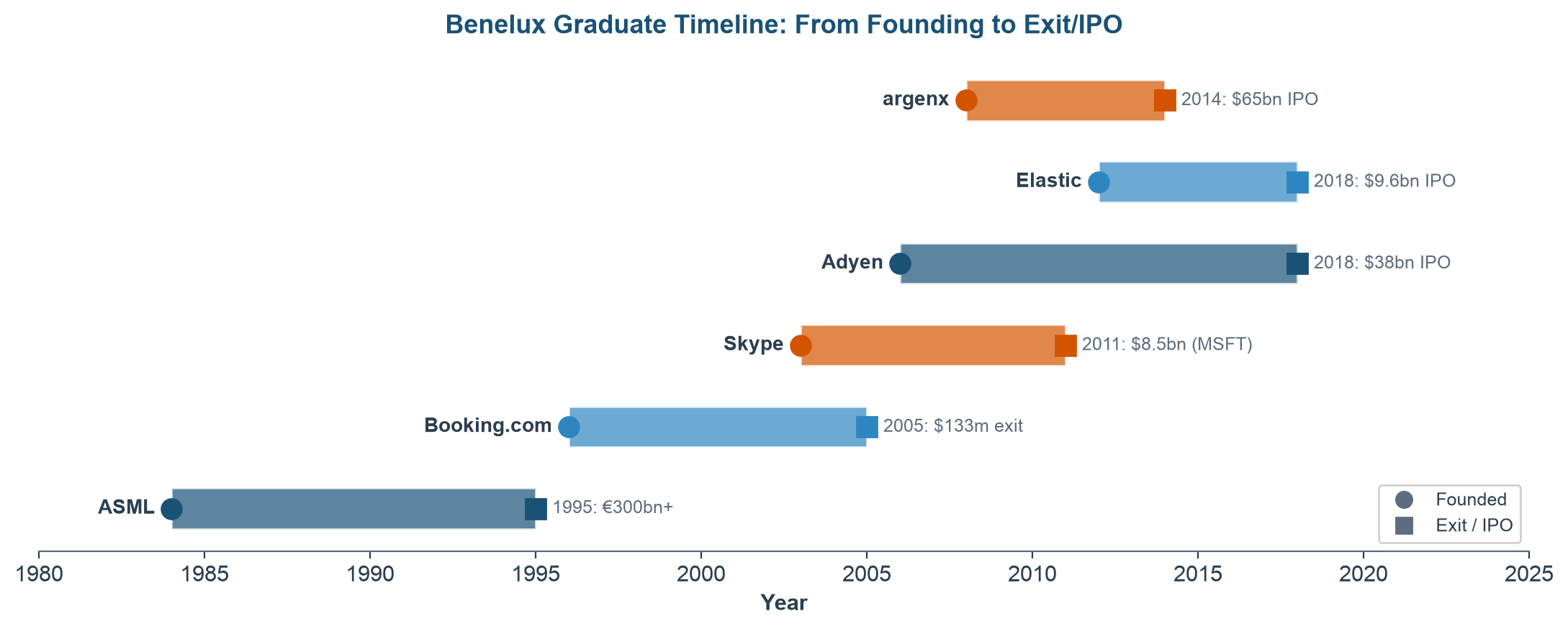
A Concluding Word on the Graduates
The pattern across this section is the inverse of France’s. France’s best graduates were bought before they could compound — Neoen, Believe, Exclusive Networks, Talend. Benelux’s best graduates compounded in public: Adyen for eight years and counting, argenx to US$50 billion-plus, Elastic steadily on the NYSE. Its failures are honest failures (Galapagos, Cnova), its take-privates were premium exits (Just Eat Takeaway at 63% over market), and even Bird’s failed bid for CM.com was an internal affair — Benelux value courted by Benelux capital. The graduate class is the ecosystem’s balance sheet, and Benelux’s is the strongest in continental Europe per capita.
The next class is already visible in this index: Backbase (IPO talk 2027), team.blue, bunq, Picnic and Mews — which has floated a possible US listing as it scales across America — are the obvious candidates, with Odoo the wildcard — a company so profitable it may simply never need to list. The question Section 8’s second recommendation addresses is whether they list on Euronext or elsewhere. Benelux’s graduate record is its proudest asset; it would be a tragedy to hand the next generation of it to New York by default.
“Three companies founded since 2000, gone public, still worth more than US$5 billion each — Adyen, argenx, Elastic. France has one, and it is in New York: Benelux does not just mint unicorns, it graduates them.” — Rupert Hoogewerf, Chairman and Chief Researcher, Hurun Research Institute
How Benelux Compares: The Post-2000 Graduate Class
Apply the strict test — founded in 2000 or later, since gone public, still listed above US$5 billion — and twenty mainland European companies qualify. Germany produced four. Sweden, with a third of Benelux’s population, produced three. Benelux produced three clean passes plus one asterisk — and France, with more than twice the union’s population, produced one: Datadog, built in New York by two French engineers, in exile.
Rank | Company | Country | Founded | Listing (IPO year) | Market Cap |
1 | Spotify | Sweden | 2006 | NYSE (2018) | US$100.4bn |
2 | Datadog † | France→US | 2010 | NASDAQ (2019) | US$99.9bn |
3 | Nebius (ex-Yandex) * | Netherlands | 2007* | NASDAQ (2011) | US$68.5bn |
4 | argenx | Belgium/NL | 2008 | Euronext (2014) | US$58.8bn |
5 | Adyen | Netherlands | 2006 | Amsterdam (2018) | US$30.7bn |
6 | BioNTech | Germany | 2008 | NASDAQ (2019) | US$24.0bn |
7 | On Holding | Switzerland | 2010 | NYSE (2021) | US$21.2bn |
8 | Unity Software † | Denmark→US | 2004 | NYSE (2020) | US$19.8bn |
9 | Evolution | Sweden | 2006 | Stockholm (2015) | US$15.5bn |
10 | Ascendis Pharma | Denmark | 2006 | NASDAQ (2015) | US$14.9bn |
11 | Delivery Hero | Germany | 2011 | Frankfurt (2017) | US$12.5bn |
12 | Elastic † | Netherlands→US | 2012 | NYSE (2018) | US$9.9bn |
13 | GitLab † | Netherlands/Ukraine→US | 2011 | NASDAQ (2021) | US$8.6bn |
14 | InPost | Poland | 2006 | Amsterdam (2021) | US$8.4bn |
15 | UiPath † | Romania→US | 2005 | NYSE (2021) | US$6.8bn |
16 | Allfunds § | Spain | 2000 | Amsterdam (2021) | US$6.3bn |
17 | Pepco Group | Poland | 2004 | Warsaw (2021) | US$6.2bn |
18 | Zalando | Germany | 2008 | Xetra (2014) | US$6.1bn |
19 | Klarna | Sweden | 2005 | NYSE (2025) | US$5.0bn |
20 | AUTO1 | Germany | 2012 | Frankfurt (2021) | US$5.3bn |
Source: Hurun Research Institute, Benelux Unicorn Index 2026
The Benelux entries on this table — Nebius, argenx, Adyen, Elastic and GitLab — are worth a combined US$176 billion: more than France’s, Germany’s or any other single country’s contribution, and ahead even of Sweden’s trio including Spotify (US$121 billion). The country scoreboard reads: Germany 4 · Sweden 3 · Benelux 3 clean · Poland 2 · Denmark 1 · Switzerland 1 · Spain 1 · Romania 1 · France 1.
* Nebius is a special case: the Yandex search engine dates to 1997, but the Dutch holding company was reincorporated in 2007 and IPO’d in 2011; its 2024 Amsterdam rebirth is treated as context, not a clean pass. † European-founded but US-incorporated. § Under an agreed Deutsche Börse takeover, still trading; completion now expected in H1 2027. Methodology: mainland Europe (excl. UK and Ireland); founded in 2000 or later; completed an IPO and still publicly listed at time of press; market capitalisation above US$5bn. Corporate mergers, spin-offs and restructuring vehicles of the period are excluded as they are not startup foundings. Market caps are point-in-time figures and move daily. AUTO1 is included at its 22 July 2026 mark (US$5.3 billion), matching the France report’s graduate-class cut-off; it has since traded below the US$5 billion bar at time of press. NXP Semiconductors (US$61.6 billion) would rank fourth but is excluded as a 2006 Philips spin-off, not a startup founding — it appears in the asterisk class above.
FINAL TAKEAWAYS
What this report means for you.
SECTION 8: FINAL TAKEAWAYS — WHAT THIS REPORT MEANS FOR YOU
For Young Entrepreneurs and Founders
Start in public, stay in control. Odoo’s Fabien Pinckaers kept more than half his company through two decades on roughly US$90 million of primary capital and now heads the union’s most valuable cohort. Move fast when you can — Wonderful went from founding to US$5 billion in eighteen months — but patience is its own strategy: Odoo took nineteen years, Backbase nineteen, Mews ten. Pick a problem people depend on: Benelux’s winners run payment rails, audit workpapers, commodity data and hotel systems, not social networks. Co-founders matter — four of nineteen unicorns were built by teams that had built before, and Adriaan Mol and Ali Niknam each founded two. And be ready to work from anywhere: the average founder was 32, technical or self-taught, frequently already on a second company, and often born abroad. This is not a region that rewards pedigree; it rewards operators.
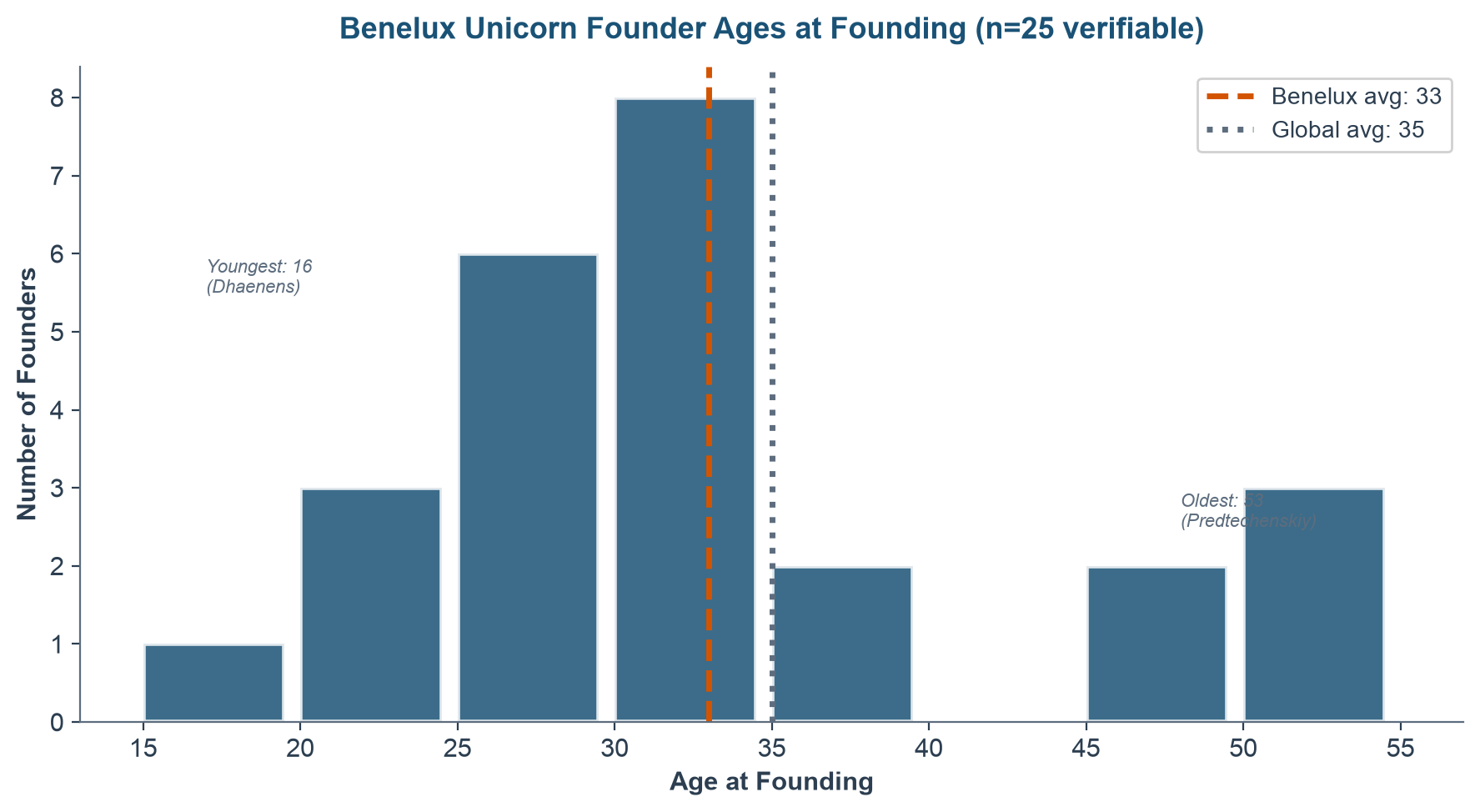
Age distribution of Benelux unicorn founders at founding. Source: Hurun Research Institute.
For International Investors
The inefficiency is real. The 19-strong Benelux cohort is a B2B-heavy, bootstrapped, honestly re-priced book in which the 2021 marks (Bird, Deliverect) have been cleared and the up-movers (Mews, Kpler, team.blue) are priced on revenue. The watchlist is the opportunity set: FINOM, Axelera AI, FLYR and QuantWare sit just below the bar. Amsterdam remains the density play — 10 of 19 unicorns, €24.9 billion, 52% of the value — while Ghent is Europe’s highest-yield unicorn city per capita. Two names to watch for re-rating: Mollie, consolidating European payments at half its 2021 price while revenue grows 29%, and Mews, which doubled in value while its neighbours fell. Growth cheques are still written in London and New York; that is the gap a patient entrant can fill.
For Policymakers and Government
The following recommendations are directed at policymakers in The Hague, Brussels, Luxembourg City and the regional governments of Flanders and Wallonia. They are ordered by expected impact. None requires a constitutional revolution; all require treating the startup economy as critical infrastructure rather than a press-release theme. The political wind is usable: Prime Minister Bart De Wever has made ‘Article 350’ — the treaty clause for deeper Benelux integration — a slogan, and Flanders’ Minister-President Matthias Diependaele proposes a Flemish-Dutch ‘innovation alliance’ on the imec–ASML axis. This report’s recommendations are what that rhetoric looks like in spreadsheet form.
“EU Inc. promises simpler, faster, cheaper incorporation — and this report shows why it matters: my researchers needed three national playbooks to count what is, in practice, one economic zone.” — Rupert Hoogewerf, Chairman and Chief Researcher, Hurun Research Institute
That quote is no longer about a campaign; it is about a bill. Von der Leyen promised a ‘28th regime’ at Davos in January 2025; Commissioner Zaharieva’s ‘Choose Europe to Start and Scale’ strategy followed in May 2025, armed with the Commission’s own finding that 30% of European unicorns left the EU between 2008 and 2021; Davos 2026 gave the regime its name — EU Inc — and on 18 March 2026 the Commission published the proposal: 48-hour, €100, fully online incorporation, plus a harmonised EU-ESOP taxed at disposal. It had not been adopted as this report went to press, and the EU-Inc campaign — to whose policy blueprint Techleap is a contributor — is fighting to stop it dissolving into 27 national versions. No region is better placed to pilot it than the one this report covers.
• 1. Pension capital into venture (The Hague): Create a regulatory safe harbour and reporting framework enabling Dutch pension funds to allocate up to 2% of assets to venture and growth equity. A 1% ABP allocation alone (€5 billion) would transform the domestic late-stage landscape. Target: first allocations by 2027.
• 2. An Euronext tech pipeline (Amsterdam–Brussels, jointly): Establish a joint Benelux task force with Euronext to prepare the 2027–2029 listing window — analyst coverage incentives, index-inclusion fast tracks, and anchor-investor commitments for Backbase, team.blue, bunq and their successors. The pipeline must exist before the candidates arrive.
• 3. 30% ruling stability (The Hague): The taper to a flat 27% from 1 January 2027 is law; now freeze it. Repeated retroactive changes destroy the predictability that makes the policy work. Commit to no further changes before 2032, and publish the grandfathering rules (pre-2024 arrivals at 30%) in one authoritative place. And finish the long-promised employee share-participation reform: ‘the ruling on share participations will be here in 2027, and that is 10 years too late,’ as Prince Constantijn puts it.
• 4. Startup visa at scale (The Hague): The €4,500 sufficient-funds-plus-facilitator design works; processing capacity does not. Scale accredited-facilitator approvals, publish processing-time SLAs, and extend the one-year permit’s renewal pathway into a five-year founder track for companies that raise institutional rounds.
• 5. A Belgian growth fund (Brussels, Flanders and Wallonia, jointly): A €500 million growth-stage vehicle co-anchored by PMV, the Walloon equivalent, Sofina and Fortino — with a mandate to lead rounds in Belgian companies at Series C and beyond. Belgium’s fragmentation is solvable precisely here, because returns are apolitical.
• 6. Luxembourg scale-up retention (Luxembourg City): The Talkwalker lesson — built in Luxembourg, grown elsewhere, sold abroad — and OCSiAl’s drift toward the US and Serbia demand a dedicated retention instrument: growth-stage co-investment matched to private leads, plus a fast-track for listing on the Luxembourg Stock Exchange’s tech segments. Attraction programmes without retention mechanics are subsidies to other ecosystems.
• 7. University spinout terms (all three countries): Standardise spinout equity and licensing terms across Twente, UCLouvain, VUB, UGent, TU/e and KU Leuven on the light-touch model that produced Collibra — universities take small, non-blocking stakes; founders keep control; capital decides the rest.
• 8. Women founders, measured (all three countries): Not one woman founder among 19 unicorns is a market failure with a measurement solution. Publish annual gender data for venture-backed founding teams, tie state co-investment to disclosure, and fund at least two dedicated female-founder vehicles at national scale by 2028.
• 9. Eindhoven deeptech patient capital (The Hague): Extend the National Growth Fund model that funded PhotonDelta (€470 million) into a standing deeptech facility for Brainport — photonics, semiconductor equipment adjacency, industrial energy like RIFT — with 10–15 year horizons that private funds cannot hold.
• 10. A Benelux scorecard (all three countries, jointly): Adopt shared KPIs — unicorn count, growth rounds led domestically, pension venture allocation, IPO count, founder-origin diversity, women-founder share — published annually. What the union measures jointly, it will fix jointly.
For Doubters and Skeptics
The data settles it. Nineteen unicorns from 30 million people is 0.63 per capita — ahead of France and Germany. The region has produced ASML, Europe’s most valuable technology company; Adyen, which processed €1.39 trillion last year; argenx, Belgium’s most valuable life-sciences company; and Elastic. Wonderful went from founding to US$5 billion in eighteen months — among the fastest ascents in European venture history. Aikido was Europe’s first unicorn of 2026, minted in Ghent three years from founding. Belgium’s seven unicorns now outnumber Sweden’s six. And the graduate record — three companies founded since 2000, listed, still worth more than US$5 billion each — is stronger than France’s. The quiet overachiever is no longer quiet.
19 unicorns from 30 million people — Benelux punches above its weight. |
“To compete with America and China, Europe needs hundred-billion-dollar unicorns — and ultimately a trillion-dollar one. Benelux is on the way: ASML, Adyen and argenx have shown the path, and the nineteen companies in this index are walking it.” — Rupert Hoogewerf, Chairman and Chief Researcher, Hurun Research Institute
SECTION 9: METHODOLOGY
The Hurun Benelux Unicorn Index 2026 uses the same methodology as the Hurun Global Unicorn Index, ensuring consistency and comparability across countries and over time. This is the first Hurun national report to cover a union of countries: the Netherlands, Belgium and Luxembourg.
Scope of this national index. This report updates the Global Unicorn Index 2026 (published 25 June 2026, cut-off 1 January 2026) with country-level research updated to time of press for key events.
Definition of a Unicorn: unlisted companies founded in 2000 or later with a current valuation of US$1 billion or more. Companies that are listed, acquired, or have fallen below US$1 billion are excluded, as are companies founded before 2000.
Valuation Methodology: Hurun Research uses the most recent valuation based on a sizeable round. Where a company underperforms its last priced round and no down-round has been announced, we mark it down using industry comparatives.
Currency Conversion: valuations are tracked in USD and presented in EUR at €1 = US$1.09; totals may differ from the sum of rows due to rounding.
Unicorns leave the index by being ‘promoted’ (IPO or acquisition) or ‘demoted’ below US$1 billion.
Time Period: cut-off 1 January 2026, with significant changes updated to the date of publication.
Data Sources: portfolio details from many of the world’s top investment houses, cross-checked against specialised databases, industry experts, media sources and unicorn co-founders, plus primary research using public filings, press releases and investor disclosures.
Sector Classification: by primary business activity; dominant revenue source where a company spans sectors.
Employment and Sales Estimates: direct employment and revenue figures are Hurun Research Institute estimates based on company disclosures, professional-network headcounts, press reports and industry benchmarks; they should be cited as such.
Founder Analysis: based on publicly available data including company websites, LinkedIn profiles, press releases and interviews.
Limitations: private-market valuations are inherently uncertain; a round’s price may not represent a sale price; companies that never raise may cross US$1 billion without a visible valuation event.
Publication Date: 13 October 2026. Unicorn valuations and index membership as of 1 January 2026, updated to time of press for key events.
APPENDIX A: THE BENELUX UNICORNS — FULL TABLE AND STORIES
The complete ranking of all 19 Benelux unicorns, using joint ranking where valuations tie — together worth €47.8 billion (approx. US$52.1 billion). The ten most valuable account for €38.0 billion, 79.5% of the total: the crown jewels of the Low Countries’ startup ecosystem. The story of each unicorn follows the table, in ranking order — Story A1 to Story A19. Valuations are as of 1 January 2026, updated to the time of press for key events.
Ref | Rank | Company | Valuation (€bn) | Valuation ($bn) | Country | City | Sector | Founded | Time to Unicorn |
A1 | 1 | Odoo | €7.0 | US$7.7 | Belgium | Louvain-la-Neuve | SaaS / ERP | 2002 | 19 yrs (Jul 2021) |
A2 | 2 | team.blue | €4.8 | US$5.3 | Belgium | Ghent | SaaS / Web Hosting & SMB | 2019 | Born merged (Combell 1999) |
A3 | 3 | Wonderful | €4.6 | US$5.0 | Netherlands | Amsterdam | AI / Enterprise Agents | 2025 | 1.5 yrs (18 months) |
A4 | 4 | Kpler | €3.7 | US$4.0 | Belgium | Brussels | Data & Analytics / Commodities | 2014 | 12 yrs (Jun 2026) |
A5 | 5 | Bird | €3.5 | US$3.8 | Netherlands | Amsterdam | SaaS / Customer Engagement | 2011 | 10 yrs (Apr 2021) |
A6 | 6 | Picnic | €3.0 | US$3.3 | Netherlands | Amsterdam | E-Commerce / Online Grocery | 2015 | 6 yrs |
A7 | 7 | Mollie | €3.0 | US$3.3 | Netherlands | Amsterdam | FinTech / Payments | 2004 | 17 yrs (Jun 2021) |
A8 | 8 | Backbase | €2.5 | US$2.7 | Netherlands | Amsterdam | FinTech / Engagement Banking | 2003 | 19 yrs |
A9 | 9 | Mews | €2.3 | US$2.5 | Netherlands | Amsterdam | Travel & Hospitality / Hotel OS | 2012 | 12 yrs (Mar 2024) |
A10 | 10 | Framer | €1.8 | US$2.0 | Netherlands | Amsterdam | SaaS / Web Design & AI | 2013 | 12 yrs |
A11 | 10 | OCSiAl | €1.8 | US$2.0 | Luxembourg | Leudelange | Advanced Materials / Nanotubes | 2010 | 9 yrs (2019 mark) |
A12 | 12 | Miro | €1.65 | US$1.8 | Netherlands | Amsterdam | SaaS / Visual Collaboration | 2011 | 11 yrs |
A13 | 12 | bunq | €1.65 | US$1.8 | Netherlands | Amsterdam | FinTech / Neobank | 2012 | 9 yrs |
A14 | 14 | Nearfield Instruments | €1.4 | US$1.5 | Netherlands | Rotterdam | Deeptech / Semiconductor Metrology | 2016 | 10 yrs |
A15 | 15 | Deliverect | €1.3 | US$1.4 | Belgium | Ghent | SaaS / Restaurant Tech | 2018 | 4 yrs |
A16 | 16 | I-care | €1.0 | US$1.1 | Belgium | Mons | Industrial AI / Predictive Maintenance | 2004 | 21 yrs |
A17 | 16 | Keyrock | €1.0 | US$1.1 | Belgium | Brussels | Blockchain / Crypto Market Making | 2017 | 9 yrs |
A18 | 18 | Aikido Security | €0.9 | US$1.0 | Belgium | Ghent | Cybersecurity | 2022 | 3 yrs |
A19 | 18 | DataSnipper | €0.9 | US$1.0 | Netherlands | Amsterdam | SaaS / Audit Automation | 2017 | 7 yrs |
Source: Hurun Research Institute, Benelux Unicorn Index 2026
A1 Odoo: Europe’s Most Bootstrapped Unicorn Takes the Crown
Odoo is the most important company in Benelux technology today — and the most instructive. Fabien Pinckaers founded TinyERP in April 2002, while still a student at UCLouvain, with a conviction that small and medium businesses deserved enterprise resource planning software that was not designed to extract maximum rent from them. Renamed Odoo in 2014, the company built an open-source ERP suite — accounting, inventory, CRM, HR, e-commerce — that now serves millions of users worldwide and generated US$712 million in billings in 2025, up 23% year on year.
What makes Odoo extraordinary is not its growth rate but its ownership structure. Pinckaers retained more than 50% of the company through two decades of compounding, raising roughly US$90 million of primary capital in its entire history (an early €3 million round in February 2010, and a US$90 million Summit Partners growth round in December 2019); every institutional round since, from CapitalG and Sequoia in November 2024 to General Atlantic in January 2026, has been a secondary purchase — and reaching profitability long before institutional money arrived. When CapitalG and Sequoia invested in November 2024 at a €5.0 billion valuation, and General Atlantic, AVP and Alkeon followed with secondaries in January 2026 at €7.0 billion, they were buying into a proven business, not funding a bet. The €2.0 billion value added in a single year is the largest absolute gain on this year’s Benelux index — achieved without a down-round, a pivot, or a hype cycle. Since the index cut-off, the market has kept moving: an internal secondary transaction in February 2026 valued Odoo at €8.6 billion, and Pinckaers himself has since put the company’s worth at roughly €10 billion — demand exists at that price, he notes, but no one wants to sell. This index holds Odoo at its 1 January 2026 mark of €7.0 billion.
Odoo’s location is itself a statement. The company is headquartered in Louvain-la-Neuve, a planned university city in Wallonia — not Brussels, not Antwerp, certainly not Paris or London. King Philippe of Belgium visited the headquarters on 21 April 2026, a recognition that Belgium’s most valuable technology company was built in the country’s francophone south, on a university science park, by a founder who never moved. Odoo is the anti-Mistral: no billion-dollar rounds, no sovereign-fund fanfare, just twenty-four years of product discipline — and it is now the Benelux’s number one. The €2.0 billion increase — from €5.0 billion in November 2024 to €7.0 billion in January 2026 — is the largest absolute gain on the Benelux index, and it was achieved without a euro of primary capital: every buyer came for old shares.
“Twenty-four years, one founder, more than half the equity, roughly US$90 million of primary capital — Odoo is the company I wish more founders would study. Europe talks about patient capital; Fabien Pinckaers practised patient ownership.” — Rupert Hoogewerf, Chairman and Chief Researcher, Hurun Research Institute
A2 team.blue: The Ghent Consolidator
team.blue is the company European private equity built — and the second Belgian unicorn in the top five. Formed in 2019 through the merger of Combell, TransIP and Register, the group provides web hosting, domains and digital services to small and medium businesses across Europe. Its origin story is a Benelux fable: Jonas Dhaenens founded Combell at sixteen, with schoolmate Frederik Poelman, and grew it into Belgium’s hosting leader; Ali Niknam — born in Windsor, Ontario, to Iranian parents and a TU Delft computer-science graduate — founded TransIP in Amsterdam at twenty-one before founding bunq, making him one of only two people with two Benelux unicorn foundings (the other is Mollie and Bird founder Adriaan Mol). Hg, the London-based software investor, is the group’s largest holder; Claudio Corbetta serves as CEO.
The financial trajectory justifies the €4.8 billion valuation set by a €550 million CPP Investments and Sofina round in July 2024. FY2025 ARR reached €866 million, built through relentless acquisitions of hosting and SMB-software brands across the continent. Where American roll-ups strip costs, team.blue’s pitch is continuity: local brands, local support, shared infrastructure. It is the quiet giant of Belgian tech — less celebrated than Odoo, larger by headcount, and headquartered in Ghent, the city that keeps producing unicorns out of proportion to its size.
team.blue also embodies the Benelux integration theme of this report. A Belgian-Dutch merger, backed by London and Canadian capital, reporting near-billion-euro recurring revenue: this is what the union looks like when it works. Its next test is the public market; a team.blue listing would be the most significant Benelux tech IPO since Adyen, and Section 8 argues it should happen on Euronext, not in New York.
A3 Wonderful: One of the Fastest Unicorns in Benelux History
Wonderful is one of the fastest unicorns in Benelux history — and the answer to the question this report’s AI section had been asking. Bar Winkler and Roey Lalazar founded the company in early 2025 — R&D in Tel Aviv, headquarters in Amsterdam — to build enterprise AI agents that work in every language and market: not copilots that assist customer-service staff, but agents that resolve the interaction end-to-end. The two are a serial Israeli pairing: Winkler was an early ironSource product executive (2012–18) before selling Approve.com to Tipalti for roughly US$40 million; Lalazar is a Unit 8200 veteran who built the AI video-localisation start-up Kaps. The pace this time was different in kind. A US$34 million seed in July 2025, US$100 million from Index Ventures at US$700 million in November, US$150 million from Insight Partners at US$2 billion in March 2026 — and on 2 September 2026, US$550 million at US$5 billion, with Salesforce joining the register. Eighteen months, four priced rounds, more than US$800 million raised.
The model is deployment-led: Wonderful embeds engineering teams with enterprise clients — telecoms, banks, manufacturers, healthcare — and integrates its model-agnostic agent platform into their workflows, market by market. It operates across more than 35 countries, claims resolution rates above 80% without human intervention, and has reached roughly US$70 million of annualised revenue — a US$100 million run-rate targeted by year-end — and about 650 employees. The headquarters is Amsterdam; the R&D heart is Israeli. It is the Miro pattern inverted — and the strongest proof yet that Amsterdam can hold a frontier-scale AI company.
The caveats are real: an eighteen-month-old company carrying a US$5 billion price is a 2021-style memory the market has sworn off, and the revenue base, while exceptional for its age, must grow into the multiple. But the strategic fact stands: the AI company Europe’s ecosystems keep losing was kept — in Amsterdam. Whether Wonderful becomes Section 5’s retention story or Section 1.7’s gravity-well story is the most interesting question the 2027 index will answer.
A4 Kpler: The Commodity Data Powerhouse
Kpler is the least-known top-five unicorn in Europe — deliberately. Founded in 2014 by François Cazor and Jean Maynier — two French engineers from the same Parisian school, ENSIIE, who had already built the carbon-market data firm eCO2Market together — and built in Brussels, Kpler tracks ships, cargoes and commodity flows to provide the data layer of global trade: who is moving what oil, gas, grain and metals, where, and at what price. Its intelligence is used by traders, shipowners, analysts and governments. The company passed US$100 million of annual recurring revenue in January 2024 and has grown aggressively through M&A, rolling up MarineTraffic and a string of data assets.
In June 2026, Kpler was re-rated: Sixth Street agreed to invest more than US$1 billion in the company — a transaction Bloomberg reported — at a valuation of roughly US$4 billion, with early backer Five Arrows exiting. That single cheque is larger than the entire venture capital raised by most of this index’s members, and it lifts Kpler from the mid-table to fifth in Benelux, up approximately €1.7 billion on prior marks. We assign Kpler to Belgium on the strength of its self-confirmed Brussels headquarters; the Hurun France Unicorn Index does not claim it, though its founders’ nationality is noted in its profile.
Kpler’s rise is a data-story about where value hides in 2026. Not in consumer apps or general-purpose AI, but in proprietary, hard-to-replicate datasets sitting atop physical-world flows. Energy security, sanctions enforcement and supply-chain resilience are policy priorities on both sides of the Atlantic; Kpler sells the observability all three require. Brussels, better known for institutions than startups, now hosts two of the index’s newest re-ratings — Kpler and Keyrock. Kpler is also a quiet lesson in how Europe actually works: French founders, a Brussels headquarters, American capital and global customers — no single-country frame describes it, and Hurun counts it, gratefully, for Belgium.
A5 Bird: The Cautionary Tale of the Dutch Cohort
Bird — MessageBird until February 2024 — is the starkest at-risk flag in the Benelux index. Robert Vis — an Amsterdam school leaver who had already built and sold the ZayPay mobile-billing platform — founded the company in Amsterdam in 2011 with Adriaan Mol, Bob Violier, René Feiner and Ihab Matta, and built it into a customer-engagement platform: SMS, voice, email and chat APIs that let businesses talk to their customers. In April 2021, Bird raised one of the largest rounds in Dutch history — US$1 billion at a US$3.8 billion valuation — taking total funding to roughly US$1.1 billion. This index still carries that mark, and flags it as stale and at-risk in the same breath.
The record since is a study in post-bubble management. The 2024 rebrand to Bird was meant to signal a broader communications platform; instead, the company has cut a fifth of its staff (May 2026), shifted its centre of gravity toward the United States, and turned would-be consolidator, bidding €165.8 million in November 2025 for CM.com — a listed Dutch graduate of the same CPaaS generation — only for CM.com’s board to reject the offer within days; Bird withdrew on 1 December 2025. The failed swoop is a confession that organic growth no longer justifies the 2021 price.
Bird’s fate matters beyond one company. Along with Miro and Mollie, it forms the Dutch 2021 cohort whose re-pricing defines this index — and it is the member of that cohort least certain to remain a unicorn by 2027. The technology works, the customer base is real, and a renewed approach for CM.com could yet prove shrewd. But if one Benelux unicorn demotes next year, the smart money watches Bird. Vis put it bluntly to Reuters as the company opened hubs in New York, Singapore and Dubai: ‘The AI Act, financing, compensation, taxes, employment law — starting and running a company in Europe is hard.’ The Hague and Brussels, he added, ‘enjoy being in meetings and talking more than they get shit done.’
A6 Picnic: The Grocery Discipline Play
Picnic is the online grocer that refused to fail like the others. Founded in 2015 by Michiel Muller, Joris Beckers, Frederik Nieuwenhuys and Bas Verheijen — distinct operating heritages in one founding team: Muller (Erasmus economics, a decade at Esso/ExxonMobil before the Tango and Route Mobiel ventures), Beckers (a Groningen corporate-law and business double degree, ex-Procter & Gamble and the Fredhopper start-up he ran with Nieuwenhuys), Nieuwenhuys (an INSEAD MBA, ex-OC&C Strategy Consultants) and Verheijen (a retail marketer who came up through P&G, Albert Heijn and C1000) — Picnic delivers groceries from centralised fulfilment centres on fixed routes, using small electric vehicles: a model that trades the instant-delivery glamour of the 2021 era for route density and unit economics. While Getir, Gorillas and Flink burned billions and collapsed or retreated, Picnic raised approximately US$1.95 billion — from the Gates Trust, Edeka and NPM Capital — and kept building methodically.
The discipline shows in the numbers: 2025 revenue of roughly €1.9 billion (approx. US$2.1 billion), market leadership in the Netherlands, and an expanding German operation that now defines its growth. A €430 million round from existing investors including NPM Capital in November 2025, following €355 million in January 2024, lifts Picnic’s estimated valuation to about US$3.3 billion — up €0.5 billion on prior estimates and one of only four risers on this year’s index. Unlike most of this list, Picnic’s valuation has never needed a downward revision: every round has been priced on operational progress, not narrative. With Edeka, one of Germany’s largest grocers, as shareholder and partner, Picnic’s German operation now leads its category — the engine that defines its growth.
Picnic’s significance for the ecosystem is its proof that capital-intensive, physical-world startups can be built from Amsterdam. The company designs its own vehicles, builds its own warehouses and writes its own routing software; it is closer to a logistics manufacturer than to an app. It is also a talent factory — Michiel Muller is among the Techleap Rise mentors feeding the next Dutch generation.
A7 Mollie: The Payments Re-Pricing with a Growth Engine
Mollie is the second pillar of the great Benelux re-pricing — and the one with the strongest operating story underneath. Adriaan Mol — a Breda school dropout who never went to university — founded the company in April 2004, aged about twenty, making it the second-oldest founding on the Dutch list after Backbase (2003), and spent seventeen years building SME payments before the market noticed: a US$800 million Series C in June 2021 valued Mollie at US$6.5 billion. With no priced round since, Dealroom now estimates US$3.3 billion, and this index carries Mollie at €3.0 billion — a 49% reduction, mirroring the France report’s treatment of Doctolib.
The business, unlike the multiple, kept growing: 2025 net revenue of €147 million, up 29%, and a signed agreement in 2025 to acquire GoCardless — a consolidation play that marries Mollie’s card payments with the UK leader in direct debit, creating one of Europe’s largest SME payment platforms. Mollie’s trajectory mirrors Stripe’s European problem in reverse: while the American giant optimises for enterprise, Mollie owns the small-business segment Adyen ignores. The GoCardless deal, once closed, will make that position continental.
The re-pricing itself is the healthiest thing about Mollie’s story. No down-round has been announced; none was needed for this index to mark the company to market. At US$3.3 billion with 29% growth and a transformative acquisition pending, Mollie is priced to perform — and Adriaan Mol, who also co-founded Bird, remains one of the two or three most consequential fintech founders in Dutch history.
A8 Backbase: Nineteen Years of Patience, One Big Round
Backbase is the engagement-banking platform that bootstrapped for nineteen years before taking serious outside money. Jouk Pleiter and Gerbert Kaandorp founded the company in Amsterdam in 2003, building the software layer through which banks’ customers interact with their accounts — the apps and portals in front of the core systems that Mambu, ironically, provides behind them. For nearly two decades Backbase grew on revenue alone, becoming the category’s global leader while the market looked elsewhere.
In June 2022, Motive Partners invested €120 million at a €2.5 billion valuation — Backbase’s first major institutional round, and one of the smallest amounts raised by any company in this index’s top ten relative to its worth. The restraint has paid off: 2025 revenue exceeded US$350 million, the company acquired Kasisto, a conversational-AI banking specialist, in 2026, and IPO talk for 2027 is now open. A Backbase listing would test the Euronext Amsterdam tech pipeline that Section 8 argues must be rebuilt — the company is exactly the profile the exchange needs.
Backbase completes a peculiar Amsterdam fintech cluster: Mollie (payments), bunq (neobank), Backbase (engagement) — three of the index’s eleven Dutch unicorns sit in financial technology, a concentration no other European city matches outside London. Mambu (core banking, Berlin–Amsterdam) is now counted in Germany’s column. The city that invented modern banking in the seventeenth century has, four hundred years later, become its software supplier.
A9 Mews: The Hotel Operating System, Doubled
Mews is the fastest riser in the Benelux top ten — a hotel property-management system that more than doubled its valuation in under two years. Richard Valtr, a Czech founder from a family-hotel background, started the company in Prague in 2012 to replace the legacy software that runs hotels’ front desks, reservations and payments. The headquarters moved to Amsterdam, and the product became an operating system for hospitality: a single platform on which independent hotels and groups run everything from check-in to revenue management.
Mews became a unicorn in March 2024 at US$1.2 billion, then re-priced sharply upward: on 22 January 2026 it raised a US$300 million Series D led by EQT Growth at US$2.5 billion — the largest hospitality-software round ever — with Atomico, Kinnevik, Battery and Tiger among its backers. The metrics justify the re-rating: US$19.7 billion of platform volume processed in 2025. At +108%, Mews is the Benelux index’s biggest percentage gainer, and at €2.3 billion it enters the top ten for the first time.
Valtr’s presence also extends the index’s foreign-founder thread: a Czech founder, a Prague-built product, an Amsterdam headquarters, London growth capital — a genuinely European company assembled from four countries’ ecosystems. Mews is what the Benelux talent-magnet thesis looks like when it works: the founder brought the company to Amsterdam because that is where the capital, the engineers and the ambition were.
“Mews doubled in value while the market re-priced its neighbours down — the single most impressive performance on this year’s index. Richard Valtr built the operating system hotels actually run on, and EQT paid US$2.5 billion to join.” — Rupert Hoogewerf, Chairman and Chief Researcher, Hurun Research Institute
A10 Framer: The Designers’ AI Unicorn
Koen Bok and Jorn van Dijk sold their celebrated Mac software studio Sofa to Facebook, then spent a decade in Amsterdam turning a designers’ prototyping tool into something much larger. Framer’s reinvention as an AI-native website builder — prompt, assemble, publish — met the market exactly when website creation moved from drag-and-drop to describe-and-done.
The August 2025 Series D — US$100 million led by Meritech and Atomico at US$2 billion — made Framer the Netherlands’ most recent minting and the index’s clearest AI-transition story: twelve years of craft, repriced in a single round. Framer proves the Benelux design tradition (Sofa’s lineage runs through Dutch software aesthetics) can carry a company into the AI era on its own terms.
A11 OCSiAl: Luxembourg’s First Unicorn
Yury Koropachinskiy, Mikhail Predtechenskiy, Oleg Kirillov and Yuriy Zelvenskiy established OCSiAl in Luxembourg in 2010. The scientific engine is Mikhail Predtechenskiy — a full academician of the Russian Academy of Sciences who invented the plasma-arc, liquid-metal-electrode synthesis for single-walled carbon nanotubes; the business engine is Yury Koropachinskiy, who in 2004 exited the Agromashholding agricultural-machinery group he ran with Oleg Kirillov before the pair screened 1,500 laboratory ideas and met Predtechenskiy. Its TUBALL additive — the first nanotube registered under the EU’s REACH regulations — makes batteries, composites and coatings conductive, and the company remains the only producer at industrial scale in Europe. Major trackers carry OCSiAl at US$2 billion; a series of rounds in 2021 reportedly closed at approximately US$1.7 billion, with Rusnano and Daikin among its backers.
The doubts, stated in full: the tracker marks descend from a July 2019 half-percent trade refreshed by the 2021 series, but nothing has been priced since; a 2021 SPAC plan targeting US$3 billion never happened; and the operational centre has drifted toward the US and Serbia, where a plant opened in 2024 after the Luxembourg expansion stalled. We include it at the editor’s decision — real industrial substance, broad tracker consensus, and a Luxembourg column better served by naming the doubts than by a silent zero. Luxembourg’s first unicorn arrives with doubts attached: a company the Grand Duchy attracted but only partly kept. None of that is enough to deny it a place: on the balance of evidence, OCSiAl is a bona fide unicorn — Luxembourg’s first.
A12 Miro: The Definitive 2021-Bubble Re-Rating
Miro is the cautionary tale and the resilience story of the Benelux index in a single company. Founded in 2011 in Perm, Russia, as RealtimeBoard by Andrey Khusid (born 1987 in Perm, a Higher School of Economics graduate) and Oleg Shardin — the pair had already run the Vitamin Group agency together — the visual collaboration platform rode the remote-work wave to a US$17.5 billion valuation in January 2022 — a US$400 million Series C led by ICONIQ Growth that made it, briefly, one of Europe’s most valuable startups. Its co-headquarters in Amsterdam and San Francisco, its US$476 million of total funding, and its position on every knowledge worker’s screen made Miro the poster child of the pandemic software boom.
The correction has been brutal and, in this index, fully recognised. Secondary-market pricing implied a discount of around 60% to the 2022 peak through 2025 — but the definitive mark arrived on 10 September 2026, when Bending Spoons agreed to acquire Miro for roughly US$1.8 billion in equity value. We carry Miro at that acquisition price — US$1.8 billion (€1.65 billion), a near-90% reduction from the January 2022 peak of US$17.5 billion. The operational record explains the fall: repeated layoffs through 2023 and 2024 as growth normalised, against estimated 2024 ARR of around US$665 million. Some trackers continue to count Miro as a US company on the strength of its San Francisco co-headquarters; Hurun assigns it to the Netherlands on the Amsterdam co-HQ, while noting its Russian founders throughout.
The deal itself is this cycle’s definitive re-rating. On 10 September 2026, Bending Spoons — the Italian group that previously bought WeTransfer — signed a definitive agreement to acquire Miro at an enterprise value of US$1.355 billion, roughly US$1.79 billion in equity value once net cash of about US$435 million is counted. That price is the new mark: it is not an estimate but a negotiated exit, and it is why Miro now ranks twelfth on the Benelux index, tied with bunq, rather than second. Completion is expected in the fourth quarter of 2026; on close, Miro moves from active unicorn to graduate, its US$17.5 billion peak a 2021 memory.
Miro’s lesson for the ecosystem is as much about honesty as about software. The whiteboard category it created is now contested by every office-suite giant, and Miro’s answer was to move up-market into enterprise workflows and AI-assisted collaboration — a pivot that added users but not, in the end, a higher exit. What matters for the Benelux is that Amsterdam kept the company through the correction and priced it honestly to the end. The 2021 bubble is over; the company it made famous is not.
A13 bunq: The Anti-2021 Fintech
Ali Niknam — born in Canada to Iranian parents, raised in Iran and the Netherlands, and one of only two people with two Benelux unicorn foundings (TransIP, now part of team.blue, being his other; Adriaan Mol of Mollie and Bird is the second) — founded bunq in Amsterdam in 2012 to build the bank he wanted: mobile-first, transparent, user-funded. Where Europe’s other neobanks burned billions chasing growth, bunq posted an €85 million profit in 2024. The one reversal of 2026 came from regulators: in the couple of months before publication, the OCC rejected bunq’s application for a US national bank charter — a reminder that its next act will be fought with supervisors as much as with competitors.
The €1.65 billion mark dates from July 2023 and is carried, flagged but comfortable: bunq raised before the correction and therefore never needed one. Founder-controlled, profitable, and patient, bunq is the anti-2021 fintech — and its presence on the index is a standing rebuke to the growth-at-all-costs era that its neighbours Mollie and Bird are still working through.
A14 Nearfield Instruments: Rotterdam’s Deeptech Breakthrough
Hamed Sadeghian came to the Netherlands from Iran for his doctorate and stayed to industrialise atomic-force microscopy. With Roland van Vliet he spun Nearfield Instruments out of TNO in 2016, building on the Nano-OptoMechatronic Instrumentation programme he had led there. The company’s QUADRA systems perform high-throughput, non-destructive nanoscale 3D metrology inside semiconductor fabs — the inspection step that every shrinking node makes more critical.
On 22 June 2026, Nearfield closed a €330 million Series D at approximately €1.4 billion — the largest deeptech round in Dutch history, and Fidelity’s first private investment in the Netherlands, with Temasek, Walden Catalyst, M&G and QIA joining Innovation Industries, Invest-NL, ING and TNO Ventures. It is this index’s first Rotterdam unicorn and its first deeptech entry, the opening proof of TNO’s ambition to mint at least two new Dutch unicorns by 2030 — and the tenth foreign-born founder story in the index.
A15 Deliverect: Restaurant Tech’s Global Plumbing
Zhong Xu, Jan Hollez, Jelte Vrijhoef and Jérôme Laredo founded Deliverect in Ghent in 2018 to solve the chaos of the delivery era: one integration layer connecting restaurants’ kitchens to every delivery platform at once. The timing was perfect — delivery boomed, Deliverect became the category’s global plumbing, and a US$150 million Series D in January 2022 priced it at US$1.4 billion.
No priced round has followed, and the mark is flagged stale: restaurant-tech normalised with the delivery market. But the plumbing remains embedded in tens of thousands of restaurants worldwide, and Deliverect’s Ghent alumni network — team.blue, Aikido, the biotech corridor — keeps the talent flywheel turning. Xu, Chinese-born, and Laredo, Canadian, add to the index’s foreign-founder thread; Ghent’s fourth act is being written now.
A16 I-care: Wallonia’s Industrial AI Champion
Fabrice Brion, born in Jemappes in 1979, trained at HELHa (Haute École Louvain en Hainaut) and seasoned at Emerson, came home to Mons in 2004 to found I-care with co-founder Arnaud Stiévenart: sensors and AI that predict when industrial machines will fail, sold as a subscription to factories, mines and utilities. Two decades later the company employs more than 1,000 people across 16 countries — on roughly US$90 million of total capital raised.
On 20 December 2025 — twelve days before the index cut-off — a €20 million round structured for existing shareholders and employees priced I-care above €1 billion, making it Wallonia’s first modern unicorn and the reason this report’s Belgium count differs from the official one. I-care is industrial AI built on an industrial belt: the coal-and-steel engineering culture of the Borinage, translated into the technology of predictive maintenance. Wallonia’s proof of concept, twenty-two years in the making. An IPO is on the company’s stated roadmap — postponed from 2025, with external investors to be admitted in a second phase first — but today I-care remains private, independent and Walloon.
A17 Keyrock: The Market Maker’s Quadruple
Kevin de Patoul, Jeremy de Groodt and Juan David Mendieta founded Keyrock in Brussels in 2017 to do the unglamorous work that makes digital-asset markets function: quoting both sides of every trade, always, so that exchanges have liquidity. Market making is infrastructure, and infrastructure is what institutions buy.
On 31 March 2026, SC Ventures — Standard Chartered’s venture arm — led a Series C of up to US$100 million with Ripple participating, quadrupling Keyrock’s valuation to US$1.1 billion. A global bank and a crypto-native giant investing together in European market infrastructure is the maturation of an asset class in one cap table. Keyrock is Brussels’s second unicorn of 2026 and, with Kpler, the evidence that the institutional capital’s tech moment has arrived.
A18 Aikido Security: Europe’s First Unicorn of 2026
Willem Delbare, Roeland Delrue and Felix Garriau founded Aikido Security in Ghent in 2022 with a developer-first conviction: security belongs inside the code pipeline, not in a console that reviews the damage afterwards. American investor-turned-operator Madeline Lawrence joined as late co-founder and Chief Growth Officer — a former Peak Ventures partner who built the go-to-market that carried the company to unicorn. Three years later — on 14 January 2026 — a US$60 million Series B led by DST Global priced Aikido at US$1 billion: Europe’s first reported unicorn of 2026 and the fastest cybersecurity unicorn in European history. It has since turned acquirer itself, buying the US security-testing rival Root for a reported US$70 million in June 2026 — private, independent, and buying rather than being bought.
The speed is the story, and the city is the subtext. Three years from founding to unicorn, from the same Ghent ecosystem that produced team.blue, Deliverect, argenx and Ablynx. When DST Global leads a round into a three-year-old Belgian security startup, the geography of European venture has shifted. Aikido is the youngest company on this index and the sharpest signal that Belgium’s surge is structural, not incidental.
A19 DataSnipper: The Accountants’ Unicorn
Jonas Ruyter, Kai Bakker and Maarten Alblas founded DataSnipper in Amsterdam in 2017 to automate the least automated corner of professional life: the audit workpaper. Alblas — a 1992-born Amsterdam economics and computer-science graduate — cut his teeth as a software engineer at the Amsterdam AI consultancy Xomnia before founding. Their Excel-native platform lets auditors extract, cross-reference and verify evidence without leaving the spreadsheet — and spread through the world’s audit firms the way good tools do, by word of mouth among the people who use it.
A US$100 million Series B led by Index Ventures in February 2024 priced DataSnipper at US$1 billion, where this index carries it, unchanged. In an index dominated by re-pricings and restructurings, DataSnipper is the quiet constant: capital-efficient, product-led, and selling automation into a profession — audit — whose labour shortage guarantees demand. The accountants’ unicorn, and Amsterdam’s most under-told success.
APPENDIX B: THE GRADUATES — STATUS, ROLES AND STORIES
Since 2000, twenty-four Benelux startups have graduated from the private ecosystem — seven listed and still compounding (argenx, Adyen, Elastic, NewAmsterdam Pharma, Flow Traders, Fastned, Materialise), nine acquired (Skype, Merus, Acerta Pharma, Ablynx, Prosensa, WeTransfer, Mendix, TiGenix, Talkwalker), two taken private (Just Eat Takeaway, Showpad), five failed or faded (Galapagos, Cnova, Ebusco, Azerion, UnifiedPost) — with Miro’s sale to Bending Spoons pending completion and two asterisked giants, Nebius and NXP, counted as context rather than graduates. Their roles map the ecosystem’s strengths: biotech is Belgium’s engine (argenx, Ablynx, Acerta, Merus, TiGenix, Galapagos — six of the class), payments and market infrastructure are Amsterdam’s (Adyen, Flow Traders), and the exits skew to strategic trade sales — Microsoft, Sanofi, AstraZeneca, Genmab, Siemens, Takeda, Prosus — rather than New York listings. The stories follow, band by band; the grading system is explained in Section 7.
B.1 The Graduate Class at a Glance
Graduate | Home | Status & Path | Value | Grade | What It Does |
argenx | Ghent (BE) | Listed — Euronext 2014, NASDAQ 2017 | US$59bn | 17 | Biotech — immunology (Vyvgart) |
Adyen | Amsterdam (NL) | Listed — Euronext Amsterdam 2018 | US$31bn | 18 | Payments infrastructure |
Elastic | Amsterdam (NL) | Listed — NYSE 2018 | US$9.9bn | 16 | Search & observability software |
Skype | Luxembourg (LU) | Acquired by Microsoft 2011 | US$8.5bn exit | Très Bien | VoIP pioneer |
Merus | Utrecht (NL) | Acquired by Genmab 2025 | US$8.0bn exit | 15 | Oncology biotech |
Acerta Pharma | Oss (NL) | Acquired by AstraZeneca 2015–21 | US$7.0bn exit | Très Bien | Biotech — Calquence |
Ablynx | Ghent (BE) | Acquired by Sanofi 2018 | US$4.8bn exit | 15 | Nanobody biotech |
Just Eat Takeaway | Amsterdam (NL) | Listed Euronext 2016; taken private by Prosus 2025 | €4.1bn exit | 14 | Food delivery |
NewAmsterdam Pharma | Netherlands | Listed — NASDAQ 2022 | US$2.7bn | Bien | Cardiometabolic biotech |
Flow Traders | Amsterdam (NL) | Listed — Euronext Amsterdam 2015 | US$1.3bn | Bien | ETP market making |
Prosensa | Leiden (NL) | Listed NASDAQ 2013; acquired by BioMarin 2014 | US$840M exit | 13 | RNA therapeutics |
WeTransfer | Amsterdam (NL) | Acquired by Bending Spoons 2024 | ~US$800M exit | 12 | File transfer |
Mendix | Rotterdam (NL) | Acquired by Siemens 2018 | US$730M exit | 13 | Low-code software |
TiGenix | Leuven (BE) | Acquired by Takeda 2018 | €520M exit | 12 | Cell therapy |
Talkwalker | Luxembourg (LU) | Acquired by Hootsuite 2024 | Undisclosed | 12 | Social listening |
Showpad | Ghent (BE) | Taken private by Vector Capital 2025 | Undisclosed | 12 | Sales enablement |
Fastned | Amsterdam (NL) | Listed — Euronext Amsterdam 2019 | — | 11 | EV fast charging |
Materialise | Leuven (BE) | Listed — NASDAQ 2014 | US$0.5bn | 10 | 3D-printing software |
Galapagos → Lakefront | Mechelen (BE) | Listed — Euronext; renamed 2026 | US$1.9bn | 8 | Biotech — fallen giant |
Cnova | Amsterdam (NL) | Listed — NASDAQ 2014 | Collapsed | Ajourné | E-commerce vehicle |
Ebusco | Netherlands | SPAC-era listing 2021 | Distressed | Insuffisant | Electric buses |
Azerion | Amsterdam (NL) | SPAC listing | Down 90% | Insuffisant | Ad-tech / gaming |
UnifiedPost / Banqup | Belgium | Listed 2020 window | Sharply lower | Insuffisant | E-invoicing |
Miro (pending) | Amsterdam (NL) | Sale to Bending Spoons completing Q4 2026 | US$1.8bn | Pending | Visual collaboration |
Nebius * | Amsterdam (NL) | Listed — NASDAQ 2011 (ex-Yandex); context, not a graduate | US$68bn | * | AI infrastructure |
NXP * | Eindhoven (NL) | Listed — NASDAQ 2010 (Philips spin-off); context, not a graduate | US$62bn | * | Semiconductors |
Source: Hurun Research Institute, Benelux Unicorn Index 2026
B.2 Très Bien / Cum Laude (16–20): The Defining Graduates — Worth More Than US$5 Billion, or Exits That Set the Class Record
argenx: Ghent’s Nanobody Crown Jewel (US$59 Billion)
argenx is Belgium’s most valuable life-sciences company and one of the great European biotech stories of the century. Founded in 2008 in the VIB/UGent corridor at Zwijnaarde, outside Ghent, listed on Euronext Brussels in 2014 and the NASDAQ in 2017, it built its franchise on Vyvgart and the antibody-engineering science that Belgian research institutions had spent decades accumulating. The numbers are of a different order from anything else in this section: 2025 product net sales of US$4.2 billion, up 90%; Q1 2026 product sales of US$1.3 billion, up 63%; a market value of roughly US$59 billion (October 2026). The 2026 leadership transition — founder Tim Van Hauwermeiren moving to Board Chair, Karen Massey appointed CEO in May — was executed without drama, the mark of an institution rather than a startup. The grade is 17, held back from perfection only by biotech’s single-product concentration risk. In July 2026 argenx agreed to acquire Forte Biosciences for roughly US$2.2 billion — its first major M&A, funded from a US$5.2 billion cash pile built on Q2 2026 product net sales of US$1.5 billion, up 60%. Ghent’s biotech cluster, which also produced Ablynx, has no European peer per capita.
Adyen: The Anchor Tenant of European Fintech (US$31 Billion)
Adyen is Europe’s defining fintech IPO and the anchor tenant of this entire report’s graduate thesis. Founded in Amsterdam in 2006 out of the Bibit lineage, it listed on Euronext Amsterdam on 13 June 2018 and built, quarter by quarter, the payments infrastructure of the platform economy. The 2025 record: €1.39 trillion processed, an EBITDA margin of roughly 53%, 4,771 staff. The 2026 record is more human: a −20% single-day drop in February on guidance, a surprise CFO resignation in May, a partial recovery above €1,000 in September that faded on take-rate worries — and, through it all, the company’s first-ever acquisition, Talon.One, for roughly €750 million, in April. At roughly US$31 billion at time of press, Adyen trades far below its 2021 peak of more than €90 billion and remains the defining fintech listing continental Europe has produced. The first half of 2026 continued the compounding: net revenue of €1.30 billion, up 19%, €803.8 billion processed, an EBITDA margin of 49% — plus a second acquisition, Orb, closed on 1 July, and a CFO transition handled without drama. The grade is 18: proof that a European tech company can list at home, keep compounding, and become infrastructure.
“Adyen is the answer to every European who says tech companies must list in New York: it listed in Amsterdam in 2018, processed €1.39 trillion last year and runs at a 53% EBITDA margin. When people ask me what Europe needs, I say: ten more companies that do exactly what Adyen did — and the public markets that let them.” — Rupert Hoogewerf, Chairman and Chief Researcher, Hurun Research Institute
Elastic NV: The Quiet Compounder (US$9.9 Billion)
Elastic is the quiet solid citizen of the class. Founded in 2012 by Shay Banon (Israeli), Steven Schuurman (Dutch), Uri Boness and Simon Willnauer, incorporated in the Netherlands and listed on the NYSE in October 2018, it commercialised open-source search into a roughly US$9.9 billion observability and security business. The caveat is structural: Elastic lists in New York, and its centre of gravity has long been global rather than Dutch. But the Dutch incorporation, the Amsterdam roots and Schuurman’s continued presence in the Techleap mentor bench keep it in the Benelux column — and its steady compounding at roughly US$9.9 billion earns a 16 — the New York listing costs it a mark, not a band.
Skype: The Original Graduate (US$8.5 Billion Microsoft Exit)
Skype Technologies S.A. was incorporated in Luxembourg in 2003 by Swede Niklas Zennström and Dane Janus Friis, with an Estonian engineering core — Ahti Heinla, Priit Kasesalu and Jaan Tallinn — whose peer-to-peer VoIP technology disrupted global telecom. eBay bought it in 2005 for roughly US$2.6 billion, a Silver Lake-led consortium took it back in 2009 for US$2.75 billion, and Microsoft acquired it in 2011 for US$8.5 billion. Skype is one of the largest tech exits with Luxembourg legal-entity roots; as with OCSiAl, the Luxembourg connection is the incorporation, not founder nationality. It pairs with OCSiAl as Luxembourg’s one active unicorn and one defining graduate.
Merus: Utrecht’s Record Oncology Exit (US$8 Billion)
Merus, a Utrecht oncology company — founded in 2003 and listed on the NASDAQ in 2016 — whose petosemtamab made it one of Europe’s most watched biotechs, was acquired by Genmab for roughly US$8 billion (US$97 per share) — announced 29 September 2025, closed on 12 December 2025, the largest European oncology deal of 2025. As an outcome it is superb; as a graduation it is an abbreviation. Merus never got to test what a US$8 billion European biotech becomes when it stays independent — the question argenx answered so magnificently. A 15: full marks for the science and the exit, docked for the ecosystem’s loss of another listed champion before its prime.
Acerta Pharma: The US$7 Billion Cancer Bet from Oss
Acerta Pharma, founded in Oss in 2012, built the BTK inhibitor Calquence into one of the great European biotech exits: AstraZeneca paid US$4 billion for 55% in 2015 and roughly US$3 billion for the rest in 2021 — a US$7 billion outcome that rivals Merus for the class record among acquired graduates.
Ablynx: The Benchmark Before argenx (US$4.8 Billion Exit)
Ablynx — founded in Ghent in 2001 on VIB nanobody science — set the Belgian biotech benchmark before argenx: listed on Euronext in 2007 and acquired by Sanofi for roughly US$4.8 billion in 2018. It is the exit that taught a generation of Flemish scientists to found companies, and its alumni are visible across the corridor that produced argenx. A 15: a class-defining exit, docked because independent compounding never got its chance.
Just Eat Takeaway: The Legend That Cashed Out at a Premium (€4.1 Billion)
Jitse Groen — born in Delft in 1978 and raised in the North Holland villages of Kolhorn and ’t Veld — founded Takeaway in 2000 from his University of Twente student room, dropping out as the orders grew, and built it into Europe’s food-delivery champion — listed on Euronext in 2016 — then, in 2020, bought its bigger rival Just Eat for £6.2 billion after outbidding Prosus; Just Eat itself was a Danish company, founded by five entrepreneurs in a Kolding basement in 2001, one year after Groen’s own Enschede founding. The ill-fated Grubhub purchase (US$7.3 billion, 2021) and its fire-sale to Wonder (US$650 million, January 2025) followed, against 653 million orders and €19 billion of GMV in 2024. The end came not as failure but as absorption: Prosus took the company private at €4.1 billion (€20.30 per share, a 63% premium), unconditional on 2 October 2025, and the shares delisted on 17 November 2025. Groen stepped down on 1 January 2026. The grade is 14: a generation-defining company, a student-founder legend, docked for the acquisition-discipline lesson of the Grubhub detour — and carrying the familiar Benelux ache that the upside now compounds on Prosus’s balance sheet rather than Euronext’s.
“Just Eat Takeaway and Merus both earned their exits — a 63% premium and a record oncology deal are not failures. But notice the direction of travel: the buyer’s balance sheet wins, and argenx shows what happens when a Benelux champion stays independent and keeps compounding.” — Rupert Hoogewerf, Chairman and Chief Researcher, Hurun Research Institute
Pending graduate — Miro (acquired by Bending Spoons, 10 September 2026, roughly US$1.8 billion equity). Miro is counted as an active unicorn at its acquisition valuation in this index, but on completion it graduates to the exits: a September 2026 finding, and the largest re-rating in this report.
Nebius *: The US$68 Billion Asterisk
Nebius is the asterisk that must be named. Reborn in Amsterdam in August 2024 from the non-Russian assets of Yandex, it is not a conventional graduate: Yandex’s search engine dates to 1997 (pre-2000), the Dutch holding company was reincorporated in 2007 and IPO’d in 2011, and its valuation reflects an AI-infrastructure business built on 25 years of Yandex R&D, not a startup that scaled from zero. What it has become is one of the world’s most valuable AI-infrastructure companies: a Microsoft AI-infrastructure deal reported by Bloomberg at US$17 billion-plus in September 2025, an expanded Meta agreement reported at up to US$27 billion, reported Q1 2026 revenue of roughly US$400 million, a share price at record highs in mid-2026, and NVIDIA holding a 9.3% passive stake as of August 2026. At roughly US$68 billion it would sit third on the leaderboard at the end of this section — behind only Spotify and Datadog — but it fails the strict post-2000 test (the corporate legacy dates to the Yandex shell, and CEO Arkady Volozh is not Benelux-born), so this report counts it as context, not as a graduate. An ungradeable phenomenon; the Bien label attaches only to its Amsterdam landing, which is itself a signal about where AI infrastructure wants to be domiciled. The momentum has only accelerated since: Q2 2026 revenue of US$582 million, up 454%, and a US$5.75 billion convertible raise in August 2026.
NXP Semiconductors *: Philips’ Second Great Gift (US$62 Billion)
The second asterisk, and the oldest parentage in this section. Philips sold 80% of its semiconductor division to a KKR-led consortium in 2006; the Eindhoven company that emerged — NXP — listed on the NASDAQ in August 2010, merged with Freescale in 2015 and survived Qualcomm’s blocked US$44 billion takeover in 2018. Today it is a US$12.3 billion-revenue automotive and edge-chip champion worth roughly US$62 billion (October 2026), headquartered at Eindhoven’s High Tech Campus. Like Nebius it fails the startup-founding test — a corporate spin-off, not a garage story — so it sits outside the leaderboard below; but as Philips’ second great gift to Benelux tech (after ASML, and alongside the TSMC stake), it belongs in this section’s memory. The closing loop: NXP’s first chief executive, Frans van Houten, went on to lead Philips itself and now chairs Techleap.
B.3 Bien / Met Genoegen (14–16): Strong Outcomes — Worth More Than US$1 Billion
Flow Traders: The Graduate Nobody Talks About at Dinner
Flow Traders is the graduate nobody talks about at dinner and everybody should study: an Amsterdam ETP market maker that listed on Euronext Amsterdam in July 2015 at €1.5 billion and has thrived in public markets ever since — the rare fintech that went public early and made the market come to it — and trades today at roughly US$1.3 billion (October 2026).
NewAmsterdam Pharma: Forbion’s Cardiometabolic Bet (US$2.7 Billion)
NewAmsterdam Pharma, Forbion’s cardiometabolic bet built around John Kastelein, listed on the NASDAQ in November 2022 and has since delivered three positive Phase 3 readouts for obicetrapib, a CHMP positive opinion in July 2026, and licensing deals with Menarini and Novo Nordisk — a US$2.7 billion reminder that Dutch biotech graduates can still compound.
B.4 Assez Bien / Regular (12–14): Fairly Good Graduates, With Challenges
The Assez Bien band is where Benelux’s sub-billion exits live: real companies, real acquirers, outcomes that built skills and returned capital without setting records. M&A is a graduation too — six graduates sit here in 2026.
Prosensa: Leiden’s RNA Pioneer (US$840 Million Exit)
Prosensa, a Leiden RNA-therapeutics pioneer founded in 2002, listed on the NASDAQ in 2013 and sold to BioMarin a year later for up to US$840 million — an early proof that Dutch biotech draws global acquirers. A 13.
WeTransfer: The File-Transfer Pioneer, Sold to Italy (~US$800 Million)
WeTransfer, Amsterdam’s file-transfer pioneer, sold to Bending Spoons in July 2024 for a reported €700–800 million — a press estimate, never confirmed — followed by a 75% staff cut: a reminder that ‘almost unicorn’ is a real category. A 12.
Mendix: Rotterdam Low-Code, Absorbed by Siemens (US$730 Million)
Mendix, the Rotterdam low-code pioneer founded in 2005, sold to Siemens for US$730 million in 2018 and still operates as a Siemens business — the rare acquisition where the product kept its name and its city. A 13.
TiGenix: KU Leuven’s Cell-Therapy Exit (€520 Million)
TiGenix, a KU Leuven spin-off founded in 2000, went to Takeda for €520 million in 2018 after Europe’s first cell-therapy approval — Belgian science, a Japanese balance sheet. A 12.
Talkwalker: Luxembourg’s Social-Listening Champion, Sold Abroad
Talkwalker, Luxembourg’s social-listening champion founded in 2009, sold to Hootsuite in April 2024 for undisclosed terms, its headquarters becoming Hootsuite’s European HQ — Luxembourg’s best modern exit and its retention lesson in one. A 12.
Showpad: Ghent’s Take-Private
Showpad, the Ghent sales-enablement pioneer founded in 2011, was taken private by Vector Capital in October 2025 and merged with Bigtincan; US$160–185 million raised never converted into a confirmed unicorn mark. A 12.
One that nearly joined by force: CM.com, the listed Dutch CPaaS graduate (founded 1999 — a whisker too old for this report), rejected Bird’s €165.8 million all-cash bid in November 2025; the offer was withdrawn that December, and Bird’s Robert Vis has since called the rejection a mistake. As of October 2026, no renewed approach has landed. Interxion (1998) misses the 2000 cut-off by the same whisker.
B.5 Passable (10–12): Barely Passing
Fastned: The Survivor of the Charging Wars
Fastned, the fast-charging network, listed on Euronext Amsterdam in June 2019 and has survived a decade of capital-intensive infrastructure building — no small feat in a sector that consumed far larger balance sheets. Its scale remains modest and its funding model creative; it passes, narrowly, as proof that a Benelux company can finance physical infrastructure through public markets without being swallowed. An 11.
Materialise: The Pre-2000 Pioneer, Faded (US$0.5 Billion)
Materialise predates the 2000s window — founded in Leuven in 1990, one of Europe’s 3D-printing pioneers — and is included for completeness. FY2025 revenue of €267.6 million and a US$0.5 billion market value (October 2026) tell the story of a technology that matured slower than its hype: real revenue, real hospitals and factories using the software, but a public market that long ago moved on. A 10, and a reminder that surviving three decades of technology cycles is its own grade.
B.6 Insuffisant (<10): Failed or Faded
Galapagos → Lakefront Biotherapeutics: The Fallen Giant
Galapagos soared on the strength of the Gilead partnership — US$3.95 billion upfront plus US$1.1 billion in equity — then spent six years demonstrating how quickly biotech premia evaporate when pipelines disappoint. The company renamed itself Lakefront Biotherapeutics (LKFT) on 8 May 2026, sitting on roughly €2 billion of cash (H1 2026) — in effect a cash shell with optionality. The grade is harsh — 8 — because the fall from its peak was the largest destruction of listed Benelux tech value ever recorded; the cash pile keeps it from Ajourné. The market now values the entire company at roughly US$1.9 billion — below its own €2.2 billion cash pile.
Cnova NV: The Class’s Clearest Failure
Cnova is the class’s clearest failure: a Casino-controlled e-commerce vehicle, Dutch-incorporated for a NASDAQ listing in November 2014, that never functioned as an independent growth company and collapsed into irrelevance. It is the counterexample that proves the value of the ecosystem’s real graduates — a listing without a business is just a ticker. Ajourné.
Ebusco: The SPAC Window at Its Most Forgiving
The 2021 SPAC-era listing window at its most forgiving; the market has since marked the bus maker to survival.
Azerion: Down 90%
Azerion still operates and still lists, but its collapse from a billion-dollar SPAC valuation is the cautionary tale of that window.
UnifiedPost / Banqup: The E-Invoicing Reality Check
Belgium’s e-invoicing champion listed into the 2020 window and has spent five years proving that recurring revenue is not the same as pricing power.
APPENDIX C: THE BENELUX DIASPORA — FOUNDERS WHO BUILT UNICORNS ABROAD
Benelux exports a second, parallel unicorn index alongside the 19-company home list: nineteen post-2000 companies built abroad by Dutch, Belgian or Luxembourgish-born founders with confirmed valuations or exits of US$1 billion or more — ten active private unicorns (Collibra, Commure, Poolside AI, Remote, CuspAI, General Intuition, Lighthouse, Rescale, Thunes, XBOW), six listed or exited graduates (GitLab, Deribit, Acquia, Tudou/Hut 8, AppNexus, Showpad) and three near-billion-dollar stories (OfferUp, HackerOne, Covariant). Taken together they are worth between US$45 billion at confirmed marks and nearly US$60 billion at reported ones — rising toward US$65 billion once OfferUp’s 2018 peak is folded in — a second Benelux index in exile, comparable in scale to the home index itself. Geography is lopsided: San Francisco, New York and Seattle absorb the Dutch cohort, Singapore and London the Belgian one. The university pipeline runs through the University of Twente (Sijbrandij), the University of Amsterdam (Job van der Voort), KU Leuven (Abbeel, De Caluwe), VUB (Collibra) and Ghent (Showpad, Lighthouse). Luxembourg — population 660,000 — contributes no billion-dollar diaspora unicorn, only seed-stage stories (Quary, Boilr.ai): stated plainly, as a finding in itself. The pattern is talent without retention: the founders are made here; the companies, overwhelmingly, are made in America. Valuations as of 1 January 2026, updated to time of press for key events; these figures represent the market value of companies founded by Benelux founders, not the personal wealth those founders hold. The table below ranks them C1 to C19; the stories of C1 to C15 follow in the same order, and the CEO diaspora — the executives who scaled other people’s giants — closes the appendix.
The pattern did not start with tech. Antwerp-born Marc Rich — Marcell David Reich — fled the Nazis for New York and founded Marc Rich & Co in 1974, the trading house that became Glencore (US$231 billion of 2024 revenue) and spun off Trafigura: two of the world’s great commodity houses descend from one Antwerp trader. He is not of this index’s era, but he is the proof that Benelux’s export of trading genius long predates venture capital — and Kpler, built in Brussels by two Frenchmen (Story A4 in Appendix A), is the same instinct with data.
The Master Diaspora Table
Ref | Company | Founder(s) | Benelux origin | Founded | Location | Sector | Valuation / Exit |
C1 | Commure | Diede van Lamoen (NL) — co-founder & first CEO | Netherlands | 2017 | Mountain View, US | Healthcare AI | $7bn (May 2026); merged with Athelas 2023 |
C2 | Collibra | Felix Van de Maele, Stijn Christiaens, Pieter De Leenheer (all BE; VUB STARLab spin-off) | Belgium | 2008 | Brussels → New York, US | Data governance | $5.25bn (Nov 2021 Series G); $596M raised |
C3 | Poolside AI | Eiso Kant (NL, raised Twente) — co-founder & CTO | Netherlands | 2023 | Paris → San Francisco, US | Foundation models for code | $3bn (Oct 2024); $12bn round reported Oct 2025 |
C4 | Remote | Job van der Voort (NL; UvA; ex-GitLab VP Product) + Marcelo Lebre (Portugal) | Netherlands | 2019 | Amsterdam / US | HR & payroll platform | $3bn (Apr 2022, SoftBank) |
C5 | CuspAI | Max Welling (NL; UvA ML prof on leave) — co-founder & CTO | Netherlands | 2024 | Cambridge, UK | AI materials discovery | $2.6bn (Jul 2026 Series B) |
C6 | General Intuition | Pim de Witte (NL; Medal spin-out) | Netherlands | 2025 | New York, US | AI agents | $2.3bn (Jun 2026); $6bn round reported Aug 2026 |
C7 | Lighthouse (ex-OTA Insight) | Gino Engels, Matthias Geeroms, Adriaan Coppens (BE, Ghent) | Belgium | 2012 | London, UK | Travel data analytics | >$1bn (Nov 2024, KKR-led Series C) |
C8 | XBOW | Oege de Moor (NL, nationality inferred — Dutch/Frisian name; DPhil Oxford; ex-Oxford CS prof; Semmle→GitHub; GitHub Copilot creator) | Netherlands (inferred) | Jan 2024 | Seattle, US | Autonomous offensive security (AI pen-testing) | >$1bn (Mar 2026); $120M Series C, extended to $155M NVIDIA-led (May 2026) |
C9 | Thunes | Peter De Caluwe (BE; KU Leuven / Groep T) | Belgium | 2016 | Singapore | B2B cross-border payments | Unicorn (undisclosed); $150M Series D Apr 2025 |
C10 | Rescale | Joris Poort (b.1983, Nijmegen, NL) | Netherlands | 2011 | San Francisco, US | Cloud HPC | >$1bn (by 2022); $115M Series D Apr 2025 |
GitLab | Sytse “Sid” Sijbrandij (b.1979, NL; CEO 2014–24, now Exec Chair) + Dmytro Zaporozhets (Ukraine) | Netherlands | 2011 OSS / 2014 Inc. | Delaware / San Francisco, US | DevOps platform | NASDAQ GTLB Oct 2021; >$11bn debut; $4.2–5bn mid-2026; FY2026 rev $955M | |
C12 | Tudou / Hut 8 | Marc van der Chijs (b.1972, Arnhem, NL) | Netherlands | 2005 / 2017 | Shanghai, CN / Vancouver, CA | Video platform / Bitcoin mining → AI infra | Tudou→$1bn Youku merger 2012; Hut 8 $11bn market cap (2026) |
C13 | Deribit | John Jansen & Marius Jansen (NL brothers) | Netherlands | 2016 | NL → Dubai, UAE | Crypto derivatives | Sold to Coinbase $2.9bn (closed Aug 2025) |
C14 | Acquia | Dries Buytaert (b.1978, Wilrijk/Antwerp, BE; Drupal creator 2000; U Antwerp Licentiate CS + Ghent PhD) | Belgium | 2007 | Boston, US | Digital-experience CMS | $1bn majority sale to Vista Equity, Sep 2019 |
C15 | HackerOne | Jobert Abma, Michiel Prins, Merijn Terheggen (all NL, Groningen) + Alex Rice (US) | Netherlands | 2012 | San Francisco / Groningen | Bug-bounty platform | Peak $829M (Jan 2022 Series E); below unicorn bar |
C16 | Showpad | Pieterjan “PJ” Bouten, Louis Jonckheere, Peter Minne (all BE; Ghent) | Belgium | 2011 | Ghent / Chicago, US | Sales enablement | $1bn (Jan 2018 Series C); merged with Bigtincan 2024 |
C17 | OfferUp | Arean van Veelen (NL) + Nick Huzar (US) | Netherlands | 2011 | Bellevue / Seattle, US | Mobile classifieds | Peak $1.2–1.3bn (Aug 2018); merged with Letgo 2020; devalued since |
C18 | AppNexus | Mike Nolet (NL; Princeton; ex-Right Media) + Brian O’Kelley (US) | Netherlands | 2007 | New York, US | Programmatic ad exchange | Acquired by AT&T 2018 for $1.6bn |
C19 | Covariant | Pieter Abbeel (b.1977, Antwerp/Brasschaat, BE; KU Leuven BS/MS EE; Stanford PhD CS 2008; UC Berkeley prof) | Belgium | 2017 | Berkeley, US | AI robotics | Acquihired by Amazon 2024; sub-$1bn |
Source: Hurun Research Institute, Benelux Unicorn Index 2026.
C1 Commure — US$7bn | Health AI | The Dutch Invisible Hand in Mountain View
Commure is the most valuable active diaspora company on this report’s table — and the least visible at home. The Dutch founder Diede van Lamoen built his health-technology company in Mountain View: merged with Athelas, valued at US$7 billion by May 2026, selling the unglamorous infrastructure of American healthcare — revenue cycle, documentation, clinical AI. The pattern of this appendix in one company: world-scale value, built quietly, somewhere else.
C2 Collibra — US$5.25bn | Data Governance | VUB Brussels to New York
Collibra is the retention warning this report keeps returning to. Founded in 2008 at Brussels’s VUB — the light-touch university spin-out model this report recommends to all three countries — it built data governance for the enterprise, took Sofina’s Belgian capital alongside Sequoia, and decamped to New York, where it was last marked at US$5.25 billion in November 2021. The science was Belgian, the early cheques were Belgian; the late-stage jobs, the equity upside and the mentors are American. Every Benelux policymaker should have the Collibra file on their desk.
C3 Poolside AI — US$3bn | Foundation Models | Twente to San Francisco
Poolside AI’s Eiso Kant, raised in Twente, builds foundation models in San Francisco — US$3 billion confirmed in October 2024, a US$12 billion round reported as this report went to press. Poolside is the frontier-AI company the Benelux imagination keeps producing and failing to keep: foundation-model ambition that needed American capital, American compute and American customers. Keeping the next Poolside is Section 8’s agenda in a single sentence.
C4 Remote — US$3bn | HR Platform | UvA to a Dual Identity
Remote was founded by Job van der Voort, a University of Amsterdam alumnus and GitLab’s first product executive — the diaspora hiring the diaspora — to sell global employment as a service. He chose a San Francisco identity from day one, and has publicly advised startups to leave Europe; SoftBank priced the company at US$3 billion in April 2022. Remote runs a dual Amsterdam/US identity to this day: the purest case study of this appendix’s thesis — Dutch talent, American gravity.
C5 CuspAI — US$2.6bn | AI for Materials | UvA to Cambridge
CuspAI’s Max Welling — on leave from his University of Amsterdam professorship — priced at US$2.6 billion in Cambridge in July 2026. One of Europe’s most-cited machine-learning scientists, Welling applies AI to materials discovery — and his orbit has a Dutch echo: Durk Kingma, his UvA doctoral student, was part of OpenAI’s founding team and now works at Anthropic. The professor left for Cambridge; the student left for California. Attraction without retention, in one academic lineage.
C6 General Intuition — US$2.3bn | Gaming AI | Medal Spin-Out to New York
General Intuition’s Pim de Witte spun the company out of his own Dutch start-up, Medal, raised at US$2.3 billion in New York in June 2026, and was reported to be finalising a US$6 billion round as this report went to press. Medal — a gaming-clips platform — was built from the Netherlands; when the AI layer became the valuable one, the new company was born American. The spin-out crossed the Atlantic because that is where the cheques are.
C7 Lighthouse — US$1bn+ | Travel Tech | Ghent to London
Lighthouse — founded in Ghent as OTA Insight — passed US$1 billion in November 2024 on a KKR-led US$370 million Series C, and is headquartered in London. Ghent built it; London’s growth capital keeps it. Alongside Collibra it is the second pin on Belgium’s retention map: the product, the engineers and the early revenue were Flemish; the headquarters decision followed the money.
C8 XBOW — US$1bn+ | AI Security | Semmle’s Dutch Founder to Seattle
XBOW is the diaspora’s newest unicorn — and its most elegant closed loop. Oege de Moor, the Dutch computer scientist who taught at Oxford, founded code-analysis pioneer Semmle (acquired by GitHub in 2019) and went on to create GitHub Copilot, founded XBOW in Seattle in January 2024 to automate offensive security outright. In 2025 the platform became the first autonomous system to top HackerOne’s US leaderboard — outranking thousands of human bug-hunters on the very platform built by Groningen’s Abma and Prins (C15): the AI that beat the Dutch-founded hackers is Dutch-founded too. A US$75 million Series B in June 2025 preceded a US$120 million Series C on 18 March 2026 at more than US$1 billion, led by DFJ Growth and Northzone with Sequoia, Altimeter and Belgium’s Sofina on the register; NVIDIA, Samsung and Accenture added a US$35 million extension in May. More than 100 enterprise customers, 250 staff, two years old — the fastest diaspora unicorn yet.
C9 Thunes — Unicorn | Payments | KU Leuven to Singapore
Thunes’ Peter De Caluwe — a KU Leuven alumnus — builds cross-border payment rails from Singapore: a unicorn on undisclosed marks following a US$150 million Series D in April 2025. Where the Dutch diaspora flies to San Francisco and Seattle, the Belgian one keeps offices in London and Singapore — De Caluwe chose Asia’s financial hub, the road less travelled in this appendix.
C10 Rescale — US$1bn+ | Cloud Supercomputing | Nijmegen to San Francisco
Rescale’s Joris Poort, born in Nijmegen, builds cloud supercomputing in San Francisco — engineering simulation for the chip and aerospace industries, past US$1 billion by 2022, with a US$115 million Series D in April 2025: a Dutch engineer selling computing power to the very industries his home country’s deeptech now feeds.
C11 GitLab — US$11bn at IPO | DevOps | Twente to NASDAQ
Sijbrandij studied engineering physics and management science at the University of Twente (M.S. 2003), not UvA. He discovered the Ukrainian open-source project GitLab in 2012, incorporated GitLab Inc. in Delaware in 2014, and went through Y Combinator Winter 2015. The all-remote model — around 2,000 people across 60-plus countries — defined the pandemic workplace story, and the October 2021 NASDAQ debut at more than US$11bn made Sijbrandij, openly living with osteosarcoma, the face of European-founder-led US public software. He stepped down as CEO in December 2024. GitLab trades around US$4–5bn with FY2026 revenue of US$955M, up 26%. His next act, Kilo Code, is an AI coding-agent venture.
C12 Tudou / Hut 8 — US$11bn Listed | Video to AI Infrastructure | Arnhem to Shanghai to NASDAQ
Marc van der Chijs, born in Arnhem, co-founded Tudou in Shanghai — China’s YouTube pioneer — merged it with Youku in a US$1 billion deal in 2012, and later co-founded Hut 8, which pivoted from bitcoin mining to AI infrastructure and stands at roughly US$11 billion on the NASDAQ. The most peripatetic founder in this appendix: Dutch schooling, Chinese scale, American listing.
C13 Deribit — US$2.9bn Exit | Crypto Options | Netherlands to Dubai
The Jansen brothers took Deribit from the Netherlands to Dubai — and sold it to Coinbase for US$2.9 billion, a deal that closed in August 2025. Crypto options are not a Benelux industry, but the exchange that dominated them was Dutch-built: another founding pair whose company, licence and exit all lived abroad.
C14 Acquia — US$1bn Vista Exit | Open Source | Antwerp to Boston
Born in Wilrijk (Antwerp) in 1978, Buytaert wrote the first version of Drupal as a student at the University of Antwerp in 2000, took a licentiate in computer science there and a PhD at Ghent, then moved to Boston. Acquia, co-founded in 2007, became the commercial back office for Drupal and was sold to Vista Equity for about US$1bn in September 2019 — the cleanest Belgian-university-to-Boston-to-private-equity exit story in the cohort.
C15 HackerOne — Near-Unicorn | Security | Groningen to San Francisco
Jobert Abma and Michiel Prins, schoolboys in Groningen, registered a small penetration-testing company with their fathers, then connected with ex-Facebook security engineer Alex Rice in 2012 and re-founded as HackerOne in San Francisco. The bug-bounty model made the company a category leader, and the January 2022 Series E priced it at about US$829M — just below the unicorn bar. A 2025 down-round kept it out of the billion-dollar list, but it remains the canonical Dutch-founder cybersecurity diaspora story.
The CEO Diaspora — Slootman, de Geus, Vogels and Kingma
Beyond the founders runs a CEO diaspora: Frank Slootman, born in the Netherlands in 1958, ran Data Domain to its 2007 IPO and a US$2.4 billion sale, ServiceNow to its 2012 IPO, and Snowflake to the largest software IPO in history in 2020; Aart de Geus, born in Vlaardingen, co-founded Synopsys and led it for three decades; Werner Vogels, born in Ermelo, has been Amazon’s CTO since 2005; and Durk Kingma, a UvA doctorate under CuspAI’s Max Welling, was part of OpenAI’s founding team and now works at Anthropic. Benelux does not just export founders — it exports the people who scale other people’s giants.
ABOUT HURUN INC.
Promoting Entrepreneurship Through Lists and Research
Oxford, Shanghai, Mumbai
Established in the United Kingdom in 1999, Hurun is a research and media group, promoting entrepreneurship through its lists and research. Widely regarded as an opinion-leader in the world of business, Hurun generated 8 billion views on the Hurun brand in 2025, mainly in China and India, and recently expanded to the UK, US, Canada, and Australia.
Best known for the Hurun Rich List series, telling the stories of the world’s successful entrepreneurs in China, India, and the world, Hurun’s other key series focus on young businesses and entrepreneurs, through the Hurun Unicorns Index and the Hurun Uth series.
Hurun ranks more than 3,000 unicorns and future unicorns around the world, making Hurun Research the world’s largest ranker of unicorns. The Hurun unicorn universe is a three-step pipeline: the annual Hurun Global Unicorns Index (startups valued at US$1Bn+) and two Hurun Future Unicorn Indexes — Gazelles, most likely to ‘go unicorn’ within three years, and Cheetahs, most likely to ‘go unicorn’ within five years.
The animal names tell the story. The cheetah is the fastest land animal on earth, sprinting at speeds of over 100km/h, but can only last for 400 metres, so has to catch its prey before then. Cheetah startups are the same: they must strike fast and ‘go unicorn’ before their early momentum runs out. The gazelle, the second-fastest land animal, has far greater endurance — it can run at speeds of close to 100km/h for up to 5km — and is famously nimble, surviving by outrunning and outmanoeuvring the cheetahs. Gazelles are the startups with the stamina and agility to go the distance.
The Hurun Uth series includes the Under25s, Under30s, Under35s, and Under40s awards, representing the cream of each generation of young entrepreneurs who have founded businesses with a social impact and worth US$1m, US$10m, US$50m, and US$100m, respectively.
Other key IPs include the Hurun 500 series, ranking the most valuable companies in the world, China and India, the Hurun Global High Schools List, ranking the world’s best independent high schools, the Hurun Philanthropy List, ranking the biggest philanthropists and the Hurun Art List, ranking the world’s most successful artists alive today.
Hurun provides research reports co-branded with some of the world’s leading financial institutions and regional governments.
Hurun hosts high-profile events across China and India, as well as London, Paris, New York, LA, Toronto, Vancouver, Sydney, Luxembourg, Istanbul, Dubai, and Singapore.
The Hurun Benelux Unicorn Index 2026 is the sixth report in the Hurun global unicorn series for 2026, following the Hurun Global Unicorn Index 2026 (released 25 June 2026) and country reports on the United Kingdom, the United States, Germany and France.
For further information, see www.hurun.net or www.hurun.co.uk
For media inquiries, please contact:
Alexandra Sanne
Mobile: +353-89 213 8626
Email: Alexandra.sanne@hurun.co.uk
Report compiled by the Hurun Research Institute | Published: 13 October 2026 | © Hurun Research Institute 2026