Hurun Nordic Unicorn Index 2026
The Nordics have done something no other region of 28 million people has ever done. Eighteen unicorns worth US$76.1 billion stand before you — and behind them a hall of fame of graduates, from Spotify to Skype to Supercell, worth almost three times as much. This is the region that taught the world how to stream music, how to call for free, how to build the games the planet plays.
HURUN NORDIC UNICORN INDEX 2026
Finland · Sweden · Norway · Denmark · Iceland
The Land of the Midnight Sun: How 28 Million People Build More Unicorn Value per Capita than Germany
18 unicorns · US$76.1 billion
Hurun Research Institute · October 2026
The Nordics have done something no other region of 28 million people has ever done. Eighteen unicorns worth US$76.1 billion stand before you — and behind them a hall of fame of graduates, from Spotify to Skype to Supercell, worth almost three times as much. This is the region that taught the world how to stream music, how to call for free, how to build the games the planet plays. Now it teaches something new: that Europe's answer to its competitiveness crisis may come not from Berlin or Paris, but from Espoo, Oulu, Aarhus and Herlev.
— Rupert Hoogewerf, Chairman and Chief Researcher, Hurun Research Institute
WHY UNICORNS MATTER
Unicorns — privately held startups valued at US$1 billion or more — are the leading indicator of an economy's future. They are where the jobs of the next decade are created, where the tax bases of the 2030s are built, and where a region's confidence in itself becomes visible to the world. For the five Nordic countries, unicorns matter even more than elsewhere: these are small, open economies that cannot rely on domestic scale. Every Nordic unicorn is, by necessity, born global — and every one that stays, lists, and compounds at home moves the entire region up the world's economic league table.
This report is the first Hurun Nordic Unicorn Index: a complete, verified census of every private billion-dollar startup in Finland, Sweden, Norway, Denmark and Iceland, built on the Hurun Global Unicorn Index 2026 and updated with key events up to the date of publication. It is the seventh report in the series, following the Global Unicorn Index itself and the UK, US, Germany, France and Benelux editions.
FOR OUR READERS
· For the Nordic governments — Helsinki, Stockholm, Copenhagen, Oslo and Reykjavik: this report is evidence that the Nordic model produces world-class innovation, and a warning that the region graduates its champions too early. Lovable at US$13.3 billion is the most valuable unicorn the region has ever built; Iceye at US$12 billion is Europe's space decacorn; Oura has filed to go public. Yet Cognite — Norway's flagship software company — moved its headquarters to the United States and then agreed to be sold to France's Schneider Electric. The policies that decide whether the next Lovable stays are being written now.
· For founders across the Nordics: these 18 unicorns are your proof. Anton Osika and Fabian Hedin built Lovable from a KTH open-source project to US$13.3 billion in under three years. Rafał Modrzewski and Pekka Laurila turned a student satellite project at Aalto University into Europe's most valuable space company. You do not need to move to San Francisco to build something extraordinary — although this report is honest about why some still do.
· For international investors: the Nordics are the most efficient unicorn factory on earth relative to their size — 0.65 unicorns per million people against Germany's 0.45 — and, after the 2026 re-ratings of Lovable, Iceye and Neko Health, the region's unicorn value rose 39% in eight months. The graduates — Spotify (US$105bn), Unity (US$19bn), Evolution (US$15bn), Ascendis Pharma (US$15bn), Supercell (US$10.2bn), Zendesk (US$10.2bn), Skype, Wolt, King — prove the ceiling is global.
· For those who only read about the Nordics' high taxes: be surprised. The world's most gender-equal region produces almost exclusively male unicorn founders. The world's most trusted pension systems invest almost nothing in their own startups. Norway's US$2 trillion sovereign wealth fund is barred from owning a single Nordic unicorn. This report is full of such paradoxes — and they are exactly where the policy opportunity lies.
WHY THE HURUN INDEX IS DIFFERENT
This report differs from other ecosystem rankings in five ways:
· A census, not a score. The Nordic Unicorn Index is a regional cut of the Hurun Global Unicorn Index 2026 — one consistent census of all 1,603 of the world's unicorns across 52 countries and 299 cities, defined by a single standard (unlisted companies founded in 2000 or later, valued at US$1 billion or more) and published annually since 2019.
· Founder-level research. We profile the people, not just the companies — ages, universities, prior employers and the 'founder factories' that produced them (Section 6).
· The diaspora ledger. We track the billion-dollar businesses built by Nordic-born founders abroad (Section 8 and Appendix B) — over US$13 billion still in play, with the departed giants Unity, Zendesk and Skype counted in the graduates register — the counterfactual that national rankings ignore.
· The graduates. We follow companies beyond unicorn status, grading every Nordic tech IPO and exit from Spotify to IQM (Section 9 and Appendix A) — an ecosystem is judged on what its companies become, not just what it mints.
· A policy scorecard. We close with findings for each of our audiences, including ten recommendations and five measurable KPIs for the five Nordic governments (Section 10), and will report back against them at each annual index.
2026: THE YEAR THE NORDICS TURNED THE FLYWHEEL
The 2026 index was not compiled in a quiet year. Between January and publication, the region re-rated its champions, sent three companies toward the public market by three different doors, and watched its diaspora set marks of its own. The year, in three buckets:
The Re-Ratings
June: Iceye closes a Series F of more than US$1.1 billion at a valuation above US$12 billion — Europe's largest-ever space round — with Nokia joining General Atlantic on the register: the old Finnish champion backing the new one. July: Neko Health raises US$700 million at a reported US$7 billion, the largest single venture round ever raised by a Swedish company. 12 August: Lovable's US$400 million Series C at US$13.3 billion — the steepest single jump in Nordic unicorn history — takes the regional crown, and the region's number-one spot moves from Espoo back to Stockholm.
The Three Roads to the Public Market
February: IQM agrees its US$1.8 billion route to Nasdaq. 10 June: Einride lists as ENRD at US$1.35 billion — cut down from US$1.8 billion after 98% of the SPAC's trust was redeemed. 30 June: Schneider Electric announces its agreed US$3.1 billion all-cash purchase of Cognite, Norway's largest software exit. 2 July: IQM completes its de-SPAC and begins trading as IQMX, with a Helsinki dual listing — Europe's first publicly traded quantum computer company. And in May, Oura files a confidential draft S-1 — the Nordics' most consequential IPO candidacy since Spotify.
The Diaspora and the Rest
26 January: Synthesia — two Danes in London — announces a US$200 million Series E at US$4.0 billion, the diaspora's fastest riser. March: Just Eat, founded in Kolding in 2001, announces it is closing its original Danish operations — the diaspora story hiding inside the graduate table. And Daniel Ek becomes Spotify's Executive Chairman, handing the day job to co-CEOs Gustav Söderström and Alex Norström to spend his time on Prima Materia, Helsing and Neko Health — the region's first true serial ecosystem builder.
This report captures the region at that moment: 18 unicorns worth US$76.1 billion, priced to the time of publication — and every 2026 event above is marked as such.
EXECUTIVE SUMMARY
18 UNICORNS · US$76.1 BILLION — up 39% in 2026 |
Lovable's US$400 million Series C at US$13.3 billion on 12 August 2026 — led by Menlo Ventures with EQT — makes it the most valuable unicorn ever built in the Nordics, overtaking Iceye. The Nordic region — Finland, Sweden, Norway, Denmark and Iceland, 27.8 million people between them — now hosts 18 unicorns worth a combined US$76.1 billion. One member sits between two worlds: Cognite, ranked twelfth, keeps its place at its last private mark of US$1.6 billion while its agreed US$3.1 billion sale to Schneider Electric (announced 30 June 2026) awaits completion — it is recorded among the graduates at the sale price. One company graduated out: Einride, the autonomous-trucking pioneer, listed on Nasdaq in June 2026.
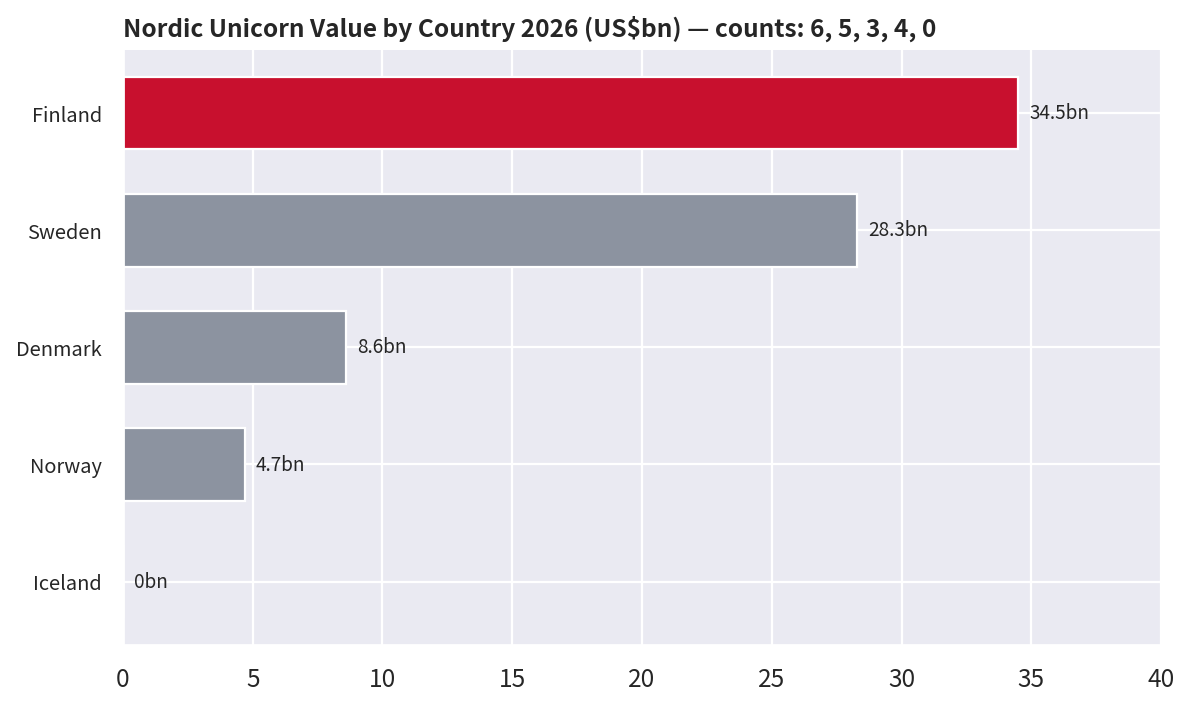
By country, the picture has inverted — and then inverted again. Finland leads the region on value with six unicorns worth US$34.5 billion: Iceye, Oura and the dual-counted IQM. Sweden has five worth US$28.3 billion and now holds the crown: Lovable, founded in 2023, is the region's number one, and Legora, also founded in 2023, is one of the fastest-rising AI companies on earth. Denmark has three unicorns worth US$8.6 billion, anchored by Pleo and Europe's fastest fintech mint, Flatpay. Norway has four worth US$4.7 billion — and, with Cognite's agreed sale and 1X Technologies' humanoid robots closing in on a mega-round, is the region's most volatile ecosystem. Iceland has none — but owns perhaps the region's most instructive story: Kerecis, the fish-skin wound-care company from a Westfjords fishing town, acquired by Coloplast for up to US$1.3 billion.
As a single bloc, the Nordics would rank eighth in the world — ahead of Israel (17) and the Netherlands (11), behind Singapore (20). Per million people, the region out-produces Germany and France by 40%. And its hall of fame of graduates — Spotify, Unity, Evolution, Ascendis Pharma, Supercell, Zendesk, Skype, Wolt, King, Klarna, Just Eat, Cognite, Mojang, Trulia, iZettle, Tink, IQM, MySQL — is worth roughly US$228 billion cumulatively, almost three times the value of the current list. The Nordic question is no longer whether the region can build billion-dollar companies. It is whether it can keep them.
What the Nordics have won — and what they risk losing. The home herd is worth US$76.1 billion; the alumni are worth roughly US$228 billion, and the diaspora still building abroad — Synthesia, Tradeshift, Neo4j, Virta Health, Linear, SoundCloud, Bestseller China — adds over US$13 billion on top. Spotify alone (US$105bn) outweighs every unicorn in this index combined. The Act I question — can the Nordics build champions? — is answered. The Act II question is whether the region can keep them long enough to compound at home.
The 18 companies directly employ well over 15,000 people — among them employers of real scale, such as RELEX (2,400), Flatpay (1,500), Iceye (1,000+) and Oura (1,000) — with many times more jobs supported indirectly. They are concentrated in nine cities, led by Stockholm (5 unicorns, US$28.3bn), and draw on a recognisable set of founder factories: Spotify, Nokia, Tradeshift, Aalto University and KTH.
Two gaps stand out in this index, and this report names them early: only two of its 44 founders are women — in the world's most gender-equal region — and its best companies still lose their headquarters and senior teams as they scale. The leak is the head office, not the ticker: Legora is now run from New York, Cognite from Arizona. Sections 6.5 and 10.3 address both.
The Nordic Unicorn Index 2026 at a Glance
Metric | Value |
Nordic unicorns | 18 |
Total value | US$76.1 billion (up 39% in 2026) |
By country | Finland 6 ($34.5bn) · Sweden 5 ($28.3bn) · Denmark 3 ($8.6bn) · Norway 4 ($4.7bn) · Iceland 0 |
Most valuable | Lovable (Stockholm, US$13.3bn) — US$400m Series C of 12 August 2026 |
Fastest riser | Iceye (Espoo, US$12bn) — +US$9.2bn, June 2026 |
New faces this year | 5 — Lovable, Legora, Flatpay, Iceye and IQM |
Born abroad | 5 of 44 founders (11%) — but their companies are worth US$21.8bn, 29% of the index |
Global standing | Would rank 8th in the world as a single nation, ahead of Israel (17) |
Per capita | 0.65 unicorns per million people — vs Germany 0.45, France 0.50, UK 1.15 |
Average founder age at founding | 34 |
Female co-founders | 2 of 44 (4.5%) |
The economic footprint | 15,000+ direct jobs — RELEX (2,400), Flatpay (1,500), Iceye (1,000+) and Oura (1,000) among the larger private employers |
Watch list | 1X, Stegra, Monta, ReOrbit, Blykalla; Hostaway (self-declared US$1bn, HQ contested); Nordic Knots (US$220m, verified below unicorn scale) |
The graduates | Spotify, Unity, Evolution, Ascendis Pharma, Supercell, Zendesk, Skype, Wolt, King, Klarna, Cognite, Trulia… 23 graduates, worth US$228 billion |
The failure | Northvolt — US$15bn raised, bankrupt March 2025, the largest in modern Nordic history |
Source: Hurun Research Institute, Nordic Unicorn Index 2026
Europe has spent two years agreeing on the Draghi diagnosis and implementing barely a tenth of it. The Nordics are the proof of concept hiding in plain sight: twenty-eight million people, eighteen unicorns, the densest unicorn region in the world after Singapore and Israel. What they need now is unglamorous — growth capital, listing venues, pension money allowed to come home. Deliver those three, and this region doubles by 2030.
— Rupert Hoogewerf, Chairman and Chief Researcher, Hurun Research Institute
SECTION 1: GLOBAL CONTEXT — THE NORDICS IN THE WORLD
1.1 The Global Picture
The Hurun Global Unicorn Index 2026 tracks a world-record 1,603 unicorns across 52 countries, worth a combined US$8 trillion. This is the year AI matured: total unicorn value surged 43%, and artificial intelligence companies now dominate the global top ten. The United States (806) and China (381) remain the twin superpowers; the United Kingdom (80) leads Europe; India (61) leads the emerging world.
Rank | Country | Unicorns | Total Value ($bn) | % of Global Count |
1 | United States | 806 | $4,800 | 50.3% |
2 | China | 381 | $1,900 | 23.8% |
3 | United Kingdom | 80 | $320 | 5.0% |
4 | India | 61 | $195 | 3.8% |
5 | Germany | 38 | $129 | 2.4% |
6 | France | 34 | $92 | 2.1% |
7 | Canada | 24 | $58 | 1.5% |
8 | Singapore | 20 | $55 | 1.2% |
— | The Nordics (as a bloc) | 18 | $76 | 1.1% |
9 | Israel | 17 | $72 | 1.1% |
10 | Netherlands | 11 | $35 | 0.7% |
Source: Hurun Research Institute, Nordic Unicorn Index 2026.
1.2 The Nordics as a Single Economic Powerhouse
Measured separately, the Nordic countries are mid-table: The global index counted Sweden 19th in the world with six unicorns, Finland 20th with five, Norway 21st with four, Denmark 25th with three, Iceland none. But the Nordics share language roots, labour markets, pension systems, research councils and a single venture-capital circuit — Stockholm's Creandum and EQT invest in Helsinki as naturally as at home. Counted as one economy, the region would sit eighth on Earth by unicorn count — remarkable for 28 million people, barely more than the population of Shanghai. The Benelux Union makes the same arithmetic work — the Netherlands, Belgium and Luxembourg counted as one, 19 unicorns strong — and the two blocs are Europe's proof that small countries compound when they count together.
The bloc framing matters for policy, too. Individually, no Nordic country can offer a growth-stage company a continental home market; jointly — with harmonised stock options, pooled pension capital and a functioning Nordic IPO venue — they begin to look like one. This report returns to that theme in its recommendations.
1.3 The World's Top Unicorn Cities — Stockholm on the Board
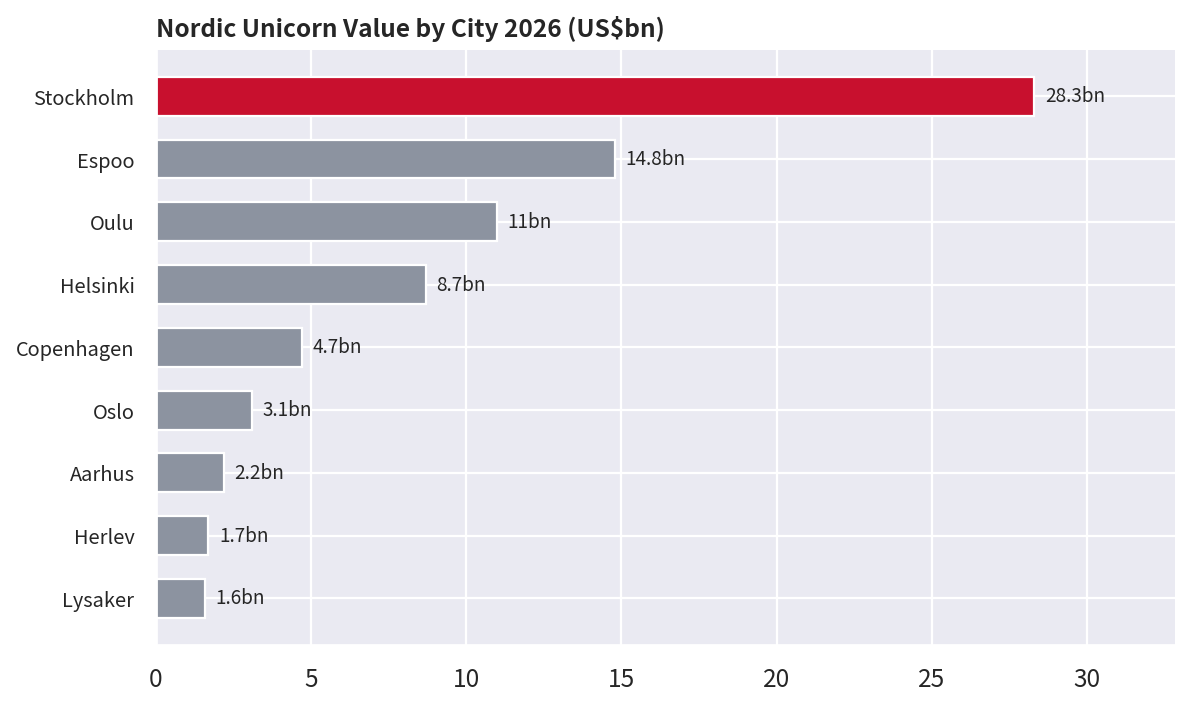
San Francisco (222) remains the World Unicorn Capital, ahead of New York (141), Beijing (86), Shanghai (74) and London (60). In continental Europe, Paris (31 in updated tracking) and Berlin (18) lead. Stockholm, with five active unicorns worth US$28.3 billion, sits among Europe's top ten unicorn cities — and, per capita, near the very top of the world: the city has produced one unicorn for every 400,000 residents, a density only the Bay Area beats. Espoo (3, US$14.8bn), Oulu (1, US$11.0bn) and Helsinki (2, US$8.7bn) give Finland an unusually distributed map; Copenhagen (1, US$4.7bn), Aarhus (1, US$2.2bn) and Herlev (1, US$1.7bn) spread Denmark's across three cities; Oslo (3, US$3.1bn) and Lysaker (1, US$1.6bn) carry Norway.
1.4 The European Landscape
Rank | Country | Unicorns | Total Value | Leading Companies |
1 | United Kingdom | 80 | $320bn | Revolut, Nscale, Checkout.com |
2 | Germany | 38 | $129bn | Helsing, Trade Republic, Personio |
3 | France | 34 | $92bn | Mistral AI, Alan, Back Market |
— | Nordics (bloc) | 18 | $76bn | Lovable, Iceye, Oura |
4 | Netherlands | 11 | $35bn | Mollie, Backbase, Mews |
5 | Switzerland | 8 | $20bn | SonarSource, Nexthink, 21.co |
6 | Finland | 6* | $35bn | Iceye, Oura, RELEX Solutions |
7 | Sweden | 5* | $28bn | Lovable, Legora, Neko Health |
8 | Norway | 4 | $5bn | Cognite, Lunar, reMarkable |
9 | Denmark | 3 | $9bn | Pleo, Lunar, Flatpay |
— | Iceland | 0 | — | Kerecis (graduated via M&A 2023) |
Source: Hurun Research Institute, Nordic Unicorn Index 2026.
Three observations. First, Finland still out-produces Sweden on value — US$34.5 billion to US$28.3 billion, six companies to five — but Sweden now owns the single biggest company, and the duel between Lovable and Iceye is the region's defining rivalry. Second, the Nordic bloc would rank fourth in Europe, ahead of the Netherlands and Switzerland combined. Third, the region's centre of gravity has shifted from consumer internet (Spotify's generation) to deep tech and applied AI: space, health, robotics and the AI application layer now carry most of the value.
1.5 Per Capita: The Nordics' Killer Statistic
Country / Region | Unicorns | Population (m) | Unicorns per Million People |
Singapore | 20 | 6.0 | 3.3 |
Israel | 17 | 9.9 | 1.7 |
United Kingdom | 80 | 69.7 | 1.15 |
The Nordics | 18 | 27.8 | 0.65 |
Netherlands | 11 | 18.1 | 0.61 |
France | 34 | 68.5 | 0.50 |
Germany | 38 | 84.6 | 0.45 |
Source: Hurun Research Institute, Nordic Unicorn Index 2026.
0.65 unicorns per million people — Germany manages 0.45 |
1.6 The US Relationship: Market, Capital — and Magnet
America is simultaneously the Nordics' best customer, their biggest investor, and their most dangerous competitor — not for companies, but for headquarters. The pattern of this index: Oura sells most of its rings in the US and files its S-1 there; Legora moved its headquarters to New York in 2026; Lovable's and Neko's rounds are led from Menlo Park and New York; Cognite moved to Arizona and was then sold. The Nordics have largely escaped the acquisition drain that worries Germany — only Cognite is leaving this index to a trade buyer — but the headquarters drain is real and accelerating. The leak is the head office and the senior team, not the ticker. Every policy lever in Section 10 should be judged by one test: does it make the next Legora keep its head office in Stockholm?
1.7 The Cities: Stockholm vs Berlin vs Paris vs London
Stockholm (5 active unicorns, US$28.3bn) cannot match Berlin (18) or Paris (31) by count — but by value per unicorn it leads them all, and by unicorns per resident it leads every city in Europe. The more instructive comparison is Helsinki-Espoo-Oulu taken together: Finland's three unicorn cities hold US$34.5 billion — 44% of Paris's US$79 billion, from one-twelfth of the population. The Nordic model is distributed excellence; the French model is capital concentration; the German model is dual-hub with regional outliers. For policymakers, the Nordic risk is the reverse of France's: not too much capital concentration, but too little of everything, everywhere.
1.8 The China Dimension
China touches this index at the edges: Tencent controls Supercell (Espoo's great graduate) and remains a major shareholder in several Nordic games studios; Chinese machinery sat at the heart of the Northvolt failure; and Iceye's strategic value lies precisely in giving Europe a capability it would otherwise buy from abroad. The Nordics' technology relationship with China is now principally about resilience — sovereign satellites, sovereign energy, sovereign quantum — which is why the region's deep-tech wave has such policy tailwind. The counter-example is Bestseller China (Section 8): two Danes who built one of the most successful foreign businesses in Chinese retail history — proof that the traffic was not always one-way.
SECTION 2: THE 18 NORDIC UNICORNS
The ten most valuable Nordic unicorns account for US$66.3 billion — 87% of the region's total. They span generative AI, radar satellites, health wearables, preventive medicine, small-business banking and quantum computing; they are headquartered in six cities across three countries. IQM, at number ten, is the tour's unusual stop — the index's only daggered member (†).
The full ranking of all 18, before their stories:
Rank | Company | Valuation ($bn) | Country | City | Sector | Founded | Change |
1 | Lovable | $13.3bn | Sweden | Stockholm | AI App Platform | 2023 | +$6.7bn |
2 | Iceye | $12.0bn | Finland | Espoo | SAR Satellites / Defence | 2014 | +$9.2bn |
3 | Oura | $11.0bn | Finland | Oulu | Health Wearables | 2013 | +$5.8bn |
4 | Neko Health | $7.0bn | Sweden | Stockholm | Preventive Health Clinics | 2018 | +$5.2bn |
5 | RELEX Solutions | $5.7bn | Finland | Helsinki | Supply Chain SaaS | 2005 | +$0.2bn |
6 | Legora | $5.6bn | Sweden | Stockholm | Legal AI | 2023 | — |
7 | Pleo | $4.7bn | Denmark | Copenhagen | Expense Management | 2015 | +$2.4bn |
8 | Aiven | $3.0bn | Finland | Helsinki | Cloud Data Platform | 2016 | — |
9 | Lunar | $2.2bn | Denmark | Aarhus | Neobank | 2015 | — |
10 | IQM | $1.8bn | Finland | Espoo | Quantum Computing | 2018 | — |
11 | Flatpay | $1.7bn | Denmark | Herlev | SME Payments | 2022 | — |
12 | Cognite | $1.6bn | Norway | Lysaker | Industrial Data | 2016 | — |
13 | Epidemic Sound | $1.4bn | Sweden | Stockholm | Music Licensing | 2009 | — |
14 | Gelato | $1.1bn | Norway | Oslo | Print-on-Demand | 2007 | — |
15 | Dune Analytics | $1.0bn | Norway | Oslo | Blockchain Analytics | 2018 | — |
15 | HMD Global | $1.0bn | Finland | Espoo | Mobile Phones | 2016 | — |
15 | KRY | $1.0bn | Sweden | Stockholm | Telehealth | 2015 | -$1.0bn |
15 | reMarkable | $1.0bn | Norway | Oslo | E-Paper Tablets | 2013 | — |
Source: Hurun Research Institute, Nordic Unicorn Index 2026.
Speed is a modern luxury. The three fastest to a billion dollars were all founded in the 2020s: Lovable in under two years from founding, Legora in about two, and Flatpay in three. At the other end, RELEX needed the best part of two decades, and Gelato fourteen years — patient companies from an era when Nordic growth capital barely existed. The median for the eighteen is about seven years; the 2020s cohort is running at less than half that. What changed is not ambition but the density of the flywheel: angels who have done it before, and venture capital that finally arrives in years two and three rather than years eight and nine.
2.1 Lovable: From Open Source to Number One in Under Three Years
Lovable — valued at US$13.3 billion after a US$400 million Series C on 12 August 2026 led by Menlo Ventures with EQT — is now the most valuable unicorn ever built in the Nordics. Founded in Stockholm in 2023 by Anton Osika (KTH, CERN particle physicist, founding engineer at Sana) and Fabian Hedin (KTH; profiles repeatedly credit him with work on Stephen Hawking's computer interface — a claim we could not trace to a primary source) out of Osika's open-source project gpt-engineer, Lovable lets anyone build working software by describing it in plain language. The ramp is the story: US$100 million of ARR in eight months (November 2024 to July 2025), US$200 million by November 2025, US$400 million by February 2026 and a US$500 million run-rate by June 2026 — company-reported figures, for what the company calls the fastest ramp in software history. It had 146 employees in February 2026. Both founders became billionaires in their twenties.
Lovable's cap table is a map of the new Nordic flywheel: Creandum and EQT at seed, Accel at Series A, and angels including Klarna's Sebastian Siemiatkowski — the previous generation's champions funding this one. The August round took Lovable from US$6.6 billion at its December 2025 Series B to US$13.3 billion in eight months — and moved the region's number-one spot from Espoo back to Stockholm.
There has never been a trillion-dollar company from Europe. The region's number one unicorn says it intends to build the first — and it is building it in Stockholm, not San Francisco. Five years ago, no European founder talked like that.
— Rupert Hoogewerf, Chairman and Chief Researcher, Hurun Research Institute
2.2 Iceye: Europe's Space Decacorn
Iceye — valued at US$12 billion after a US$520 million Series F in June 2026 led by General Atlantic — held the title of most valuable Nordic unicorn for exactly one summer, and remains the most valuable the region has produced in deep tech. Founded in 2014 by Rafał Modrzewski, a Polish engineering student, and Pekka Laurila at Aalto University's Otaniemi campus in Espoo, Iceye builds and operates synthetic-aperture radar (SAR) satellites that image the Earth through cloud and darkness. The insight was brutal and simple: northern Europe is cloudy, and optical satellites are blind most of the year.
The numbers are now industrial scale: 64 satellites in orbit, revenue above US$290 million and growing 100% year-on-year, EBITDA above US$115 million, a contracted backlog exceeding US$1.7 billion, and seven European governments operating sovereign Iceye systems. A US$2.0 billion framework with Rheinmetall anchors German defence demand; Nokia joined the June 2026 round as a strategic investor — the old Finnish champion backing the new one. Iceye is the purest expression of what this report calls the Nordic deep-tech turn: patient university research, defence-grade engineering, and customers who pay in nine figures.
2.3 Oura: The Ring That Put Oulu on the Map
Oura — valued at US$11 billion after a Series E of more than US$900 million in October 2025, led by Fidelity — sells the world's defining health wearable: a titanium ring that tracks sleep, recovery and illness for more than 5.5 million owners. Founded in 2013 in Oulu by Petteri Lahtela, Kari Kivelä and Markku Koskela — veterans of Nokia's Oulu R&D operation, with Virpi Tuomivaara in the early founding team — Oura is the direct descendant of the wireless-sensor talent pool that Nokia and Polar Electro spent decades building above the 64th parallel.
Oulu, a city of 215,000 people, now hosts an US$11 billion unicorn — a ratio matched almost nowhere on Earth. Revenue passed US$500 million in 2024, doubled into 2025, and the company is profitable; in May 2026 it filed a confidential draft S-1 with the SEC. Oura's IPO, when it comes, will be the defining test of whether a Nordic deep-tech champion can list and compound on the global stage from a small northern city.
2.4 Neko Health: Daniel Ek's Second Act
Neko Health — valued at a reported US$7 billion after a US$700 million Series C in July 2026 co-led by Lightspeed and O.G. Venture Partners, with individual investors ranging from Mark Zuckerberg and Priscilla Chan to Maria Sharapova and Jimmy Iovine — is, after Lovable, the fastest re-rating in Nordic history: US$1.8 billion in January, four times that six months later. Founded in 2018 by Hjalmar Nilsonne (CEO, KTH engineer, serial energy-data founder) and Daniel Ek (Chairman — and co-founder of Spotify), Neko operates clinics that run a full-body scan in minutes: millions of skin images, cardiac echo, blood analytics, reviewed by AI and doctors in one visit.
More than 100,000 scans are done across eight clinics in Sweden and the UK, with a 350,000-person waitlist and a first US clinic opening in Manhattan in 2026. Neko is also the purest founder-factory story in this index: the man who built the Nordics' greatest graduate is now building one of its most valuable active unicorns — and recycling Spotify's capital, talent and ambition into preventive healthcare.
2.5 RELEX Solutions: Finland's Quiet Software Giant
RELEX — valued at US$5.7 billion since a €500 million Blackstone Growth round in February 2022, still Finland's record — optimises supply chains for retailers and consumer brands: forecasting demand, cutting waste, filling shelves. Founded in 2005 by three supply-chain scientists from the Helsinki University of Technology research group that became Aalto University — Mikko Kärkkäinen (CEO), Johanna Småros and Michael Falck — RELEX now serves more than 500 retailers in over 20 countries, from M&S Food to Dollar Tree, employs 2,400 people, and is the region's largest pure software employer. Småros is one of only two female co-founders in this entire index. The founders have endowed a US$115 million foundation — an early sign of Nordic unicorn wealth recycling into public goods.
2.6 Legora: The Lawyer That Silicon Valley Bet On
Legora — valued at US$5.6 billion after a US$600 million Series D closed in spring 2026 led by Accel, with NVIDIA's venture arm and Atlassian joining an extension — builds the AI workspace used by more than a thousand law firms and legal teams across 50 markets. Founded in 2023 at the Stockholm School of Economics' business lab by Max Junestrand (CEO, a former esports professional turned VC, who turned down a pro Dota 2 career at 18) and Sigge Labor (CTO), Legora passed US$100 million of annualised revenue in April 2026, quadrupled headcount in a year, and has moved its headquarters to New York — a relocation this report tracks with concern, and returns to in Section 1.6.
2.7 Pleo: Denmark's Fintech Anchor
Pleo — valued at US$4.7 billion since a Coatue-led extension in December 2021 — gives 40,000-plus European companies smart expense cards and spend management. Founded in Copenhagen in 2015 by Jeppe Rindom and Niccolo Perra, who met as CFO and early employee at Tradeshift — the clearest founder-factory chain in this index — Pleo grew revenue 25% to US$150 million in 2025 and guides to breakeven in the first half of 2027. A Copenhagen IPO is openly on the table: Pleo would be the natural test case for a Nordic tech listing venue.
2.8 Aiven: The Plumbers of the Data Cloud
Aiven — valued at US$3.0 billion since a US$210 million round in May 2022 led by Eurazeo and BlackRock — runs managed open-source data infrastructure (PostgreSQL, Kafka, ClickHouse and more) across ninety-plus cloud regions. Founded in Helsinki in 2016 by four engineers — Oskari Saarenmaa, Hannu Valtonen, Mika Eloranta and Heikki Nousiainen — who met at F-Secure (Saarenmaa is also ex-Nokia), Aiven is the Nordics' quiet infrastructure champion: no consumer brand, no hype, just the plumbing that thousands of companies' data stacks depend on.
2.9 Lunar: The Last Neobank Standing
Lunar — valued at US$2.2 billion — is the last neobank standing of the Nordic wave, with a full Danish banking licence since 2019, a million customers across Denmark, Sweden and Norway, and a first-of-its-kind Scandinavian crypto licence under the EU's MiCA regime (October 2025). Founded in Aarhus in 2015 by serial founder Ken Villum Klausen (who previously built and sold Wallmob to Visma), with Malaysian-born co-founder Andrew Tan, Lunar cut its pre-tax loss from US$99 million to US$35 million in 2025, raised a further US$53 million in January 2026, and targets break-even this year. While N26, Monzo and Revolut grabbed the headlines, Lunar quietly built a profitable-looking Nordic banking business — from Denmark's second city.
2.10 IQM: Europe's Quantum Champion
IQM builds full-stack superconducting quantum computers that customers install in their own data centres: sovereign machines, not rented cloud time. That on-premises bet — against the cloud-rental model of its American rivals — has made it the quantum beneficiary of Europe's strategic-autonomy procurement turn. Founded in 2018 as a spin-out from Aalto University and VTT by German physicist Jan Goetz (who came to Espoo as a Marie-Curie fellow), Aalto professor Mikko Möttönen, Juha Vartiainen and Malaysian-born Kuan Yen Tan, IQM has sold 26 systems, including to four of the world's ten largest supercomputing centres. A US$320 million Series B in September 2025 — the largest quantum Series B outside the United States — carried it past US$1 billion; first-half 2026 revenue rose 47% and the order backlog passed US$115 million. It ranks tenth in this index at US$1.8 billion † (the company listed on Nasdaq in July 2026 and also appears in the graduates register — see Section 9).
2.11 Flatpay: Denmark’s Fastest-Ever Unicorn
Sander Janca-Jensen, Rasmus Busk, Rasmus Hellmund Carlsen and Peter Lüth founded Flatpay in 2022 with a merchant's-eye insight: card pricing is a trap of hidden fees, so charge one flat rate — 0.99–1.49% — and say it out loud. Three and a half years later: 60,000-plus merchants, 1,500 employees, Germany as the largest market, and a US$170 million round in November 2025 that made it Denmark's fastest-ever unicorn. Flatpay is also a founder-factory story — three of the four founders are Verisure alumni — and a reminder that Denmark's pipeline no longer needs a Copenhagen postcode.
2.12 Cognite: Norway’s Most Instructive Loss
John Markus Lervik founded FAST Search & Transfer in 1997 and sold it to Microsoft for US$1.2 billion; in 2016, backed by Aker's Kjell Inge Røkke, he founded Cognite to liberate industrial data — oil platforms, ships, factories — into software. Revenue passed US$170 million in 2025. Then came the departure this report flags as a warning: headquarters moved to Arizona in January 2025, and on 30 June 2026 Schneider Electric announced a definitive agreement to buy Cognite for US$3.1 billion, all cash — Norway's largest software exit, and its most instructive loss. The sale is expected to complete in the coming quarters. ‡ dual-counted — recorded among Section 9's graduates at the sale price.
2.13 Epidemic Sound: The Creator Economy’s Picks and Shovels
Five partners founded Epidemic Sound in 2009 — songwriter-producers Peer Åström and David Stenmarck (220-plus US Billboard entries between them), media veterans Jan Zachrisson and Hjalmar Winbladh, and Oscar Höglund — around a new kind of music economy: commission tracks from artists, pay them properly (an average composer earns US$60–80,000 a year), and license the catalogue to the world's creators. Its music now plays three billion times a day across the internet. EQT and Blackstone Growth backed a US$450 million round at US$1.4 billion in 2021; the company has ruled out an IPO. A quiet, profitable Swedish original — the creator economy's picks-and-shovels business.
2.14 Gelato: Moving Bits, Not Boxes
Henrik Müller-Hansen founded Gelato in Oslo in 2007 with a logistical inversion: instead of shipping printed goods around the world, route each order to the nearest of a hundred-plus print partners in thirty-plus countries. The model — local production, global software — made Gelato a unicorn with Insight Partners' US$240 million round in 2021, and made it Norway's quiet answer to the question of what software is for: moving bits, not boxes.
2.15 Dune Analytics: The Exit-Tax Case Study
Fredrik Haga and Mats Olsen founded Dune in 2018 to make blockchain data legible: open SQL access to on-chain activity, used by analysts, funds and protocols worldwide. Coatue led it to US$1 billion in February 2022. Since then the ride has been rougher — a 25% layoff in May 2026 and a pivot to institutional on-chain data — and Haga has become Norway's most prominent policy critic, leaving the country over its exit tax on unrealised gains. Dune is simultaneously a working Norwegian unicorn and the case study for recommendation 3 of this report.
2.16 HMD Global: The Final Chapter of the Nokia Phone Saga
When Microsoft exited phones in 2016, ex-Nokia leadership founded HMD Global in Espoo to carry the Nokia brand forward — four hundred million devices sold since. A US$100 million raise in 2018 made it a unicorn. Today the Nokia smartphone era is ending (the brand licence runs to 2026 for smartphones, 2029 for feature phones) and HMD is pivoting to its own brand and emerging markets. Its billion-dollar mark is the most fragile on this list; its story is the final chapter of the Nokia phone saga — and the bridge to whatever Finland's hardware scene builds next.
2.17 KRY: A Doctor in Every Pocket
Johannes Schildt, Josefin Landgård, Fredrik Jung Abbou and Joachim Hedenius founded KRY in 2015 to put a doctor in every pocket. A decade later it is Sweden's digital-health backbone: US$260 million of revenue, sixty-plus clinics, the country's first digitally integrated emergency department, profitable in every market since January 2024. The index marks it down from US$2 billion to US$1 billion as pandemic-era telehealth multiples normalised; Swedish secondary markets disagree, implying closer to US$2 billion. Landgård is one of this index's two female co-founders.
2.18 reMarkable: The Tablet for Thinking, Not Scrolling
Magnus Wanberg founded reMarkable in 2013 around an anti-modern idea: a tablet for thinking, not scrolling — no email, no apps, just paper-feel writing. Two million devices later, the Oslo company crossed US$1 billion in May 2022 and keeps shipping (the colour Paper Pro arrived in 2024). In a region of software, reMarkable is Norway's proof that Nordic design sensibility plus patient hardware engineering can still build a global consumer brand from a country of five and a half million people.
Valuations as of October 2026. Profiles draw on company disclosures and verified press reporting cited in Section 11.
SECTION 3: SECTOR ANALYSIS
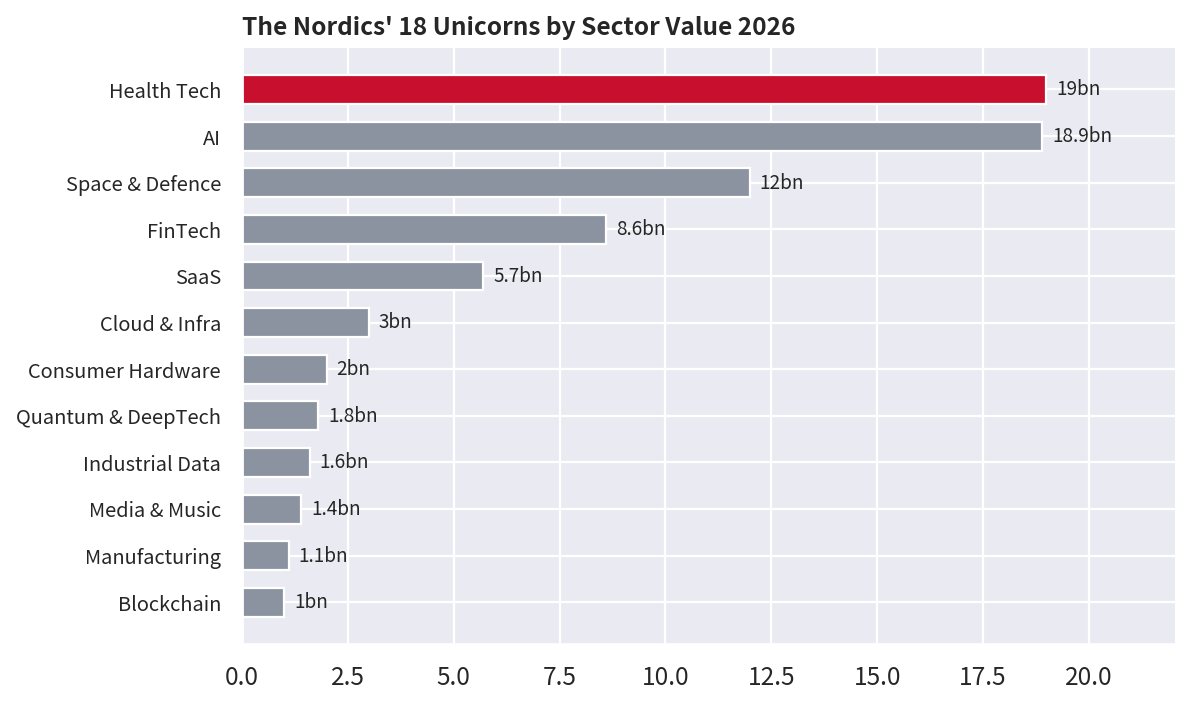
The 18 Nordic unicorns span twelve sectors, with three dominant clusters — health, AI and space — worth US$49.9 billion between them, 66% of the region's total.
Sector | Unicorns | Value (US$bn) | Share | Companies |
Health Tech / Life Sciences | 3 | $19.0bn | 25.0% | Oura, Neko Health, KRY |
Artificial Intelligence | 2 | $18.9bn | 24.8% | Lovable, Legora |
Space & Defence | 1 | $12.0bn | 15.8% | Iceye |
FinTech | 3 | $8.6bn | 11.3% | Pleo, Lunar, Flatpay |
SaaS | 1 | $5.7bn | 7.5% | RELEX Solutions |
Cloud & Infrastructure | 1 | $3.0bn | 3.9% | Aiven |
Consumer Hardware | 2 | $2.0bn | 2.6% | reMarkable, HMD Global |
Quantum & DeepTech | 1 | $1.8bn | 2.4% | IQM † |
Industrial Data | 1 | $1.6bn | 2.1% | Cognite ‡ |
Media & Music | 1 | $1.4bn | 1.8% | Epidemic Sound |
Manufacturing / Print | 1 | $1.1bn | 1.4% | Gelato |
Blockchain | 1 | $1.0bn | 1.3% | Dune Analytics |
Source: Hurun Research Institute, Nordic Unicorn Index 2026.
3.1 Health Tech: The Region's New Signature Sector
Health is now the Nordics' largest unicorn sector at US$19 billion — a fact that would have astonished observers five years ago. Oura (consumer wearable), Neko Health (preventive clinics) and KRY (digital-first care delivery) attack the same theme from three angles: the shift from reactive healthcare to continuous, data-driven prevention. The Nordic advantage is structural — universal health systems with decades of clean population data, high public trust in medical registers, and hardware heritage from Nokia and Polar. Watch this sector: it is where the region's demographic credibility meets its engineering base.
The Nordics' new signature sector is health — a ring from Oulu, body scanners from Stockholm, a doctor in every pocket. It is built on something Silicon Valley cannot copy: a population that trusts institutions with its data.
— Rupert Hoogewerf, Chairman and Chief Researcher, Hurun Research Institute
3.2 AI: Two Companies, One Category Each
The Nordics have no foundation-model company — the capital requirements are beyond a 28-million-person region — and may not need one. Lovable (AI application builder) and Legora (AI legal workspace) each own an application-layer category globally, built on American foundation models. This is the Nordic AI strategy in practice: not competing with OpenAI, but being its most dangerous customer. Combined value US$18.9 billion, both founded 2023, both Stockholm — and Lovable now the region's largest company of any kind.
3.3 Space & Defence: The Iceye Effect
One company, US$12 billion, and a sector transformed. Iceye's June 2026 round did for Nordic space what Helsing did for German defence tech: it proved that European governments will pay strategic premiums for sovereign capability. The pipeline behind it is real — ReOrbit (Helsinki, sovereign GEO satellites), IQM (quantum, †), Blykalla (nuclear SMRs) — and the region's research base (Aalto/VTT, KTH, DTU Space) is producing more. Defence and space procurement, long taboo in Nordic public life, is becoming a legitimate growth industry from Helsinki to Oslo.
Europe's strategic autonomy is not being negotiated in Brussels — it is being built in Espoo, in radar satellites and quantum machines. The Nordics' fastest-rising companies are sovereignty technologies, and they are the region's moat.
— Rupert Hoogewerf, Chairman and Chief Researcher, Hurun Research Institute
3.4 FinTech: The Steady Hand
FinTech built the Nordic unicorn scene (Klarna, iZettle, Tink) and remains its steadiest producer: Pleo (expense management), Lunar (licensed neobank) and Flatpay (SME acquiring) are worth US$8.6 billion combined, all profitable-leaning and founded 2015–2022. The pattern has shifted from consumer wallets to SME infrastructure — less glamorous, more durable. With Klarna now public and trading below its IPO price, the region's fintech centre of gravity has quietly moved from Stockholm to Copenhagen.
3.5 The Long Tail
Beyond the big four clusters: RELEX (supply-chain SaaS, US$5.7bn) and Aiven (cloud data infrastructure, US$3.0bn) are classic Nordic B2B compounding; Epidemic Sound (music rights, US$1.4bn) monetises the creator economy; reMarkable and HMD Global carry the consumer-hardware flag; Cognite (industrial data, US$1.6bn, ‡) and Gelato (print-on-demand, US$1.1bn) represent Oslo's B2B tradition; Dune Analytics is the region's only crypto-native unicorn. Notably absent at unicorn scale: consumer social, e-commerce marketplaces, and food delivery — the categories of the previous Nordic generation, now all graduated or consolidated.
The sector mix tells you where Europe's AI opportunity actually lies. The Nordics will not build the next OpenAI — they are building the companies that make OpenAI useful: Lovable for writing software, Legora for practising law. While Brussels debates the rules of the model layer, the Nordics are quietly taking the application layer.
— Rupert Hoogewerf, Chairman and Chief Researcher, Hurun Research Institute
SECTION 4: THE MOVERS OF 2026 — RISERS, NEW FACES AND FALLEN
The 2026 movers in one breath: five new faces — Lovable, Legora, Flatpay, and, entering before their mid-year re-ratings, Iceye and IQM †. Four re-ratings, all upward — Iceye, Oura, Neko Health and Lovable again. One markdown — KRY. And three different roads to the public market — Einride's IPO, IQM's listing, Cognite's agreed sale. Net effect: the index is worth 39% more than in January. In the Nordics this year, the up-moves are the story.
Value created in 2026
Company | Jan 2026 mark | Today | Added |
Iceye | US$2.8bn | US$12.0bn | +US$9.2bn |
Lovable | US$6.6bn | US$13.3bn | +US$6.7bn |
Oura | US$5.2bn (Dec 2024) | US$11.0bn | +US$5.8bn |
Neko Health | US$1.8bn | US$7.0bn | +US$5.2bn |
Source: Hurun Research Institute, Nordic Unicorn Index 2026.
Value marked down or impaired
Company | Was | Now | Moved |
KRY | US$2.0bn | US$1.0bn | -US$1.0bn |
Einride | US$1.8bn announced | US$1.35bn at listing | -US$0.45bn |
Northvolt | US$12bn peak (US$15bn raised) | Written off | -US$12bn |
Source: Hurun Research Institute, Nordic Unicorn Index 2026.
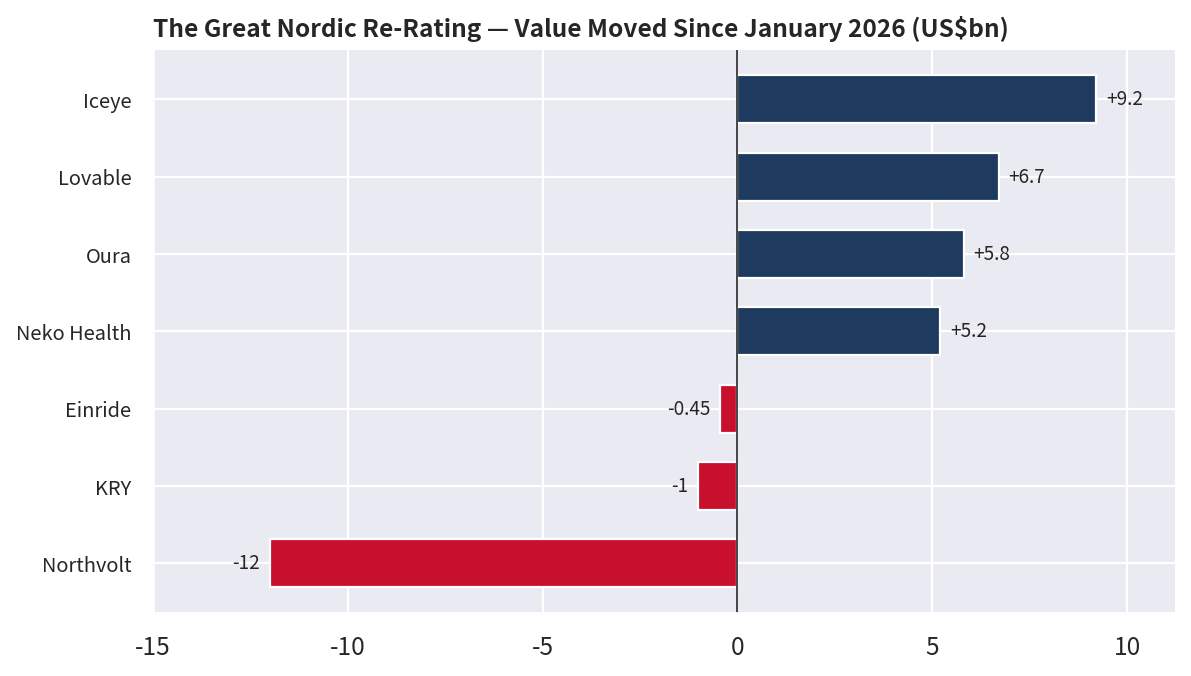
The up-moves and the down-moves are the same story: the Nordic index is being marked to reality — and in 2026 reality re-rated the Nordics upward.
Source: Hurun Research Institute, Nordic Unicorn Index 2026.
4.1 Risers
Lovable: +US$6.7 billion in 2026. Lovable entered 2026 at US$6.6 billion, fresh from a US$330 million Series B in December 2025 led by CapitalG and Menlo Ventures. On 12 August 2026 it closed a US$400 million Series C at US$13.3 billion — the steepest single jump in Nordic unicorn history, and enough to take the regional crown from Iceye. The driver: a revenue ramp (US$100 million of ARR in eight months, a US$500 million run-rate by June 2026, per the company) that has no European precedent.
Iceye: +US$9.2 billion in 2026. Iceye entered the index at US$2.8 billion on 1 January 2026, following a US$230 million Series E in December 2025. Six months later, on 9 June 2026, it closed a Series F of more than US$1.1 billion (US$520 million primary) at a valuation above US$12 billion — Europe's largest-ever space round — with General Atlantic leading and Nokia, QIA and TCV joining Finland's state investor Tesi and pension giants Varma and Ilmarinen. The driver: defence. Radar satellites that see through clouds have become strategic infrastructure for European governments, and Iceye is the only company on the continent that can sell them as a sovereign system.
Neko Health: +US$5.2 billion in 2026. Neko Health entered the index at US$1.8 billion in January 2025 terms. On 15 July 2026 it closed a US$700 million Series C at a reported US$7 billion — the largest single venture round ever raised by a Swedish company. The driver: proof of demand (100,000 scans, a 350,000-person waitlist) and the US market opening. The driver behind the driver: Daniel Ek's brand of patient, category-defining ambition, applied for the second time.
Oura: +US$5.8 billion in a year. Oura was valued at US$5.2 billion in December 2024. By October 2025, Fidelity led more than US$900 million into the company at US$11 billion — doubling it in ten months on the strength of three million rings sold in a single year and a path to US$1 billion of revenue. The confidential S-1 filing of May 2026 makes Oura the Nordics' most consequential IPO candidate since Spotify.
Look at where the value is being created. Not in consumer apps — in radar satellites, preventive medicine, supply chains and the AI application layer. Europe's governments have rediscovered strategic autonomy, and the Nordic unicorns of 2026 are what strategic autonomy buys. Procurement has become the quiet venture capitalist of this index.
— Rupert Hoogewerf, Chairman and Chief Researcher, Hurun Research Institute
4.2 New Faces
Five companies joined the Nordic index this year: two Stockholm AI companies founded in 2023, one Danish payments company founded in 2022, one Finnish satellite company a decade in the making — and one Finnish quantum company carrying the index's only dagger (†). Between them, the five added US$18.5 billion at entry.
Lovable (2023, Stockholm, US$13.3bn)
Covered in Section 2.1. The headline: from open-source side project to US$13.3 billion in under three years — an ascent the company calls the fastest ramp in software history.
Legora (2023, Stockholm, US$5.6bn)
Covered in Section 2.6. Founded as Leya at the Stockholm School of Economics, through Y Combinator, to a US$600 million round at US$5.6 billion — with NVIDIA and Atlassian on the register. Legal AI is the category where the Nordics currently hold a world-class hand: Legora and its US rival Harvey are defining it between them.
Flatpay (2022, Herlev, US$1.7bn)
Flatpay — valued at US$1.7 billion after a US$170 million round in November 2025 led by AVP Growth and Smash Capital — became Denmark's fastest-ever unicorn at three and a half years old, and sits eleventh in this year's index, just outside the top ten. Founded in 2022 in Herlev, outside Copenhagen, by Sander Janca-Jensen (CEO), Rasmus Busk (previously co-founder of Mofibo and Plenti), Rasmus Hellmund Carlsen and Peter Lüth — three of them alumni of Verisure's sales machine — Flatpay sells small merchants something radical: flat-rate card pricing (0.99–1.49%) with no hidden fees. Sixty thousand merchants at the raise, 1,500 employees, Germany already its largest market, and a plan to reach US$460–580 million of annualised revenue by the end of 2026. And note the postcode: not central Copenhagen, but Herlev, a suburb of 30,000. Nordic unicorns increasingly come from where the founders live, not where the capital is.
Iceye (2014, Espoo, US$2.8bn at entry)
Covered in Section 2.2. Iceye is the unusual 'new face' that took eleven years: Aalto University student project to 64 satellites. Its January entry was, in hindsight, badly timed — six months later it was the region's largest unicorn. The lesson for index-watchers: deep tech compounds quietly, then all at once.
IQM (2018, Espoo, US$1.8bn †)
Covered in Section 2.10. IQM is the new face with the dagger †: a September 2025 Series B that carried it past US$1 billion without announcing the mark, then a February 2026 agreement that set the US$1.8 billion price.
4.3 Drops
KRY: the marked-down survivor. KRY (Livi in the UK and France) fell from US$2 billion to US$1 billion — the steepest markdown on the Nordic list — as telehealth valuations normalised after the pandemic. The markdown may prove conservative: Swedish secondary-market prices imply a value closer to US$2 billion, revenue grew 22% to US$260 million in 2024, the operating loss halved, and every market has been profitable since January 2024. Founded in 2015 by Johannes Schildt, Josefin Landgård, Fredrik Jung Abbou and Joachim Hedenius — Landgård is one of the index's two female co-founders — KRY now runs 60-plus clinics and Sweden's first digitally integrated emergency department, under a surgeon-CEO appointed in December 2024.
The watch list: Dune and HMD Global. Two companies hold their US$1 billion marks under pressure. Dune Analytics (Oslo), the blockchain data platform founded in 2018 by Fredrik Haga and Mats Olsen, cut a quarter of its staff in May 2026 and is pivoting to institutional on-chain data; its founder publicly left Norway over the exit tax on unrealised gains — a policy this report examines in Section 10. HMD Global (Espoo), the custodian of the Nokia phone brand founded by ex-Nokia leadership in 2016, has not raised a priced round since 2020 and is winding down Nokia-branded smartphones as the licence era ends; its own-brand pivot makes its billion-dollar mark the most fragile on the list.
4.4 The Northvolt Lesson
No honest Nordic unicorn report can skip Northvolt. The battery maker raised US$15 billion — the best-funded startup in European history — reached a peak valuation around US$12 billion with factories in Skellefteå, Gothenburg and Québec, and then collapsed: US Chapter 11 in November 2024, Swedish bankruptcy in March 2025 (the largest in modern Swedish history), production halted that June, assets ultimately sold to US lithium-sulfur startup Lyten. The autopsy points to untested machinery, runaway capital intensity and a business plan that required everything to go right at once.
Northvolt's failure is not an argument against Nordic ambition — it is an argument about its financing. A region that could assemble US$15 billion for a single bet, but not the patient industrial discipline to de-risk it, has a scale-up capital culture problem. The contrast with Iceye — comparable capital, staged against delivered satellites and signed government contracts — is the sharpest case study in this report.
Northvolt raised fifteen billion dollars and went bankrupt. Iceye raised a fraction of that and is worth twelve. The difference was not talent or ambition — it was milestones. Europe is learning to write bigger cheques; the Nordic lesson is that staging them against physics matters more than the size of the cheque.
— Rupert Hoogewerf, Chairman and Chief Researcher, Hurun Research Institute
4.5 Ones to Watch
The bench behind the 18 is unusually deep. 1X Technologies (Norway's humanoid robots, targeting a US$10 billion round), Monta (Denmark's EV-charging operating system), ReOrbit (Helsinki's sovereign GEO satellites), Stegra (Sweden's green steel — multi-billion potential, unpriced) and Blykalla (Sweden's small modular reactors) all have credible paths to the list. Two further names deserve a note of their own. Hostaway, founded in Helsinki in 2015 by Marcus Räder, Saber Kordestanchi and Mikko Nurminen, declared a US$1 billion valuation in October 2025 — but its headquarters now sits between Toronto and Miami, the mark is self-declared rather than priced, and its claim to a place in a Nordic index is contested. And Nordic Knots, the fast-growing Stockholm design brand, is a pipeline name only: verified at a US$220 million valuation, it has never been a unicorn — the 'US$2.2 billion' that briefly circulated abroad was a SEK/USD conversion error. With defence-tech, quantum and climate capital flooding into the region, next year's list will look different again — the full audit trail is Appendix C.
SECTION 5: GEOGRAPHICAL DISTRIBUTION
Nine cities host the Nordics' 18 unicorns. Stockholm leads by count and, after Lovable's August re-rating, by value; but the story of this index is the rise of the small city: Oulu, Herlev, Aarhus, Espoo and Lysaker between them host seven unicorns worth US$31.3 billion — 41% of the region's total from cities most investors could not place on a map.
Rank | City | Country | Unicorns | Value (US$bn) | Key Companies |
1 | Stockholm | Sweden | 5 | $28.3bn | Lovable, Legora, Neko Health, Epidemic Sound, KRY |
2 | Espoo | Finland | 3 | $14.8bn | Iceye, HMD Global, IQM † |
3 | Oulu | Finland | 1 | $11.0bn | Oura |
4 | Helsinki | Finland | 2 | $8.7bn | RELEX, Aiven |
5 | Copenhagen | Denmark | 1 | $4.7bn | Pleo |
6 | Oslo | Norway | 3 | $3.1bn | Gelato, Dune, reMarkable |
7 | Aarhus | Denmark | 1 | $2.2bn | Lunar |
8 | Herlev | Denmark | 1 | $1.7bn | Flatpay |
9 | Lysaker | Norway | 1 | $1.6bn | Cognite ‡ |
Source: Hurun Research Institute, Nordic Unicorn Index 2026. Einride (Stockholm) graduated to Nasdaq in June 2026 and is excluded; Cognite remains, ‡ dual-counted while its agreed sale completes.
5.1 Stockholm: The Founder Capital of the North
Stockholm's five active unicorns are all in AI, health or media — the highest-value density per company in the region — and now include the region's number one. The city's advantage is compounding: two decades of graduates (Spotify, Evolution, King, Klarna, iZettle, Tink) created an alumni network of angel investors, operators and engineers that now seeds each new generation. Daniel Ek funding and chairing Neko Health; Sebastian Siemiatkowski backing Lovable; Creandum and EQT recycling Spotify returns into both — this is the flywheel every European ecosystem claims to want and only Stockholm demonstrably has.
Stockholm: one unicorn for every 400,000 residents |
Stockholm has no Silicon Roundabout, but it has a corridor. The unicorn geography clusters on a few blocks of Norrmalm between Hötorget and Stureplan: Spotify grew up on Birger Jarlsgatan, Klarna on Sveavägen, and the fintech and gaming generations filled the streets between. The scene has since built permanent institutions on the same blocks: SUP46 (Start-Up People of Sweden), the members' hub on Regeringsgatan that has been the community's clubhouse since 2013; Epicenter on Mäster Samuelsgatan, Scandinavia's first digital innovation house, opened in 2015; and Norrsken House — Europe's largest impact-tech hub, bankrolled by Klarna co-founder Niklas Adalberth — in a converted tram depot on Birger Jarlsgatan, a few doors from where Spotify started. North of the centre, Kista Science City, the ICT district built around Ericsson, is the hardware counterweight: a reminder that Stockholm's software boom stands on a century of telecoms engineering. In Stockholm, a first-time founder can walk the whole ecosystem in fifteen minutes — and most do.
5.2 Oulu: The Arctic Unicorn Town
Oulu (population 215,000, five hours north of Helsinki by train) hosts an US$11 billion company — the highest unicorn-value-per-resident of any city outside California. The explanation is industrial archaeology: Nokia's Oulu campus, once 5,000 engineers strong, trained a generation in radio, sensors and miniaturisation; Polar Electro added heart-rate science; the University of Oulu anchors 6G research. When Nokia contracted, that talent did not emigrate — it founded. Oura is the flagship, and the city's story is the Nordic answer to a question every industrial region asks: what do we do when the champion leaves? Oulu's answer: keep the engineers.
5.3 Espoo and Helsinki: Finland's Twin Engine
Espoo — home of Aalto University's Otaniemi campus — hosts Iceye, HMD Global and IQM †; Helsinki hosts RELEX and Aiven. Together the capital region accounts for US$23.5 billion, most of it from Aalto-linked deep tech. With ReOrbit (Helsinki) rising behind them, the Helsinki region has built the densest space-and-quantum cluster in Europe.
5.4 Denmark's Three-City Spread
Denmark distributes its unicorns like no other Nordic country: Copenhagen (Pleo), Aarhus (Lunar) and Herlev (Flatpay) — three cities, three fintechs, three different models (expense management, licensed banking, SME acquiring). Aarhus's Lunar is notable: Denmark's second city has produced a licensed bank taking on the Copenhagen establishment, led by a founder who never worked in finance. And Denmark's graduates ledger now has a flagship: Ascendis Pharma, founded in Hellerup in 2007 and listed on Nasdaq in 2015 at barely US$413 million, is worth about US$15 billion today with headquarters and R&D still in Copenhagen — proof that a Danish biotech can re-rate in public without moving.
5.5 Oslo and Lysaker: Norway's B2B Belt
Norway's four unicorns are all B2B or prosumer — industrial data (Cognite), print infrastructure (Gelato), developer analytics (Dune), e-paper hardware (reMarkable) — reflecting a country whose consumer internet never escaped the shadow of its energy economy. The concern: Cognite moved its headquarters to Arizona in January 2025 and agreed to be sold to Schneider Electric in June 2026; Dune's founder left over the exit tax. Oslo has the talent (1X Technologies, targeting a US$10 billion round, may soon prove it); the question is whether Norway gives that talent a reason to stay.
5.6 Reykjavik: The Empty Seat
Iceland — 390,000 people, the world's most gender-equal society for sixteen consecutive years — has no unicorn. It has had one: Kerecis, built in Ísafjörður, sold to Coloplast for up to US$1.3 billion in 2023. Alvotech, the Reykjavik biosimilars company, is publicly listed at around the billion-dollar mark; CCP Games, the EVE Online studio, was sold to Pearl Abyss and then, in a twist, bought back by its own CEO in May 2026. Iceland's constraint is arithmetic: its venture pool is too shallow to fund a US$100 million Series C, so its best companies exit or list early. The fix is regional — Iceland should be the first beneficiary of any pan-Nordic growth fund.
People expect Nordic innovation to mean Stockholm. But look at the map: an US$11 billion company above the Arctic Circle, Denmark's fastest unicorn in a suburb, quantum computers and radar satellites from Espoo. Brussels is now legislating for a single European company; the Nordics have lived as one for years. Their deepest strength is that excellence is not confined to the capital — and their deepest risk is that capital still thinks it is.
— Rupert Hoogewerf, Chairman and Chief Researcher, Hurun Research Institute
5.7 The Five National Scorecards
The region in five panels, ordered by unicorn value: each country's unicorns, intensity, new faces, graduates and diaspora, with one observation.
Finland — 6 unicorns · US$34.5bn
Unicorns | Iceye US$12.0bn · Oura US$11.0bn · RELEX US$5.7bn · Aiven US$3.0bn · IQM US$1.8bn † · HMD US$1.0bn |
Value and rank | US$34.5bn — 1st of 5 |
Per million people | 1.07 — the region's best |
New in 2026 | Iceye, IQM |
Key graduates | Supercell, Wolt, Trulia, MySQL; IQM dual-counted † |
Virta Health US$2.0bn · Linear US$1.25bn — both San Francisco | |
Observation | The region's value leader — and the only Nordic country to have modernised stock-option taxation (April 2026). |
Source: Hurun Research Institute, Nordic Unicorn Index 2026.
Sweden — 5 unicorns · US$28.3bn
Unicorns | Lovable US$13.3bn · Neko Health US$7.0bn · Legora US$5.6bn · Epidemic Sound US$1.4bn · KRY US$1.0bn |
Value and rank | US$28.3bn — 2nd of 5 |
Per million people | 0.47 |
New in 2026 | Lovable, Legora |
Key graduates | Spotify, Evolution, King, Mojang, Klarna, iZettle, Tink, Sana, Yubico, Einride; Skype shared with Denmark |
Key diaspora | Neo4j (US$2.3bn, San Mateo) · SoundCloud (US$1bn, Berlin) |
Observation | The region's deepest founder bench and its number one company — all five unicorns in one city. |
Source: Hurun Research Institute, Nordic Unicorn Index 2026.
Denmark — 3 unicorns · US$8.6bn
Unicorns | Pleo US$4.7bn · Lunar US$2.2bn · Flatpay US$1.7bn |
Value and rank | US$8.6bn — 3rd of 5 |
Per million people | 0.50 |
New in 2026 | Flatpay — Denmark's fastest-ever unicorn |
Key graduates | Zendesk, Ascendis Pharma, Just Eat; Unity shared with Iceland |
Key diaspora | Synthesia (US$4.0bn, London) · Tradeshift (US$2.7bn peak, San Francisco) · Bestseller China (two US$ billionaires, Beijing) |
Observation | Three unicorns in three cities: Copenhagen, Aarhus and Herlev. |
Source: Hurun Research Institute, Nordic Unicorn Index 2026.
Norway — 4 unicorns · US$4.7bn
Unicorns | Cognite US$1.6bn ‡ · Gelato US$1.1bn · Dune US$1.0bn · reMarkable US$1.0bn |
Value and rank | US$4.7bn — 4th of 5 |
Per million people | 0.73 |
New in 2026 | None |
Key graduates | Kahoot!; Cognite dual-counted ‡ at the US$3.1bn sale price |
Key diaspora | None on the register — but the year's warning: Dune's founder left over the exit tax on unrealised gains |
Observation | Its largest software exit (Cognite, US$3.1bn) and one founder departure (Dune's Haga) both trace to tax. |
Source: Hurun Research Institute, Nordic Unicorn Index 2026.
Iceland — no unicorns (yet)
Unicorns | None |
Value and rank | — (5th of 5) |
Per million people | 0 |
New in 2026 | None |
Key graduates | Kerecis; Unity shared with Denmark (co-founder Helgason is Icelandic) |
Key diaspora | Unity's David Helgason — counted among the graduates (A.2); Iceland's most valuable tech company was built by an Icelander abroad |
Observation | The region's only empty seat; its proof points sit in the graduates and diaspora registers. |
Source: Hurun Research Institute, Nordic Unicorn Index 2026.
SECTION 6: WHAT FOUNDERS HAVE IN COMMON
Who builds a Nordic unicorn? This section draws on the verified biographies of the index's 44 named founders — their ages, their universities, their previous employers, their passports and their genders — and ends with the factories that produced them. The full founder-by-founder matrix — every name, age, birthplace, university, course and prior employer we could verify — is published as a companion spreadsheet (Nordic_2026_Founder_Research_v2.xlsx), with ages now documented for 30 of the 44 founders, linked to the France, Germany and Benelux founder research files.
6.1 Founder Demographics at a Glance
The Nordics' 44 named unicorn founders share a recognisable profile: technically trained, locally educated, internationally minded — and, with two exceptions, male. The average age at founding is 34.
Dimension | The Nordic Founder Profile |
Founders counted | 44 named founders across 18 companies |
Average age at founding | 34 years (range 23–47) |
Youngest founders | Max Junestrand (23, Legora), Fabian Hedin (24, Lovable), Rafał Modrzewski (25, Iceye), Johannes Schildt (27, KRY), Fredrik Haga (27, Dune) |
Most seasoned | Jan Zachrisson (47, Epidemic), John Markus Lervik (47, Cognite), Rasmus Busk (about 42, Flatpay); HMD's Jean-François Baril (63) was an executive assembly, not a founder story |
Female co-founders | 2 of 44 (4.5%): Johanna Småros (RELEX) and Josefin Landgård (KRY) |
Foreign-born founders | 5 of 44 (11%): Modrzewski (Poland), Perra (Italy), Goetz (Germany), Tan (Malaysia), Müller-Hansen (a Swede building in Norway) — their companies are worth US$21.8bn, 29% of the index; HMD adds France (Baril) and Germany (Seiche) |
Serial entrepreneurs | 20 of 44 (45%): Ek, Klausen, Busk, Jung Abbou, Winbladh, Höglund, Landgård, Lervik, Nilsonne, Osika, Hedin, Labor, Janca-Jensen, Hellmund Carlsen, Lüth, Lahtela, Kivelä, Valtonen, Zachrisson, Schildt |
Doctorates | 7 — all four IQM founders (Goetz, Möttönen, Vartiainen, Tan), Kärkkäinen and Småros (RELEX), Lervik (Cognite): Nordic founders finish their degrees |
Most common prior employers | Aalto/HUT research labs (7 — Iceye, RELEX, IQM), F-Secure (all four Aiven founders), Nokia and Polar (Oura's Oulu trio, 3 each), Microsoft (3), Verisure (three Flatpay founders), Tradeshift (both Pleo founders), Schibsted (both Dune founders) |
Source: Hurun Research Institute, Nordic Unicorn Index 2026.
Profile the forty-four founders and a recognisable figure emerges: thirty-four years old on average when they started, most likely schooled at Aalto, KTH or the Stockholm School of Economics, most often forged inside Nokia, F-Secure or a university research lab — and nearly half had founded a company before. Their unicorns took eleven years on average to reach this list. The Nordic unicorn is not a dropout story; it is a second-career story.
— Rupert Hoogewerf, Chairman and Chief Researcher, Hurun Research Institute
6.2 University Rankings: The Founder Factories
Rank | University | Founders (this index) | Notable Companies |
1 | Aalto University / HUT (Helsinki) | 10 across 4 companies | Iceye (both founders), RELEX (all three), IQM (all four), Aiven (Valtonen) |
2 | KTH Royal Institute of Technology (Stockholm) | 6 | Lovable (both), Neko Health (Nilsonne), Legora (Erséus; Junestrand started), Ek (famously, eight weeks) |
3 | Stockholm School of Economics | 4 | Legora (Junestrand), Epidemic (Höglund), Gelato (Müller-Hansen), KRY (Landgård) |
4 | University of Oulu | 3 | Oura (all three founders) |
4 | Copenhagen Business School | 3 | Pleo (Rindom), Flatpay (Janca-Jensen, Busk) |
4 | NTNU (Trondheim) | 3 | Cognite (Lervik, PhD), reMarkable (Wanberg), Dune (Olsen, attended) |
7 | Stockholm University | 2 | KRY (Schildt, attended), Epidemic (Höglund, philosophy) |
8 | NHH (Bergen) | 1 | Dune (Haga) |
8 | Chalmers (Gothenburg) | 1 (graduated) | Einride (Falck) |
Source: Hurun Research Institute, Nordic Unicorn Index 2026.
6.3 One Border Crossing: Do Nordic Founders Stay Home?
The short answer is yes — overwhelmingly, Nordic founders build at home. Every Swedish unicorn on this index was founded by Swedes in Stockholm; Denmark's three were founded by Danes in Copenhagen, Aarhus and Herlev; Norway's Cognite, Dune and reMarkable by Norwegians in the Oslo belt; Finland's Oura, RELEX and Aiven by Finns. Of the entire index, only one founder crossed a Nordic border to build his company: Henrik Müller-Hansen, a Swede educated at the Stockholm School of Economics who became CEO of Tele2 Norway at 31 and founded Gelato in Oslo in 2007. There is no Swedish founder in Denmark, no Dane in Sweden, no Norwegian in Finland.
The real cross-border flows are different, and they run in two other directions. Inward, via the universities and research labs: Rafał Modrzewski came from Poland to Aalto and stayed to build the region's most valuable deep-tech company; Niccolo Perra came from Sardinia to study in Copenhagen, joined Tradeshift and co-founded Pleo; Jan Goetz came from Germany to Aalto as a Marie-Curie fellow and spun out IQM; Kuan Yen Tan came from Malaysia via a Sydney PhD to the same Otaniemi labs. Outward, at scale: the diaspora of Section 8 (Swedes to Berlin and San Francisco, Danes to London and California), and now Legora's headquarters move to New York. Sweden, in other words, does not export founders to Denmark — it barely exports founders at all until they are already successful; the contest is over whether it exports their companies later. The one structural exception is corporate: HMD Global, a Nokia spin-out, was assembled by French and German executives in Espoo — proof that when a major employer opens a door across borders, international founders walk through it.
The five foreign-born founders are worth dwelling on. They are 11% of this index's founders, yet their companies — Iceye (US$12.0bn), Pleo (US$4.7bn), Lunar (US$2.2bn), IQM (US$1.8bn) and Gelato (US$1.1bn) — are worth US$21.8 billion, 29% of the index. By comparison, 7 of the 106 founders in the Hurun France Unicorn Index 2026 were born abroad, against 46% of the UK's unicorn founders. The Nordics sit between the two: open enough to attract a Polish satellite engineer and a Malaysian quantum physicist, closed enough that every foreign-born success ran through a university lab rather than a venture fund. The policy implication is direct: the Nordic countries compete for founders not with each other, but with the United States and the United Kingdom — and their most powerful recruiting tool is the university place, not the venture fund. Every Aalto scholarship is, in expectation, a fraction of an Iceye — or an IQM.
5 of 44 founders born abroad — their companies hold 29% of the index's value |
6.4 Serial Entrepreneurs and the Flywheel
Twenty of the 44 founders — 45% — had built a company before their unicorn: Daniel Ek (Advertigo, Spotify → Neko Health), Ken Villum Klausen (a first webshop at 18; Wallmob, sold to Visma → Lunar), John Markus Lervik (FAST, sold to Microsoft for US$1.2bn; Cxense, listed and sold → Cognite), Rasmus Busk (CEO of TELMORE; Mofibo, sold to Storytel; Plenti, sold to Telia → Flatpay), Fredrik Jung Abbou (six companies, including Lendo → KRY), Hjalmar Winbladh (Sendit → Epidemic), Oscar Höglund (United Screens, sold to Bonnier → Epidemic), Jan Zachrisson (Zodiak, Perfect Day Media → Epidemic), Josefin Landgård (Glossybox → KRY; MANTLE after), Johannes Schildt (Wowallets, Tieday → KRY), Hjalmar Nilsonne (Watty, sold to Assa Abloy → Neko), Anton Osika (Depict → Lovable) and Fabian Hedin, who sold a prop-tech startup before he finished school — with Oura's Lahtela and Kivelä, Aiven's Valtonen, Legora's Labor and Flatpay's Janca-Jensen, Hellmund Carlsen and Lüth rounding out the twenty. The region's serial-founder rate is rising — the surest sign that graduate wealth and experience are being recycled. The one missing piece: big-ticket founder-led second acts are still more common in Stockholm than anywhere else in the region.
6.5 Founder Diversity: The Nordic Gender Paradox
Here is the paradox this report cannot resolve but must name. The Nordics have topped the World Economic Forum's Global Gender Gap Index for two decades — Iceland first for sixteen consecutive years, Finland, Norway and Sweden all in the top ten — and women-only founding teams' share of Nordic venture funding doubled in 2025. Yet of the index's 44 founders, two are women.
Johanna Småros (RELEX Solutions) — co-founded the supply-chain company out of Helsinki University of Technology logistics research; two decades later it is Finland's third-most-valuable unicorn.
Josefin Landgård (KRY) — co-founded Europe's largest telehealth company; previously Glossybox, since MANTLE. She has spoken publicly about her departure from KRY as a pregnancy-discrimination case — a reminder that the gap is cultural as well as financial.
The alumni generation runs deeper: Linnéa Kornehed Falck co-founded Einride; Stina Ehrensvärd co-founded Yubico and was named EY World Entrepreneur of the Year 2025; Anna Nordell Westling co-founded Sana; and Virpi Tuomivaara was part of Oura's early founding team.
Political and corporate equality, it turns out, does not automatically produce founder equality — the bottleneck sits in who receives venture capital and who is in the technical pipelines a decade earlier. Section 10 proposes a concrete lever: tying state LP commitments to diversity in fund portfolios.
6.6 The Age Question: 34, and Two Generations
The citable average 34 hides two distinct generations. The AI cohort is the youngest this index has ever recorded: Max Junestrand was 23 when he started Legora, Fabian Hedin 24 when he co-founded Lovable, Rafał Modrzewski 25 when he started Iceye as an Aalto student, Johannes Schildt and Fredrik Haga 27. The deep-tech and payments cohort is a decade or two older: Jan Goetz was 33 when he spun out IQM, Ken Villum Klausen 33 when he founded Lunar, Jeppe Rindom 37 when he co-founded Pleo, Rasmus Busk about 42 when he co-founded Flatpay, John Markus Lervik 47 when he founded Cognite after two prior companies, Jan Zachrisson 47 when Epidemic began; HMD's Jean-François Baril, at 63, was an executive assembly rather than a founder story. The rule of thumb matches Germany's: application-layer speed rewards youth, infrastructure rewards patience — and the Nordics now produce both at once.
6.7 The Founder Factories: Where They Come From
Factory | Founders in this index | The Connection |
F-Secure | 4 | All four Aiven founders met there as engineers and architects |
Nokia | 3 | Oura's founding trio came out of its Oulu R&D operation; HMD Global was assembled by ex-Nokia leadership (an executive assembly, not founder-counted) |
Polar Electro | 3 | The same Oura trio — Oulu's heart-rate-science and sensor heritage |
Microsoft | 3 | Winbladh (Sendit, sold to Microsoft; became a GM), Lervik (FAST, sold to Microsoft; corporate VP), IQM's Tan (senior research scientist) |
Verisure / Securitas Direct | 3 | Three of the four Flatpay founders are alumni of its sales machine |
Tradeshift | 2 | Rindom was CFO, Perra an early employee — the clearest founder-factory chain in this index (both Pleo founders) |
Schibsted | 2 | Both Dune Analytics founders (Haga and Olsen) ran its two-person blockchain team |
McKinsey | 2 | Pleo's Rindom and Legora's Junestrand are both alumni |
Boston Consulting Group | 2 | Epidemic's Höglund and reMarkable's Wanberg are both alumni |
Source: Hurun Research Institute, Nordic Unicorn Index 2026.
The absences are as instructive as the factories. No founder in this index came from Goldman Sachs — or from any investment bank — and none from the region's industrial giants: not Volvo, not Ericsson, not Maersk, not Equinor — ABB comes closest, and only as a robotics internship (Lovable's Hedin). The only ex-Volvo unicorn founder the region has produced, Einride's Robert Falck, has graduated out of this index. And then there is the Spotify paradox. Spotify alumni fund the next wave — Sophia Bendz is a general partner at Cherry Ventures, Henrik Torstensson a partner at Alliance VC, and the SpotiAngels syndicate (Katia Yakovleva, John Bonten, Axel Bard Bringéus) seeded what became EQT Ventures — yet no ex-Spotify employee has founded a unicorn. The closest is Soundtrack Your Brand, co-founded by former Spotify head of business development Andreas Liffgarden, which at a US$25 million revenue run-rate remains sub-unicorn. Daniel Ek is the exception that explains the rule: he did not leave Spotify to found Neko Health — he co-founded it from the chairman's seat of the house that feeds the flywheel.
Source: Hurun Research Institute; Accel/Dealroom founder-factory research.
SECTION 7: INVESTORS AND THE ECOSYSTEM ARCHITECTS
7.1 The Investor Landscape: A Nordic Wall of Money, Global at the Top
The Nordic venture scene punches far above its weight at seed and Series A — Creandum (early backer of Spotify, Lovable and Legora), EQT Ventures and EQT Growth, Atomico (founded by Skype's Niklas Zennström, US$5bn+ under management, London-based but Nordic at heart), Lifeline Ventures and Maki.vc in Helsinki, byFounders and Seed Capital in Copenhagen, Alliance and Skyfall in Oslo. The region's 2026 vintage is tracking record volumes: Swedish venture funding alone reached US$2.8 billion in the first half of 2026, nearly matching all of 2025.
But the cap tables tell the deeper story. Of the ten largest Nordic unicorn rounds on record, nine were led by American or global firms — General Atlantic, Fidelity, Lightspeed, Accel, Menlo, CapitalG, Coatue, Insight, Blackstone. The pattern is identical to Germany's: the Nordics originate, the world scales. The difference is that Nordic founders increasingly keep control through it — Lovable, Legora and Iceye all raised mega-rounds without selling the company.
7.2 Government Policy: Four Models, One Laggard, One Absent
Finland is the region's policy leader. Tesi (Finnish Industry Investment) quadrupled deployment to US$490 million in 2025 and now anchors the state's consolidated venture operations, with a target of channelling US$14 billion of growth capital with private partners; Business Finland funds R&D; the Startup Permit welcomes foreign founders; and in April 2026 parliament agreed the region's cleanest stock-option reform yet — options in unlisted companies taxed at sale, not at exercise. It is not a coincidence that Finland now leads the region on unicorn value.
Denmark has quietly built the second-best regime: EIFO (the merged state investment fund) publishes the annual From Startup to Scaleup review, the 2024 Entrepreneurship Package made dividends from small unlisted holdings tax-free from January 2025 and expanded employee-share schemes, and Danske Vækstkapital IV (DKK 1.7bn) is raising against a government target of making Denmark 'world class' for startups.
Sweden presents a contradiction. It has the region's best founders and its thinnest current policy story: AP6 — the sixth AP fund, the state's dedicated private-equity investor for thirty years and an early backer of Creandum and Spotify — was merged into AP2 and wound down in December 2025; the National Audit Office has opened a review of all state venture capital, reporting in October 2026; and Sweden's qualified-stock-option regime, unreformed since 2022, ranks only mid-table in Europe. Sweden wins despite its framework, not because of it.
Norway is the laggard, and this report says so plainly. The world's largest sovereign wealth fund — some US$2 trillion built on Norwegian oil — was refused permission to invest in unlisted companies for the fourth time in April 2024. Its startups face an exit tax on unrealised gains that drove Dune Analytics' founder out of the country. Cognite redomiciled to the United States and then sold to France. Norway has every ingredient except the policy settings, and its unicorn count — four — shows it. The March 2025 expansion of the option scheme was a start, not a solution.
Iceland is the absent player: no state venture arm of consequence, no growth capital, and therefore no unicorns — its successes (Kerecis, Alvotech) exit or list abroad early. For a country that tops the world's gender and education rankings, the missing ingredient is purely financial architecture.
Finland now taxes stock options at sale, not at exercise — and Finland leads the region on unicorn value. That is not a coincidence. It is a template, and the other four governments should steal it.
— Rupert Hoogewerf, Chairman and Chief Researcher, Hurun Research Institute
7.3 The Role of Research Institutions
The Nordic deep-tech turn runs on public research: Aalto University and VTT (Iceye, IQM, and the Otaniemi cluster), KTH (Lovable, Neko), the University of Oulu and its 6G programme (Oura), DTU Space and the Niels Bohr Institute in Denmark (Sparrow Quantum's photonic chips), NTNU (Cognite, Kahoot!). The region's pattern — degree first, doctorate often, spin-out later — is slower than the American dropout model but produces companies with harder moats. Finland's decision to let researchers take intellectual property with them at reasonable terms should be regional policy.
7.4 Incubators and Accelerators
The region's unicorn-seeding institutions are compact but elite: SSE Business Lab (Legora, and before it Klarna-era alumni), KTH Innovation (Lovable's first cheque, and its founders' 2025 innovation award), Aalto Startup Center and the Otaniemi deep-tech pipeline, Copenhagen's FinTech cluster around Tradeshift and Just Eat alumni, and Slush — the Helsinki conference that remains the region's single best piece of ecosystem marketing, the week each November when global capital comes to the founders rather than the reverse.
SECTION 8: NORDIC FOUNDERS ABROAD
The Nordics' most valuable companies are not always in the Nordics. This section ranks the billion-dollar companies being built abroad by Nordic-born founders today — a diaspora worth over US$13 billion — and asks what each departure teaches. The three biggest departure stories ended in exits: Unity, Zendesk and Skype have graduated, and their stories are told in Section 9 and Appendix A. What follows are the seven still in play.
Rank | Founder(s) | From | Company (HQ) | Founded | Value Today |
1 | Victor Riparbelli, Steffen Tjerrild | Denmark | Synthesia (London) | 2017 | US$4.0bn (Jan 2026) |
2 | Christian Lanng, Mikkel Hippe Brun, Gert Sylvest | Denmark | Tradeshift (San Francisco) | 2010 | US$2.7bn peak (2018) |
3 | Emil Eifrem, Johan Svensson, Peter Neubauer | Sweden | Neo4j (San Mateo) | 2007 | US$2.3bn (2021) |
4 | Sami Inkinen | Finland | Virta Health (San Francisco) | 2014 | US$2.0bn (2021) |
5 | Dan Friis, Allan Warburg | Denmark | Bestseller China (Beijing/Hong Kong) | 1996 | The business made both founders US$ billionaires (Hurun Global Rich List 2018) |
6 | Karri Saarinen, Tuomas Artman, Jori Lallo | Finland | Linear (San Francisco) | 2019 | US$1.25bn (2025) |
7 | Alexander Ljung, Eric Wahlforss | Sweden | SoundCloud (Berlin) | 2007 | US$1bn sale process |
Source: Hurun Research Institute, Nordic Unicorn Index 2026.
Neo4j was founded in Malmö in 2007 and moved its headquarters to San Mateo in 2011, after the A round — 'you can build a world-changing organization anywhere,' Emil Eifrem told TechCrunch, 'but the job is always easier at your industry's center of gravity… for tech, it's Silicon Valley.' Engineering stayed in Malmö. Tradeshift moved from Copenhagen to San Francisco in 2012 — closer to the North American market, its workforce and its investors; its longest shadow runs home, since Pleo's founders are Tradeshift alumni. SoundCloud, covered in our Germany report as a Berlin story, is equally a Swedish diaspora story: two Swedes who conceived it at KTH and built it in Berlin from 2007. And the outlier that is not a startup at all: Bestseller China, built from 1996 by two young Danes, Dan Friis and Allan Warburg, into more than 7,000 stores — a business that made both founders US-dollar billionaires and, by personal wealth, the most successful foreigners in China on Hurun's own rich lists.
Two Finnish cases join the register this year. Sami Inkinen's Virta Health (San Francisco, US$2.0 billion) is his second billion-dollar build after Trulia; Linear (San Francisco, US$1.25 billion) was founded by Karri Saarinen, Tuomas Artman and Jori Lallo. Helsinki now has a founders-abroad story of its own.
The pattern: the leavers went where the market was — enterprise software to San Francisco, media to London and Berlin. The pattern is also reversing: this index's best companies (Lovable, Iceye, Oura, Neko) are staying, and the diaspora's capital (Atomico, and Skype/King/Klarna alumni angels) is flowing back. The next decade's contest is between those two forces. The founding stories behind each of these companies are told in Appendix B.
Every Nordic country has a diaspora giant — and Norway is now manufacturing new ones by tax policy. Denmark has Synthesia and Tradeshift; Sweden has Neo4j and SoundCloud; Finland has Virta Health and Linear; Iceland's most valuable tech company was built by an Icelander abroad. The question is not why they left — it is what would have made them stay. Tax liquidity, not paper wealth, and the next Zendesk incorporates in Copenhagen, not California.
— Rupert Hoogewerf, Chairman and Chief Researcher, Hurun Research Institute
SECTION 9: THE GRADUATES — THE TROPHY CABINET
No region on earth graduates unicorns like the Nordics. The alumni below — twenty-three companies that IPO'd or were acquired out of unicorn status — are worth roughly US$228 billion cumulatively, almost three times the value of today's index. This is the region's greatest asset (proof of what its ecosystem can produce) and its central policy problem (proof of what it cannot keep).
Spotify alone (US$105bn) outweighs every unicorn on today's index combined |
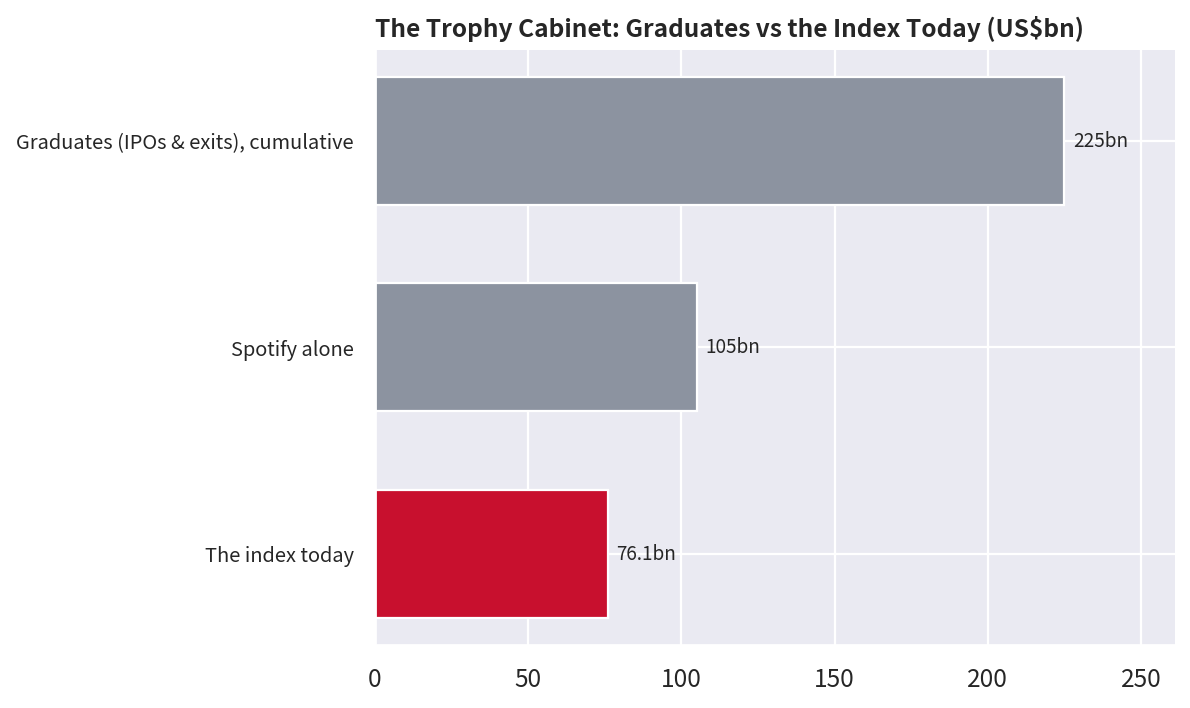
Company | Country | Exit | Year | Value Then | Value / Status Now |
Spotify | Sweden | NYSE direct listing | 2018 | US$26.5bn | US$105bn market cap — Europe's most valuable tech graduate |
Unity | Denmark/Iceland | NYSE IPO | 2020 | US$13.7bn | US$19bn market cap |
Evolution | Sweden | Nasdaq First North Premier IPO; main market 2017 | 2015 | Listed below US$1bn (≈US$0.34bn) | US$15bn market cap — peaked at US$30.4bn in 2021; July 2026 mandatory offer from Candle Lake at ≈US$14.5bn |
Ascendis Pharma | Denmark | Nasdaq IPO (US); ordinary-share switch 2026 | 2015 | Listed below US$1bn (US$0.41bn) | US$15bn market cap — +55% in 2025 on Skytrofa and Yorvipath; HQ and R&D still in Copenhagen |
Supercell | Finland | Tencent control (84%) | 2016 | US$10.2bn | US$10.2bn (2016 price; no newer disclosed mark); US$3.1bn revenue, US$1.1bn pre-tax profit 2025 |
Zendesk | Denmark | NYSE, then PE take-private | 2014/2022 | US$10.2bn | Private (H&F/Permira) |
Skype | Sweden/Denmark | eBay, then Microsoft | 2005/2011 | US$8.5bn | Retired by Microsoft, May 2025 |
Wolt | Finland | DoorDash (all-stock) | 2022 | US$8.1bn | DoorDash International's engine |
King | Sweden | Activision Blizzard | 2016 | US$5.9bn | Now inside Microsoft Gaming |
Klarna | Sweden | NYSE IPO | 2025 | US$15.1bn (fully diluted) | US$5bn market cap — down two-thirds from its IPO |
Just Eat | Denmark-origin | Prosus takeover | 2025 | US$4.7bn | Delisted Nov 2025; Danish operations closed 2026 |
Cognite ‡ | Norway | Schneider Electric (agreed sale) | 2026 | US$3.1bn | Agreed 30 June 2026, all-cash, expected to complete in coming quarters — ‡ dual-counted at #12 in this index |
Mojang | Sweden | Microsoft | 2014 | US$2.5bn | Minecraft, the best-selling game ever |
Trulia | Finland-origin | Zillow (all-stock) | 2015 | US$2.5bn | Announced at US$3.5bn in 2014; now Zillow's listings brand — Inkinen went on to found Virta Health |
iZettle | Sweden | PayPal | 2018 | US$2.2bn | PayPal's in-store arm |
Tink | Sweden | Visa | 2022 | US$2.2bn | Visa's open-banking platform |
IQM † | Finland | Nasdaq de-SPAC (IQMX) + Helsinki dual listing | 2026 | US$1.8bn | US$2bn market cap — † dual-counted at #10 in this index; Europe's first listed quantum company |
Kahoot! | Norway | Take-private (GSAM/KIRKBI) | 2023 | US$1.7bn | Private |
Einride | Sweden | Nasdaq SPAC (ENRD) | 2026 | US$1.35bn | US$1bn market cap — below its US$1.35bn June listing; FY2025 revenue US$48m, net loss US$180m — a fragile graduate (98% trust redemptions) |
Kerecis | Iceland | Coloplast (M&A) | 2023 | Up to US$1.3bn | Iceland's first unicorn |
Sana | Sweden | Workday acquisition | 2025 | US$1.1bn | Europe's largest AI acquisition; founder now Workday Chief AI Officer |
MySQL | Finland/Sweden | Sun Microsystems | 2008 | US$1.0bn | Sequel MariaDB: SPAC, then US$37m take-private — the cautionary coda |
Yubico | Sweden | Nasdaq Stockholm (First North 2023; main market 2024) | 2023 | Listed below US$1bn | US$0.5bn market cap — the list-at-home case |
Source: Hurun Research Institute, Nordic Unicorn Index 2026.
How the Nordics Compare: The Post-2000 Graduate Class
Apply the strict test — founded in 2000 or later, since gone public, still listed above US$5 billion — and nineteen mainland European companies qualify. Sweden, with a third of the Benelux's population, produced three. Denmark produced one, plus its share of US-incorporated Unity; Finland none — Supercell chose not to list; Norway none. The Nordics' four clean passes level them with Germany's and the Benelux's three each — and France, with more than twice the Nordics' population, produced one: Datadog, built in New York by two French engineers, in exile.
Rank | Company | Country | Founded | Listed | Market cap today |
1 | Spotify | Sweden | 2006 | NYSE (2018) | US$105bn |
2 | Datadog † | France→US | 2010 | NASDAQ (2019) | US$99.9bn |
3 | Nebius (ex-Yandex) * | Netherlands | 2007* | NASDAQ (2011) | US$68.5bn |
4 | argenx | Belgium/NL | 2008 | Euronext (2014) | US$58.8bn |
5 | Adyen | Netherlands | 2006 | Amsterdam (2018) | US$30.7bn |
6 | BioNTech | Germany | 2008 | NASDAQ (2019) | US$24.0bn |
7 | On Holding | Switzerland | 2010 | NYSE (2021) | US$21.2bn |
8 | Unity † | Denmark/Iceland→US | 2004 | NYSE (2020) | US$19bn |
9 | Evolution | Sweden | 2006 | Stockholm (2015) | US$15bn |
10 | Ascendis Pharma | Denmark | 2007 | NASDAQ (2015) | US$15bn |
11 | Delivery Hero | Germany | 2011 | Frankfurt (2017) | US$12.5bn |
12 | Elastic † | Netherlands→US | 2012 | NYSE (2018) | US$9.9bn |
13 | GitLab † | Netherlands/Ukraine→US | 2011 | NASDAQ (2021) | US$8.6bn |
14 | InPost | Poland | 2006 | Amsterdam (2021) | US$8.4bn |
15 | UiPath † | Romania→US | 2005 | NYSE (2021) | US$6.8bn |
16 | Allfunds § | Spain | 2000 | Amsterdam (2021) | US$6.3bn |
17 | Pepco Group | Poland | 2004 | Warsaw (2021) | US$6.2bn |
18 | Zalando | Germany | 2008 | Xetra (2014) | US$6.1bn |
19 | Klarna | Sweden | 2005 | NYSE (2025) | US$5bn |
Source: Hurun Research Institute, Nordic Unicorn Index 2026.
The country IPO scoreboard reads: Sweden 3 · Denmark 1 (plus Iceland's share of Unity) · Finland 0 — Supercell chose not to list · Norway 0. The Nordics' four clean passes leave them level with Germany and the Benelux (three each); Poland has two, Switzerland, Spain and Romania one apiece — and France's one was built in New York.
The Grade Report: The Graduates, Marked Like a Pan-Nordic School
Read the alumni register as a school report and the grades write themselves — with affection, and with one eye on what each company teaches the region that produced it. Each graduate is marked twice: on the pan-Nordic A-to-F scale, and on the Danish 7-point scale (12 down to −3), so no Dane feels left out of parent-teacher evening.
Grades are awarded on the pan-Nordic A–F scale, with the Danish 7-point scale alongside — the legend:
Grade | Danish scale | What it means |
A | 12 | Head of school — compounded past US$10bn, or a class-defining exit |
B+ | 10 | Excellent — strong outcome, a mark docked for leaving |
B | 7 | Good — solid exit, most of the compounding elsewhere |
C | 4 | Fair — graduated, but the market has its doubts |
D | 00 | Must improve — the fragile route taken |
F | −3 | Failed or faded |
— | — | Transferred mid-semester — special cases |
Source: Hurun Research Institute, Nordic Unicorn Index 2026.
Graduate | Grade (A–F) | Danish scale | One-line teacher's comment |
Spotify | A | 12 | Head of school: US$105 billion, 300 million subscribers, and still setting the curriculum. |
Supercell | A | 12 | Took the foreign scholarship and stayed home anyway — Espoo keeps the company, the culture and the tax. |
Skype | A | 12 | The founding myth: free calls from Luxembourg, London and Tallinn, and an impact still felt in every video call; retired in 2025, still funding the class. |
Evolution | A | 12 | Sat down on First North in 2015 at SEK 80 a share and ran the table to a US$30 billion peak — listed small, stayed home, kept compounding. |
Zendesk | B+ | 10 | Top marks for the work; the address was San Francisco. The loft in Copenhagen remembers. |
Sana | B+ | 10 | Europe's largest AI acquisition — and the founder stayed in Stockholm as Workday's Chief AI Officer. |
Ascendis Pharma | B+ | 10 | Listed in New York at US$413 million and re-rated on Skytrofa to US$15 billion — Denmark's biotech flagship; the mark docked for the American ticker. |
Unity | B | 7 | A brilliant engine, built in a Copenhagen basement, handed to America at Sequoia's request. |
Wolt | B | 7 | Married well — and was promoted at the in-laws: now runs DoorDash International from Helsinki. |
King | B | 7 | One sweet franchise, sold to Activision; Stockholm's games scene lives off the pocket money. |
Mojang | B | 7 | A single perfect essay — Minecraft — handed in early and never surpassed. |
Trulia | B | 7 | Sold the property portal to Zillow for US$2.5 billion — and the Finn promptly wrote a sequel (Virta Health). |
iZettle | B | 7 | Put card readers in market stalls; PayPal paid US$2.2 billion nine days before graduation. |
Tink | B | 7 | Quiet, diligent; now does Visa's open-banking homework. |
Kerecis | B | 7 | Iceland's first unicorn, from fish skin and a town of 2,600. Extra credit for degree of difficulty. |
Just Eat | C+ | 4 | Danish by birth, Dutch by marriage, Prosus by settlement; closed its original Danish operations in March 2026. |
Kahoot! | C | 4 | Made learning fun, then went private and stopped putting its hand up. |
Yubico | C | 4 | Mission intact, listed at home, worth half a billion — the grade reflects the market cap, not the morals. |
Klarna | C− | 02 | Must do better: down two-thirds from its September 2025 IPO. A formidable business, graded for now by its share price. |
IQM | C+ | 4 | Sat the public exam first of the quantum class — Europe's first listed quantum computer company, dual-listed in New York and Helsinki, holding its US$2bn entry mark; the order book decides whether it joins the A stream. |
Cognite | Transferred mid-semester | — | Moved its desk to Arizona, then agreed to marry Schneider Electric for US$3.1 billion; Norway mourns, politely. |
Einride | D | 00 | Came in through the SPAC door at a cut price, with 98% redemptions and a US$180 million loss — and now trades below its entry mark. Must improve. |
MySQL/MariaDB | F | −3 | The one that got away: Sun, Oracle, a SPAC and a US$37 million take-private. See me after class. |
Northvolt | F | −3 | Expelled — US$15 billion raised, the largest bankruptcy in modern Swedish history. |
Source: Hurun Research Institute, Nordic Unicorn Index 2026.
Read the grades as a distribution and the pattern is clear. The A's are the companies that kept their compounding at home or close to it — Spotify by listing on its own terms, Supercell by selling control without selling the furniture, Skype by seeding the generation after it. The C's and D's are not failures of business — Klarna remains formidable, Einride may yet grow into its ticker, Yubico's mission is intact. They are, mostly, lessons in timing: companies that met the public market at the wrong moment, or through the wrong door.
The lesson is not 'never sell'. It is that the Nordics systematically sell at the moment their companies become most valuable — the growth stage between US$1 billion and US$10 billion — because that is where Nordic capital runs out. Fix the growth-capital gap, and more of this table looks like Spotify. The stories behind each graduate — from Spotify's twenty-year road to US$105 billion to Iceland's one and only unicorn — are told in Appendix A.
The Nordics do not have a startup problem, or even a listing problem. The leak is headquarters and senior teams, not the ticker: Legora now run from New York, Cognite from Arizona, and an alumni register worth well over two hundred billion dollars built somewhere else. Give the next Lovable a reason to keep its boardroom in Stockholm, and the grades will take care of themselves.
— Rupert Hoogewerf, Chairman and Chief Researcher, Hurun Research Institute
SECTION 10: FINDINGS FOR OUR READERS
This report opened with four audiences. It closes with what each should take from the evidence of 2026 — and with the measures the Hurun Research Institute will report against at next year's index.
10.1 For Young Entrepreneurs Across the Nordics
The 44 founders in this index are your proof that the path is real: average age 34 at founding, nearly half of them serial entrepreneurs, seven PhDs, and five born outside the Nordics — recruited, every one, through a university or a research lab. Anton Osika and Fabian Hedin went from a KTH open-source project to US$13.3 billion in under three years; Max Junestrand turned down professional Dota 2 at 18 and built Legora; Rafał Modrzewski arrived from Poland as a student and built Europe's space decacorn. The lesson of 2026 is that you no longer have to leave: Lovable, Iceye, Oura and Neko all scaled from home.
Two predictions for your planning horizon. The Nordics will pass 30 unicorns by 2030 — the pipeline (1X, Monta, ReOrbit, Stegra, Blykalla, and design brands like Nordic Knots) is the deepest it has ever been. And Lovable or Legora becomes the Nordics' first homegrown AI decacorn within two years: at US$500 million and US$100 million of annualised revenue respectively, and compounding, one of the Stockholm pair crosses US$10 billion. The next seat at that table is open.
10.2 For International Investors
The Nordics remain the most efficient unicorn factory on earth relative to size — 0.65 unicorns per million people against Germany's 0.45 — and the region's unicorn value rose 39% between January and publication. Nine of the ten largest rounds on record were led by American or global firms; the deal flow is proven, the competition for allocation is not local, and the re-ratings of 2026 (Lovable, Iceye, Neko) all rewarded investors who moved early.
Three predictions. Iceye and Oura will both be public — or decacorns — by 2030: Oura's S-1 is filed, and Iceye's backlog argues for staying private longer; either way Finland enters 2030 with two of Europe's defining technology companies. A Nordic alumnus passes US$150 billion: Spotify, at US$105 billion and still growing double digits, is the obvious candidate, and the graduates' collective value will double before the active list does. And at least two of this index's 18 will have graduated by next year's edition — Cognite's sale completes, Oura is the most likely to list. Graduation, on the evidence of Section 9, is the point rather than the loss; the goal is to make the next graduates list in Stockholm, Helsinki or Copenhagen.
10.3 For the Five Nordic Governments
The Hurun Research Institute makes ten recommendations. The theme: the region already acts as one ecosystem for founders; its policies should catch up.
Ten recommendations, ordered by expected impact, with the capital that owns each.
1. Let the pension money home. Norway's US$2 trillion fund remains barred from unlisted equity — the single most absurd self-denial in European finance — while Denmark's ATP shows pension capital can back early-stage tech and return 19.5% in a year; a 1% allocation would dwarf the region's entire venture industry. (All five, jointly)
2. Create a pan-Nordic Scale-Up Fund. Pool Tesi (Finland), EIFO (Denmark), Saminvest/Almi (Sweden), Investinor and Nysnø (Norway) into a joint late-stage vehicle of at least US$3.5 billion, mandated to lead the US$100–500 million rounds now led by default from Menlo Park. (All five, jointly)
3. End the exit-tax exodus. Norway's tax on unrealised gains for emigrating founders — with an allowance of only NOK 3 million — has already cost the country Dune Analytics' founder and contributed to Cognite's departure; tax liquidity events, not paper wealth, and defer until sale. (Oslo)
4. Harmonise employee stock options to the Finnish standard. Finland's April 2026 reform — options in unlisted companies taxed at sale, not exercise — is the region's best practice; one Nordic regime would let a Stockholm startup hire a Helsinki engineer without a tax-treaty headache. (All five, jointly)
5. Fight for the headquarters, not just the listing. The leak is head offices and senior teams, not the ticker: Legora now runs from New York, Cognite from Arizona. The instruments are unglamorous — competitive R&D credits, procurement as first customer, and growth capital at home (recommendations 1 and 2) — but they decide where the next Lovable keeps its boardroom. (All five, jointly)
6. Procure sovereign deep tech. Iceye's rise was financed substantially by European governments buying satellites; extend the model to quantum (IQM), humanoid robotics (1X), small modular nuclear (Blykalla) and sovereign space (ReOrbit) — demand-side policy that costs a fraction of subsidies. (All five, jointly)
7. Build a Nordic tech listing venue. Nasdaq Nordic led European exchanges in first-half 2026 listings, yet Klarna, Unity and Oura all chose or filed in New York; a joint Nordic tech segment — unified prospectus rules, research coverage, pension-fund anchor demand — is the credible answer, and Pleo's mooted Copenhagen IPO is the test case. (Stockholm and Helsinki)
8. Scale the founder visa. Five of the index's 44 founders were born outside the Nordics, yet their companies are worth US$21.8 billion — 29% of the index; every one was recruited by a university or research lab, not a venture fund. Finland's Startup Permit should become a Nordic Startup Permit: one application, five countries, fast-tracked for technical founders. (Helsinki, extended to all five)
9. Close the gender paradox with LP leverage. Two female co-founders of 44, in the world's most gender-equal region, is a market failure the states already fund; every state LP commitment (Tesi, EIFO, Saminvest, Investinor) should require portfolio-level diversity reporting and targets — the mechanism that moved corporate boards a decade ago, now applied to cap tables. (All five, jointly)
10. Include Iceland. Iceland's constraint is financial architecture, not talent: no growth capital means every Kerecis sells early. The pan-Nordic fund (recommendation 2) should carry an explicit Iceland allocation, and Reykjavik should join the option and visa harmonisation — the cheapest way to add a sixth Nordic unicorn country by 2030. (Reykjavik)
How we will keep score. The Hurun Research Institute will report back against five measurable KPIs at each annual index:
KPI | Today (2026) | Target |
Nordic unicorn count | 18 | 25 by 2030 |
Share of the region's ten largest rounds led by Nordic or European investors | 1 of 10 | 5 of 10 |
Top-ten unicorns with headquarters and senior leadership in the Nordics | 8 of 10 (Legora in New York, Cognite in Arizona) | 10 of 10 by 2028 |
Female co-founders on the index | 2 of 44 | 10 by 2030 |
Combined unicorn value | US$76.1 billion | US$150 billion by 2030 |
Source: Hurun Research Institute, Nordic Unicorn Index 2026.
When a hundred of Norway's top four hundred taxpayers leave to protect their companies, the message is about the tax code, not the entrepreneurs. Norway is manufacturing other countries' unicorns — and the fix is one paragraph of legislation.
— Rupert Hoogewerf, Chairman and Chief Researcher, Hurun Research Institute
10.4 For Everyone Who Thought the Nordics Were Just High Taxes
Be surprised. The world's most gender-equal region produces almost exclusively male unicorn founders — two women of 44. The world's most trusted pension systems invest almost nothing in their own startups. Norway's US$2 trillion sovereign wealth fund is barred from owning a single Nordic unicorn — while its tax office drives founders abroad. And the region that supposedly smothers enterprise just produced, from a Stockholm open-source project, what its maker calls the fastest-ramping software company in history. These paradoxes are not embarrassments; they are the policy opportunity, and this report has named them one by one.
Two closing predictions. Iceland gets its first private unicorn by 2028 — most likely from life sciences or geothermal energy, the two sectors where the island's endowment is unfair. And Norway produces its next unicorn in 1X — and, if recommendation 3 is adopted, keeps it; if not, expect 1X's 2030 annual report to be written in Palo Alto.
In 2016, the world asked whether the Nordics could keep producing unicorns after Spotify. Ten years later the answer is eighteen companies and US$76.1 billion. The question for 2036 is different: whether the region can produce a Spotify that never has to leave. On the evidence of Lovable, Iceye, Oura and Neko Health — it can. Whether it will is a policy choice, being made right now in five parliaments.
— Rupert Hoogewerf, Chairman and Chief Researcher, Hurun Research Institute
SECTION 11: METHODOLOGY
Scope. This report covers privately held companies headquartered in Finland, Sweden, Norway, Denmark or Iceland and valued at US$1 billion or more. The Baltics are excluded: Estonia, Latvia and Lithuania merit their own Hurun index; Skype's Tallinn engineering core (Heinla, Kasesalu, Jaan Tallinn) is part of its story.
Time Period. The base list is the Hurun Global Unicorn Index 2026, with significant changes in valuation and status updated to the date of publication (October 2026). Hurun Research Institute has been tracking unicorns since 2017.
Series. The Hurun Nordic Unicorn Index 2026 is the seventh release in Hurun’s global unicorn series this year, following the Hurun Global Unicorn Index 2026 (25 June 2026) and country reports on the UK, US, Germany, France and Benelux.
Valuations. US dollars throughout, as the index's reporting currency and the natural common denominator across the euro, Swedish krona, Danish krone, Norwegian krone and Icelandic króna. Figures for 2025–26 items reported in other currencies are converted at rates: EUR/USD 1.154; USD/DKK 6.48; USD/SEK 9.55; USD/NOK 9.30. January 2026 valuations are the global index's marks; later valuations are from priced rounds or, where noted, credible press reporting.
Sources. Hurun Global Unicorn Index 2026 data; company announcements and filings; TechCrunch, Sifted, Bloomberg, Reuters, The Information, Dealroom, PitchBook and Nordic trade press, verified between February and October 2026.
Acknowledgements and disclaimer. Hurun Research Institute thanks the founders, investors and ecosystem organisations whose public information made this census possible. This report is for information only and does not constitute investment advice.
APPENDIX A: THE GRADUATES’ STORIES
The graduates table of Section 9 lists the outcomes; this appendix tells the journeys — how the Nordics' most successful alumni were built, sold or listed, and what each one teaches. The register below orders them strictly by size, from the company that defines the region's story to its smallest listed champion; the stories follow in the same order.
A. | Graduate | Value today | Grade |
A.1 | Spotify | US$105bn (NYSE) | A / 12 |
A.2 | Unity | US$19bn (NYSE) | B / 7 |
A.3 | Evolution | US$15bn (Nasdaq Stockholm) | A / 12 |
A.4 | Ascendis Pharma | US$15bn (Nasdaq) | B+ / 10 |
A.5 | Supercell | US$10.2bn (2016 Tencent mark) | A / 12 |
A.6 | Zendesk | US$10.2bn (take-private, 2022) | B+ / 10 |
A.7 | Skype | US$8.5bn (Microsoft, 2011; retired 2025) | A / 12 |
A.8 | Wolt | US$8.1bn (DoorDash, 2022) | B / 7 |
A.9 | King and Mojang | US$5.9bn + US$2.5bn (Microsoft family) | B / 7 each |
A.10 | Klarna | US$5bn (NYSE; down two-thirds from IPO) | C− / 02 |
A.11 | Just Eat | US$4.7bn (Prosus, 2025) | C+ / 4 |
A.12 | Cognite | US$3.1bn (Schneider, agreed sale) | Transferred mid-semester |
A.13 | Trulia | US$2.5bn (Zillow, 2015) | B / 7 |
A.14 | iZettle and Tink | US$2.2bn each (PayPal 2018; Visa 2022) | B / 7 each |
A.15 | IQM † | US$2bn (Nasdaq IQMX) | C+ / 4 |
A.16 | Einride | US$1bn (Nasdaq ENRD) | D / 00 |
A.17 | Kerecis | up to US$1.3bn (Coloplast, 2023) | B / 7 |
A.18 | Sana | US$1.1bn (Workday, 2025) | B+ / 10 |
A.19 | Yubico | US$0.5bn (Nasdaq Stockholm) | C / 4 |
Source: Hurun Research Institute, Nordic Unicorn Index 2026.
A.1 Spotify: The Twenty-Year Road to US$105 Billion
Spotify begins, as so many Nordic stories do, with piracy. In 2006 Sweden was the world capital of illegal file-sharing — home of The Pirate Bay — and Daniel Ek, a 23-year-old from Rågsved in southern Stockholm, had already lived three startup lives: he sold his advertising company Advertigo to Tradedoubler, served briefly as CTO of the virtual-world startup Stardoll, and ran uTorrent through its sale to BitTorrent, recruiting its lead developer Ludvig Strigeus along the way. With Martin Lorentzon, the 37-year-old co-founder of Tradedoubler who put up the early money, Ek founded Spotify AB in a Stockholm apartment on 23 April 2006 around one conviction: the only way to beat piracy was to be better than it — free, instant and legal.
The first two years went not to code but to lawyers: licensing the world's music meant signing the major labels, and the price of their signatures was equity — widely reported at 15–20% collectively. Spotify launched, invite-only, in October 2008 across eight European countries; the waitlist became the marketing. The US launch followed in July 2011 with all four majors signed, and deep Facebook integration two months later turned sharing into the growth engine. The freemium flywheel — a free, ad-funded tier converting listeners into US$9.99 subscribers — was set, and it has never really changed.
The next defining choice came in April 2018: rather than a conventional IPO, Spotify took the then-radical step of a direct listing on the NYSE — no new capital, no underwriters, no lockup, liquidity for existing holders without dilution. It opened at US$165.90 and closed its first day worth about US$26.5 billion, making it Europe's most valuable technology listing of the decade and writing the playbook later followed by others.
Then came the bet that made — and nearly unmade — the modern company. From 2019 Spotify spent more than US$1 billion buying podcasting: Gimlet (US$195m), Anchor, Parcast, The Ringer, the Megaphone ad platform, and the exclusive Joe Rogan deal (reported at US$100m, later revealed to be at least US$200m). Audiobooks followed in October 2022. The market hated it: between the tech rout and scepticism over content spending, the stock fell 66% in 2022 to a market value of US$15.2 billion — below its listing price, four years on.
The recovery is the part of the story most worth a policymaker's attention, because it was operational, not financial. Spotify raised prices without losing subscribers, cut costs and staff, made podcasting profitable rather than exclusive, and pushed gross margin from 25% in 2022 to 33% in 2026. The result: 2024 delivered the first full-year operating profit in company history (US$1.6 billion on US$18.1 billion of revenue); 2025 brought US$19.6 billion of revenue and record subscriber growth; and the second quarter of 2026 made Spotify the first audio service in history with 300 million paying subscribers, alongside 777 million monthly users, a record 33.4% gross margin and US$755 million of quarterly operating income. The company has now paid the music industry more than US$11 billion a year, more than US$70 billion cumulatively — the royalty engine that replaced the piracy it was founded to kill.
The market-cap journey tells the decade in one line: US$26.5 billion at the 2018 listing; US$15.2 billion at the 2022 trough; an all-time high near US$155–158 billion in June 2025; and US$105 billion at publication — the decline from the peak driven by an AI-fear selloff across software stocks in early 2026 and a deliberate US$230 million step-up in marketing and R&D spending, not by any deterioration in the business. Even after the fall, Spotify is worth nearly four times its listing value, and analysts' consensus target sits near US$600 a share.
And Ek? He became Executive Chairman in January 2026, handing the day job to co-CEOs Gustav Söderström and Alex Norström, and now spends his time on capital allocation and his investment firm Prima Materia — which led rounds in Helsing, Europe's most valuable defence startup at US$18 billion, where Ek is co-chairman — and on Neko Health, his second unicorn, ranked fourth in this index. Worth about US$12.5 billion on the Hurun Global Rich List 2026 (Lorentzon, US$13.7 billion), Ek has become the region's first true serial ecosystem builder: founder of its greatest graduate, chairman of its most valuable defence company, and co-founder of one of its fastest-rising health unicorns.
The lesson: Spotify is the counterfactual made real. It is what a Nordic unicorn becomes when it can fund the growth stage without selling — first from a global investor base, then from public markets. Every graduate story that follows is a variation on the question of why more of them did not get to try.
A.2 Unity: Iceland's Uncrowned Champion
In a Copenhagen basement in September 2004, David Helgason (Icelandic), Nicholas Francis (Danish) and Joachim Ante (German) founded Over the Edge — the company that became Unity — bootstrapped with little more than €25,000 from Ante's father. Their first game, GooBall, flopped; the tools they had built to make it did not. They launched the engine at Apple's WWDC in June 2005 around a democratising ambition: give everyone, not just studios, the means to build 3D worlds. Sequoia's US$5.5 million Series A in October 2009 came with a condition — Helgason had to move to Silicon Valley; he relocated that September while his co-founders stayed in Copenhagen. The engine beneath most of the world's mobile games followed; so did a NYSE IPO in 2020 at US$13.7 billion, a peak near US$57 billion in 2021, the ironSource merger in 2022, and after a brutal correction and reset, a market value of US$19 billion today. Unity is simultaneously Denmark's and Iceland's most valuable software graduate — and the reason this report insists Iceland's unicorn drought is about financial architecture, not talent.
A.3 Evolution: The House Always Wins
Jens von Bahr and Fredrik Österberg, two Swedes, founded Evolution in 2006 and opened their first live-casino studio in Riga — real dealers, streamed to the world's online casinos. They listed early and small: Nasdaq First North Premier in March 2015 at SEK 2.9 billion (about US$340 million), stepping up to the Stockholm main market in 2017. What followed was one of Europe's great public-market compounding stories: the US$2.1 billion acquisition of NetEnt in 2020 made Evolution the undisputed giant of online casino content, the market value peaked at US$30 billion in 2021, and even after a regulatory reset it stands at about US$15 billion — on 2025 revenues of €2.07 billion, EBITDA margins of 66% and 22,900 employees. In July 2026, Kenneth Dart's Candle Lake crossed the 30% threshold and launched a mandatory cash offer at SEK 695 per share, valuing Evolution at about US$14.5 billion — quite possibly the next Nordic giant to change hands. Evolution listed below US$1 billion and built its valuation in public; it is included here for scale and impact.
A.4 Ascendis Pharma: Denmark's Biotech Flagship
Jan Møller Mikkelsen spent eleven years at Novo Nordisk, rising to VP of Protein Discovery, then co-founded ProFound Pharma (sold to Maxygen) and ran the Copenhagen-listed LifeCycle Pharma for four years. In December 2007, backed by Gilde Healthcare and Sofinnova, he founded Ascendis Pharma in Hellerup around the TransCon platform — long-acting prodrug versions of proven therapies, starting with once-weekly growth hormone. Ascendis listed on Nasdaq in New York in January 2015 at just US$413 million, crossed US$1 billion as a public company in 2017, and re-rated hard as Skytrofa and Yorvipath reached patients: up 55% in 2025 alone, to about US$15 billion — Denmark's most valuable post-2000 startup by a distance, with HQ and R&D still in Copenhagen. In April 2026 it switched from ADSs to a direct ordinary-share listing on Nasdaq. Ascendis listed below US$1 billion and built its valuation in public; it is included here for scale and impact.
A.5 Supercell: The Graduate That Stayed
Ilkka Paananen, Mikko Kodisoja, Petri Styrman, Lassi Leppinen, Visa Forstén and Niko Derome — six founders, two of them (Paananen and Kodisoja) veterans of Sumea, sold to Digital Chocolate in 2004 — founded Supercell on 14 May 2010 in a 30-square-metre office in Niittykumpu, Espoo (not Helsinki, as often reported), putting in €250,000 of their own money alongside a €400,000 Tekes loan; Accel led US$12 million in May 2011. The bet: tablet-first games built by small autonomous 'cells'. Clash of Clans became one of the highest-grossing games ever made. SoftBank bought 51% for US$1.5 billion in 2013; a Tencent-led consortium bought 84% at a US$10.2 billion valuation in 2016 — still the last disclosed price. Yet Supercell never left: still Espoo-headquartered, still independently operated, with 2025 revenue of US$3.1 billion and pre-tax profit of US$1.1 billion — and some US$250 million of annual Finnish tax. Supercell is the counter-model to the acquisition drain: proof that control can be sold without the company, its culture or its tax base moving an inch.
A.6 Zendesk: Copenhagen to California
Mikkel Svane, Morten Primdahl and Alexander Aghassipour — three friends — built the first version of Zendesk in Svane's Copenhagen loft in 2007: customer-service software that didn't require an IT department, self-funded through consulting work. When the 2008 crash evaporated what European venture interest they had, American investors — Janz Capital, CRV, Benchmark — and American customers pulled them across the Atlantic; the company moved to San Francisco in early 2009. A NYSE IPO followed in 2014, a rejected US$17 billion private-equity approach in early 2022, and a US$10.2 billion take-private with Hellman & Friedman and Permira that November. Zendesk is the classic diaspora pattern: Nordic product culture, American scale capital, and a founding team that concluded — rightly, at the time — that the two could not meet in Copenhagen.
A.7 Skype: The Original Graduate
Niklas Zennström, a Swede, and Janus Friis, a Dane, founded Skype in 2003 — Skype Technologies S.A., incorporated in Luxembourg as its legal seat, with real operations split between London and Stockholm and engineering in Tallinn, where Ahti Heinla, Priit Kasesalu, Jaan Tallinn and Toivo Annus built the product that made phone calls free. eBay paid US$2.6 billion in 2005; Microsoft paid US$8.5 billion in 2011; Microsoft retired the service in May 2025, twenty-two years after launch. Skype's real legacy is its second generation: Zennström's Atomico (US$5 billion-plus under management) funds this index's companies, Friis builds Starship's delivery robots, and the Tallinn alumni built Wise and Pipedrive. Every ecosystem claims to want a flywheel; Skype is the Nordic-Baltic one, still spinning.
A.8 Wolt: From Slush to DoorDash
Miki Kuusi built his reputation running Slush, Helsinki's founder conference, before co-founding Wolt in 2014 to do food delivery the Nordic way — politely, efficiently, profitably. DoorDash bought the company in an all-stock deal worth US$8.1 billion, completed in May 2022; Kuusi now runs DoorDash's entire international operation from Helsinki. Wolt is the happiest version of the acquisition story: a full price, a founder promoted rather than replaced, and an operating headquarters that stayed put.
A.9 King and Mojang: Sweden's Microsoft Pair
Two Swedish games companies, two Microsoft-family outcomes. King, founded in Stockholm in 2003 by Riccardo Zacconi and colleagues, turned Candy Crush Saga into a mobile-gaming institution and sold to Activision Blizzard for US$5.9 billion in 2016 — now part of Microsoft Gaming. Mojang, Markus 'Notch' Persson's one-phenomenon studio, sold Minecraft — the best-selling game in history — to Microsoft for US$2.5 billion in 2014, with Persson departing at closing. Together they explain why Stockholm's games scene remains a unicorn nursery (and why its founders' angel cheques appear across this index).
A.10 Klarna: The Cautionary Decacorn
Founded in Stockholm in 2005 as Kreditor by Sebastian Siemiatkowski, Niklas Adalberth and Victor Jacobsson — Siemiatkowski and Adalberth had met as teenagers at Burger King; Jacobsson they met at the Stockholm School of Economics, where the trio entered the university's entrepreneurship competition and were rejected (angel Jane Walerud was wiser, investing SEK 600,000 for 10%) — Klarna, renamed in 2009, invented buy-now-pay-later and rode it to a US$45.6 billion peak valuation in a SoftBank-led round in June 2021 — then Europe's most valuable startup. The fall was as instructive as the rise: an 85% down round to US$6.7 billion in 2022, a public rebuild around AI-first operations, and a NYSE IPO on 10 September 2025 at US$15.1 billion fully diluted that was meant to be the comeback. Today Klarna trades at a US$5 billion market capitalisation — down two-thirds from its IPO, and worth less than half of Lovable, a private Stockholm company founded in 2023. Klarna remains a formidable business — US$3.5 billion of revenue, 100 million-plus users — but its market journey is the region's sharpest lesson in the cost of peaking at the wrong moment, and in how ruthlessly public markets re-price fintech narratives.
A.11 Just Eat: The Danish-Origin Question
Just Eat was founded in Kolding, Denmark, in 2001 — the service launched that August — by five Danes: Jesper Buch, Per Meldgaard, Henrik Østergaard, Christian Frismodt and a fifth co-founder whose name varies by source (David Buttress, who joined in 2006 as UK CEO, was not a founder). Bo Bendtsen bought out most of the founders in 2005; the headquarters moved to London in 2006; the LSE IPO followed in April 2014 at a valuation near £1.47 billion. Dutch by its 2020 merger with Takeaway.com, it was taken private by Prosus for US$4.7 billion in 2025, delisted from Euronext that November, and in March 2026 announced it is closing its original Danish operations. Denmark understandably claims Just Eat as a graduate; just as instructively, almost all of its value was created and realised abroad. It is the diaspora story hiding inside the graduate table — and the reason Danish business associations count 13 Danish-born unicorns, most of which left early.
A.12 Cognite: Norway's Largest Software Exit
John Markus Lervik — an NTNU PhD in telecommunications — founded FAST Search & Transfer in 1997 and sold it to Microsoft for US$1.2 billion, then served as a Microsoft corporate vice president and founded Cxense (listed, then sold). In 2016, backed by Kjell Inge Røkke's Aker, he founded Cognite in Lysaker to liberate industrial data — oil platforms, ships, factories — into software. Revenue passed US$170 million in 2025. Then came the exit this report flags as a warning: the headquarters moved to Arizona in January 2025, and on 30 June 2026 Schneider Electric announced a definitive agreement to acquire 100% of Cognite for US$3.1 billion, all cash — the largest software exit in Norwegian history, expected to complete in the coming quarters. Cognite is ‡ dual-counted in this index: ranked 12th at its last private mark of US$1.6 billion, and recorded here at the agreed sale price. The lesson for Norway is not about one company but about a pattern: its best software company concluded that its customers, capital and comparables were all in America.
A.13 Trulia: Inkinen's First Act
Sami Inkinen — born in Ruokolahti in south-east Finland, an engineering-physics graduate of Helsinki University of Technology — took his MBA at Stanford and stayed in California. In 2004 he co-founded Trulia in San Francisco with Britain's Pete Flint and built the property-listings portal all the way to a NYSE listing in September 2012. Zillow announced a US$3.5 billion all-stock takeover in July 2014; by the time the deal completed in February 2015, market movement had made it a US$2.5 billion exit. Inkinen had already founded his second company, Virta Health — still private at US$2.0 billion, and therefore on the diaspora register (Appendix B). Finland's diaspora does not just leave; it repeats.
A.14 iZettle and Tink: The Payments Seeds
Stockholm's fintech graduates seeded today's list. iZettle — founded in April 2010 by Jacob de Geer (TradeDoubler's first employee) and Magnus Nilsson, from an idea credited to de Geer's former wife, an eyewear importer who lost sales at a trade fair unable to take cards; 'he moved into my office,' Nilsson has recalled, 'and we spent a month together' — put card readers in market stalls and was bought by PayPal for US$2.2 billion in May 2018, nine days after announcing its own IPO. Tink — founded in 2012 by Daniel Kjellén and Fredrik Hedberg, described by backer Dawn Capital as 'long-term friends and repeat entrepreneurs' — began as a consumer app, pivoted to B2B open banking in 2018, and sold to Visa for US$2.2 billion (€1.8bn), completed in 2022. Their alumni and angel money are woven through the current index; Pleo, Lunar and Flatpay are, in part, their inheritance.
A.15 IQM: Europe's First Listed Quantum Company
Spun out of Aalto University and VTT in 2018 by Jan Goetz, Juha Vartiainen, Kuan Yen Tan and Mikko Möttönen, IQM builds full-stack superconducting quantum computers that customers install in their own data centres — an on-premises bet against the cloud-rental model of its American rivals. A US$320 million Series B in September 2025 — the largest quantum Series B outside the United States — carried it past US$1 billion; on 2 July 2026 it completed its de-SPAC merger and began trading on Nasdaq as IQMX, with a dual listing in Helsinki, raising US$234 million and becoming Europe's first publicly traded quantum computer company. The early report card is instructive: first-half revenue up 47% year-on-year, an order backlog above US$115 million by August, systems running at Oak Ridge and the Leibniz Supercomputing Centre — and a share price that has drifted back toward its US$10 reference, valuing the company at US$2.0 billion. Quantum's timelines are long; the public market's patience is quarterly. IQM is the newest test of whether Europe's deepest tech can grow up in public. † dual-counted.
A.16 Einride: The Newest Graduate — and a Warning Label
Founded in 2016 by Robert Falck — a Volvo Group veteran (director of powertrain manufacturing engineering) and serial entrepreneur for whom Einride is a seventh company — Linnéa Kornehed Falck — a self-taught coder who built systems for Nasdaq, NCC and Bonava, met Robert on an exchange year in Barcelona (they later married), and was a Forbes 30 Under 30 honouree in 2020 — and Filip Lilja, Einride built electric and autonomous freight into a Nordic industrial hope — then chose the SPAC route to Nasdaq, listing as ENRD on 10 June 2026 at a US$1.35 billion valuation cut down from US$1.8 billion, after 98% of the SPAC's trust was redeemed. FY2025 revenue was US$48 million against a net loss of US$180 million. The shares surged on debut, then gave it back: the stock now trades at around US$1 billion, below its June entry mark — and the balance sheet remains the question. Einride graduates this index, but it is the fragile kind of graduate — and a reminder that the direct-listing discipline Spotify modelled and the SPAC shortcut are not the same door.
A.17 Kerecis: Iceland's One and Only
In Ísafjörður, a fishing town of 2,600 people in the Westfjords, Gudmundur Fertram Sigurjónsson — a chemist (BSc University of Iceland, MSc DTU), raised in the town — conceived the idea that sounds like folklore: turning fish skin into wound grafts for burns and diabetic ulcers. He had begun medical-device ventures in 2007 and conceived fish-skin wound healing around 2009; the company itself dates formally from 2013 (sources differ between conception and incorporation — we flag both years), and its first FDA clearance came in November 2013. A US$100 million round from KIRKBI (the Lego family office) in 2022 set the stage; Coloplast completed the acquisition in August 2023 for up to US$1.3 billion — Iceland's first and only unicorn outcome. The lesson is written into Section 10: with no domestic growth capital, Iceland's best companies will keep graduating by acquisition. Kerecis is the proof of both the talent and the constraint.
A.18 Sana: Europe's Largest AI Acquisition
Joel Hellermark taught himself to code at thirteen and founded Sana in Stockholm in 2016, aged nineteen, with Anna Nordell Westling — first an AI learning platform, then an enterprise knowledge assistant used by more than a million people. Workday announced its acquisition in September 2025 for about US$1.1 billion — Europe's largest AI acquisition — completed that November, and Hellermark stayed in Stockholm, rising to Workday's Chief AI Officer in June 2026. Sana's deepest legacy may be its alumni: Anton Osika was its first employee in 2016; seven years later he co-founded Lovable, ranked first in this index. The flywheel, again.
A.19 Yubico: The Key That Listed at Home
Husband and wife Stina and Jakob Ehrensvärd — an industrial designer and a security engineer — founded Yubico in Stockholm in 2007; the YubiKey followed in 2008, after Stina met podcaster Steve Gibson at the RSA conference and found her evangelist. The hardware security key now protects 19 of the world's 20 largest internet companies. With its legal headquarters in Stockholm and its US arm in Santa Clara, Yubico listed on Nasdaq First North in September 2023 (via a merger with ACQ Bure) and graduated to the Nasdaq Stockholm main market in December 2024 — a unicorn-scale company that chose to list, and stay, at home. The market has been volatile (it trades at a US$0.5 billion market capitalisation today, down more than 60% from its August 2024 peak), but the franchise is real: profitable, a 2026 partnership with OpenAI, and Stina Ehrensvärd named EY World Entrepreneur of the Year 2025 — the first Swede to win it. Yubico is included in the graduates table as the region's model of the list-at-home path this report advocates.
Market values as of October 2026 (Spotify US$105bn; Unity US$19bn; Klarna US$5bn; IQM US$2bn; Yubico US$0.5bn). Historical deal values per company announcements and contemporaneous reporting, cited in Section 11.
APPENDIX B: THE DIASPORA — HOW THE NORDICS' GLOBAL CHAMPIONS WERE BUILT
Section 8 ranks the billion-dollar companies founded by Nordic-born entrepreneurs abroad; this appendix tells how each was built — and why it was built somewhere else, in the order of the Section 8 table. Unity, Zendesk and Skype — departed, but already exited — are told among the graduates' stories in Appendix A.
B.1 Synthesia — US$4.0bn | AI Video | Two Danes in London
Victor Riparbelli and Steffen Tjerrild, two Danes, co-founded Synthesia in London in 2017 with Matthias Niessner (TU Munich) and UCL professor Lourdes Agapito, to replace cameras and studios with AI-generated presenters. Why London? Riparbelli — IT University of Copenhagen, then a Stanford semester — considered the US but, as he told GV, 'the easiest way to get a visa is through a job at a big company, and I didn't want to do that. London seemed to have a great ecosystem… That's where I met Matthias Niessner.' He moved in 2016, into the post-DeepMind AI talent pool, UCL's computer-vision science and the world's enterprise customers. The result: more than US$100 million of ARR by April 2025, over 90% of the Fortune 100 as customers, and a US$200 million Series E at US$4.0 billion announced on 26 January 2026 — having reportedly turned down Adobe's interest. It is the diaspora's fastest riser, and the proof that the pattern is not historical: Danish founders are still choosing London first, for the same reasons their predecessors chose San Francisco.
B.2 Neo4j — US$2.3bn | Graph Databases | Malmö to San Mateo
Emil Eifrem, Johan Svensson and Peter Neubauer founded Neo4j in Malmö in 2007 around an unfashionable idea — that connected data deserved its own kind of database. After the A round, the headquarters moved to San Mateo in 2011: 'you can build a world-changing organization anywhere,' Eifrem told TechCrunch, 'but the job is always easier at your industry's center of gravity… for tech, it's Silicon Valley.' Engineering stayed in Malmö. The graph category Neo4j created now underpins fraud detection, recommendation engines and AI pipelines worldwide; a 2021 round valued the company at US$2.3 billion. Enterprise infrastructure, built on Swedish engineering, sold from California — the Zendesk pattern repeated a decade later.
B.3 Tradeshift — US$2.7bn Peak | B2B Commerce | Copenhagen to San Francisco
Christian Lanng, Mikkel Hippe Brun and Gert Sylvest founded Tradeshift in Copenhagen in 2010 and took it to San Francisco in 2012 — closer to the North American market, its workforce and its investors — to build a business-network platform for global trade; it peaked at US$2.7 billion in 2018. Its longest shadow is inside this index: Jeppe Rindom was Tradeshift's CFO and Niccolo Perra an early employee before they founded Pleo — the clearest founder-factory chain in Nordic tech, running from a diaspora company back home to Copenhagen.
B.4 Virta Health — US$2.0bn | Digital Health | Inkinen's Second Act in San Francisco
Sami Inkinen's second act — for the first, Trulia, see Appendix A. Born in Ruokolahti and trained as an engineering physicist at Helsinki University of Technology before a Stanford MBA, Inkinen founded Virta Health in San Francisco in 2014 to reverse type-2 diabetes through nutrition-led, physician-supervised telemedicine — a Finnish engineer's answer to America's most expensive chronic disease. Tiger Global led a US$133 million Series E at US$2.0 billion in April 2021, and management now talks of an IPO. Two billion-dollar companies, one Finn, both built in San Francisco.
B.5 Bestseller China — The Business That Made Two Danes Billionaires | Fashion Retail | Beijing
Not a startup unicorn — a billion-dollar business built abroad, and the most successful China story ever written by foreigners. Danes Dan Friis and Allan Warburg were two young Bestseller employees when, in early 1996, they pitched CEO Troels Holch Povlsen on China; Warburg had been in Beijing since 1992 with the East Asiatic Company, a CBS economics master's in hand. Bestseller Fashion Group China — Lingzhi (绫致时装) — was established that year; the first ONLY store opened at Beijing's Xidan Saite mall, and 24 stores in nine cities followed within a year. ONLY, Vero Moda, Jack & Jones and Selected (exited China 2022) grew past 7,000 stores in more than 500 Chinese cities (per the company) — big enough to make both founders US-dollar billionaires. The company is stand-alone — 50% Anders Holch Povlsen, 50% Friis and Warburg, who run it day to day — and is not consolidated into Bestseller A/S. On the Hurun Global Rich List 2018, Friis and Warburg were two of only three self-made non-Chinese US-dollar billionaires in mainland China; the Hurun China Rich List 2025 values each at US$0.8 billion, Warburg resident in Hong Kong, Friis in Beijing.
B.6 Linear — US$1.25bn | Developer Tools | Three Finns in San Francisco
Karri Saarinen, Tuomas Artman and Jori Lallo — three Finns from Helsinki's startup scene — founded Linear in San Francisco in 2019 to build the issue-tracking tool they could not find for modern software teams. Accel led a US$82 million Series C at US$1.25 billion in June 2025. Helsingin Sanomat marked the moment by calling Saarinen 'the third Finn' to build a billion-dollar tech company in America — after Inkinen, twice (Trulia and Virta Health).
B.7 SoundCloud — US$1bn | Audio Streaming | Two Swedes in Berlin
Alexander Ljung and Eric Wahlforss, two Swedes, conceived SoundCloud at KTH and moved to Berlin in 2007 — 'Berlin, as a city, feels a bit like a startup,' Wahlforss explained. 'It's a melting pot of art, tech, creators.' They built it into the world's open audio platform — hundreds of millions of tracks, a near-death experience in 2017, stabilisation under new ownership, and a sale process since 2024 at US$1 billion. It is the diaspora story that stayed inside Europe: Swedish founders, German headquarters, global product — and a reminder that Berlin, as well as California, has been a beneficiary of Nordic founder exports.
One more for the record. Kristian Segerstråle, born in Finland, co-founded Glu Mobile in London in 2001 and took it public on NASDAQ in 2007; Electronic Arts bought it for US$2.4 billion in 2021 — fourteen years after he had left. His next company, Playfish, went to EA in 2009 for up to US$400 million. Neither counts on the register, but both belong in the file.
APPENDIX C: WATCHLIST AND EXCLUSIONS — METHODOLOGICAL TRANSPARENCY
Every candidate we examined and the disposition we reached — so readers can check the calls.
Candidate | Status |
Hostaway | Declared US$1bn October 2025, but self-declared mark and headquarters now Toronto/Miami — claim contested, not counted |
Nordic Knots | US$220m verified valuation; the 'US$2.2bn' that circulated was a SEK/USD conversion error — never a unicorn |
1X Technologies | Targeting a US$10bn round — watch |
Monta | Watch |
ReOrbit | Watch |
Stegra | Multi-billion potential, unpriced — watch |
Blykalla | Watch |
Einride | Listed on Nasdaq June 2026 — counted among the graduates |
IQM | Listed July 2026 — counted once in the index at its last private mark (†) and once among the graduates |
Sana | Acquired by Workday November 2025 — graduate |
Source: Hurun Research Institute, Nordic Unicorn Index 2026.
ABOUT HURUN INC.
Promoting Entrepreneurship Through Lists and Research
Oxford, Shanghai, Mumbai
Established in the United Kingdom in 1999, Hurun is a research and media group, promoting entrepreneurship through its lists and research. Widely regarded as an opinion-leader in the world of business, Hurun generated 8 billion views on the Hurun brand in 2025, mainly in China and India, and recently expanded to the UK, US, Canada, and Australia.
Best known for the Hurun Rich List series, telling the stories of the world’s successful entrepreneurs in China, India, and the world, Hurun’s other key series focus on young businesses and entrepreneurs, through the Hurun Unicorns Index and the Hurun Uth series.
Hurun ranks more than 3,000 unicorns and future unicorns around the world, making Hurun Research the world’s largest ranker of unicorns. The Hurun unicorn universe is a three-step pipeline: the annual Hurun Global Unicorns Index (startups valued at US$1Bn+) and two Hurun Future Unicorn Indexes — Gazelles, most likely to ‘go unicorn’ within three years, and Cheetahs, most likely to ‘go unicorn’ within five years.
The animal names tell the story. The cheetah is the fastest land animal on earth, sprinting at speeds of over 100km/h, but can only last for 400 metres, so has to catch its prey before then. Cheetah startups are the same: they must strike fast and ‘go unicorn’ before their early momentum runs out. The gazelle, the second-fastest land animal, has far greater endurance — it can run at speeds of close to 100km/h for up to 5km — and is famously nimble, surviving by outrunning and outmanoeuvring the cheetahs. Gazelles are the startups with the stamina and agility to go the distance.
The Hurun Uth series includes the Under25s, Under30s, Under35s, and Under40s awards, representing the cream of each generation of young entrepreneurs who have founded businesses with a social impact and worth US$1m, US$10m, US$50m, and US$100m, respectively.
Other key IPs include the Hurun 500 series, ranking the most valuable companies in the world, China and India, the Hurun Global High Schools List, ranking the world’s best independent high schools, the Hurun Philanthropy List, ranking the biggest philanthropists and the Hurun Art List, ranking the world’s most successful artists alive today.
Hurun provides research reports co-branded with some of the world’s leading financial institutions and regional governments.
Hurun hosts high-profile events across China and India, as well as London, Paris, New York, LA, Toronto, Vancouver, Sydney, Luxembourg, Istanbul, Dubai, and Singapore.
The Hurun Nordic Unicorn Index 2026 is the seventh report in the Hurun global unicorn series for 2026, following the Hurun Global Unicorn Index 2026 (released 25 June 2026) and country reports on the United Kingdom, the United States, Germany, France and the Benelux.
For further information, see www.hurun.net or www.hurun.co.uk
For media inquiries, please contact:
Hurun Report
Alexandra Sanne
Mobile: +353-89 213 8626
Email: Alexandra.sanne@hurun.co.uk
Report compiled by the Hurun Research Institute | Published: 20 October 2026 | © Hurun Research Institute 2026