Hurun Global Rich List 2026
Hurun Research today released the Hurun Global Rich List 2026, a ranking of the US dollar billionaires in the world. Wealth calculations are a snapshot of 15 January 2026. This is the 15th year of the ranking.
HURUN GLOBAL RICH LIST 2026
THE WORLD’S BILLIONAIRE COUNT SMASHES THROUGH 4,000 MARK FOR FIRST TIME
TWO NEW BILLIONAIRES MINTED EVERY DAY OF THE LAST YEAR, A NEW WORLD RECORD. 4020 BILLIONAIRES IN THE WORLD, UP 578, ALSO NEW WORLD RECORD!
726 NEW ENTRANTS, LED BY 318 FROM CHINA.
THE BILLIONAIRE BATON SWINGS BACK TO CHINA. CHINA LEADS WITH 1110 BILLIONAIRES, UP 287, WHILE THE US FOLLOWS WITH 1,000, AN INCREASE OF 130.
INDIA THIRD WITH 308 BILLIONAIRES, UP 24, FOLLOWED BY GERMANY, THE UK, AND SWITZERLAND. RUSSIA, AUSTRALIA, SINGAPORE, CANADA AND BRAZIL EACH ADDED 10 OR MORE BILLIONAIRES.
ELON MUSK, 54, RICHEST PERSON IN THE WORLD FOR THE FIFTH TIME IN SIX YEARS, WITH WEALTH OF US$792BN, UP 89% OR US$372BN, DRIVEN BY SURGE IN SPACEX AND TESLA VALUATIONS.
114 BILLIONAIRES FROM AI COMPANIES, WITH 46 JOINING FOR THE FIRST TIME, MAKING AI THE SINGLE LARGEST SOURCE OF NEW BILLIONAIRE CREATION.
JEFF BEZOS, 62, OF AMAZON RETAINS SECOND PLACE WITH US$300BN, UP 13% OR US$34BN, DRIVEN BY AMAZON'S DEEPENING DOMINANCE IN AI-POWERED CLOUD COMPUTING AND THE GROWTH OF BLUE ORIGIN’S SPACE PROGRAMS.
LARRY PAGE OF ALPHABET BREAKS INTO TOP THREE FOR THE FIRST TIME, FOLLOWING A 65% SURGE IN WEALTH TO US$271BN.
JENSEN HUANG, 62, OF NVIDIA ENTERS THE TOP 10 AFTER NVIDIA BROKE THROUGH THE US$5 TRILLION MARK, LIFTING HIS WEALTH TO US$172BN, UP 34%.
EUROPE’S RICHEST PERSON BERNARD ARNAULT OF LVMH, ONLY NON-US IN TOP 10, SEVENTH WITH US$178 BILLION, AFTER A REBOUND OF 13%.
MARK ZUCKERBERG, 41, DROPS OUT OF TOP THREE, TO SIXTH WITH US$234 BILLION, UP 2%.
BILL GATES DONATES US$20BN IN LAST YEAR, DROPPING HIM OUT OF TOP 10 FOR FIRST TIME SINCE THE HURUN LIST INCEPTION FIFTEEN YEARS AGO, BUT STILL WITH US$115BN
INDIA’S MUKESH AMBANI OF RELIANCE ‘RICHEST PERSON IN ASIA’ WITH US$109BN, UP US$9BN. FOLLOWED BY GAUTAM ADANI WITH $83BN.
BY CITY, NEW YORK IS THE BILLIONAIRE CAPITAL OF THE WORLD FOR THE THIRD YEAR RUNNING WITH 146, UP 17. SHENZHEN OVERTOOK SHANGHAI FOR SECOND PLACE. BEIJING THIRD.
FINANCIAL SERVICES IS THE MAIN SOURCE OF WEALTH FOR BILLIONAIRES, WITH ONE IN TEN MAKING THEIR MONEY THERE, FOLLOWED BY MEDIA & ENTERTAINMENT AND RETAIL.
ANTHROPIC, THE COMPANY BEHIND CLAUDE AI, SAW SEVEN NEW ENTRANTS ON THE HURUN GLOBAL RICH LIST 2026 AS ITS VALUATION SOARED TO US$380BN.
THE THREE FOUNDERS OF AI RECRUITMENT STARTUP MERCOR; BRENDAN FOODY, ADARSH HIREMATH, AND SURYA MIDHA, ALL AGED 22, BECOME YOUNGEST SELF-MADE BILLIONAIRES ON HURUN GLOBAL RICH LIST 2026, EACH ENTERING AT US$2.4BN.
BY SECTOR, INDUSTRIAL PRODUCTS HAD MOST NEW ENTRANTS, ADDING 109 BILLIONAIRES, FOLLOWED BY HEALTHCARE.
23 CRYPTO BILLIONAIRES, LED BY BINANCE FOUNDER 'CZ' ZHAO CHANGPENG WITH US$29 BILLION, UP 32%. GIANCARLO DEVASINI, 61, OF STABLECOIN TETHER OVERTOOK COINBASE’S BRIAN ARMSTRONG FOR SECOND PLACE.
A RECORD 463 BILLIONAIRES NOW OWN SUBSTANTIAL STAKES IN SPORTS TEAMS, LED BY JERRY (US$20BN) OF DALLAS COWBOYS, ALONGSIDE PETER GUBER (US$1.9BN) AND JOE LACOB (US$2.5BN) OF THE GOLDEN STATE WARRIORS.
25 CELEBRITY AND SPORTS BILLIONAIRES. TOTO WOLFF OF MERCEDES-AMG PETRONAS FORMULA 1 TEAM UP 52% TO US$2.1 BILLION.
96 INDIVIDUALS LOST THEIR BILLIONAIRE STATUS, LOWEST NUMBER SINCE RECORDS BEGAN.
LEADING AUTHORITY ON GLOBAL WEALTH, HURUN REPORT, RELEASES 15TH HURUN GLOBAL RICH LIST.
KEY FINDINGS
1. 4020 BILLIONAIRES IN THE WORLD, UP 17% OR 578 FROM LAST YEAR.
2. SOURCES OF WEALTH. BILLIONAIRES MADE THEIR WEALTH IN FINANCIAL SERVICES (11%), MEDIA & ENTERTAINMENT (10%), RETAIL (9%) AND CONSUMER GOODS (8%).
3. GOOD YEAR FOR 1. ELON MUSK, ESPECIALLY SINCE HE LEFT THE DOGE, 2. AI, LED BY JENSEN HUANG OF NVIDIA AND SAM ALTMAN OF OPENAI, AND INCLUDING THE LIKES OF BRETT ADCOCK OF ROBOTICS MAKER FIGURE AI, 3. CHINA GOING GLOBAL, ESPECIALLY FOR INDUSTRIAL PRODUCTS, HEALTHCARE AND CONSUMER ELECTRONICS AND THEIR SUPPLY CHAINS, 4. GREEN ENERGY, LED BY ROBIN ZENG OF CATL AND CAO RENXIAN OF SUNGROW, AND MINING, LED BY COPPER MAGNATE GERMÁN LARREA, BECAME CONFIRMED WEALTH MACHINES, WHILE 5. FINTECH AND CRYPTO INFRASTRUCTURE BUILDERS AT TETHER OUTPERFORMED SPECULATORS. 6. CYBERSECURITY, DATA CENTER SUPPLIERS, AND COMMERCIAL SPACE LEADERS PROVED THAT BUILDING THE HARDWARE OF THE INTELLIGENCE ECONOMY IS 2026’S ULTIMATE TRADE. 7. SHIPPING.
4. BAD YEAR FOR SAAS, ESPECIALLY SALESFORCE AND ATLASSIAN BILLIONAIRES.
5. FASTEST RISERS OF THE YEAR. 162 INDIVIDUALS ADDED US$5BN OR MORE, DOUBLE THAT OF LAST YEAR
6. AVERAGE AGE OF THE LIST: 65 YEARS, BORN 1961.
7. 196 FORTY OR UNDER, OF WHICH 112, UP 37, WERE SELF-MADE AND 84 INHERITED. 36 ARE 30 OR UNDER, WITH YOUNGEST AGED 20, GERMANY-BASED JOHANNES VON BAUMBACH OF BOEHRINGER INGELHEIM WITH US$7BN.
8. 285 SELF-MADE WOMEN. CHINA CONTINUED TO DOMINATE WITH 75%. WISCONSIN-BASED ‘ROOFING QUEEN’ DIANE HENDRICKS, 78, OF ABC SUPPLY RICHEST SELF-MADE WOMAN IN THE WORLD FOR THE FOURTH TIME WITH US$24BN, UP US$1BN, WHILST ALICE WALTON, 76, OF WALMART RICHEST WOMAN IN THE WORLD WITH US$119BN, UP US$17BN.
9. 14% ARE IMMIGRANT BILLIONAIRES, A NOMINAL DECREASE FROM 15%. THE USA LED WITH 175 IMMIGRANT BILLIONAIRES, FOLLOWED BY 67 IN THE UK AND 63 IN SWITZERLAND. NOTABLE IMMIGRANTS INCLUDED ELON MUSK (BORN IN SOUTH AFRICA), SERGEY BRIN (BORN IN RUSSIA), AND JENSEN HUANG (BORN IN TAIWAN).
10. OLDEST FAMILIES. 144 ARE BILLIONAIRES FOR 4TH GENERATION OR MORE, UP 29 FROM LAST YEAR.
5 March 2026 | Shanghai, China, Mumbai, India and Oxford, UK: Hurun Research today released the Hurun Global Rich List 2026, a ranking of the US dollar billionaires in the world. Wealth calculations are a snapshot of 15 January 2026. This is the 15th year of the ranking.
Stock Markets and Currencies. In the year to 15 January 2026, stock markets generally performed well, with notable gains across major indices. In the US, the Nasdaq rose 20%, and the S&P 500 gained 16%. In Europe, Germany’s DAX jumped 21%, the UK FTSE 100 was up 20%, the Paris-based Euronext 100 was up 18% and the EURO STOXX 50 up 17%. In China, both the Shanghai index and Hong Kong’s HK 50 surged 27%. India's Sensex was up 9%, whilst Russia's MOEX was down 5%.
In the same period, the US dollar weakened against most major currencies, weakening 13% against the euro, 10% against the British pound and 5% against the Chinese yuan. In contrast, the dollar strengthened by 4% against the Indian rupee. The Russian ruble was up 30%. Over the same period, crude oil prices fell by 13% and bitcoin was down 4%. Gold was up 70%.
The List at a glance
The Hurun Global Rich List 2026 ranked 4020 billionaires, up 17% from 3442 last year, from 2914 companies and 73 countries. Their total wealth increased 28%.
3201 saw their wealth increase, of which 726 were new faces. 809 saw their wealth decrease, of which 96 dropped off. A further 107 stayed the same and 44 died. 69% were self-made, and 31% inherited their wealth. 56% make their money by selling to consumers, i.e., B2C, whilst 44% sell to businesses, i.e., B2B. 63% sell physical products, whilst 37% sell software and services. The average age was 65.
Hurun Report, the Chairman and Chief Researcher, Rupert Hoogewerf, remarked,
“The Hurun Global Rich List tells the story of the global economy, through the stories of the most successful entrepreneurs on the planet. I hope this list can inspire the next generation of entrepreneurs.”
“More than 70%, or 2900, of this year's 4000 billionaires, were not on the list ten years ago, showing just how much wealth creation has changed. What makes money today is completely different from what made money a decade ago.”
“Wealth was created faster last year than at any point in the Hurun Global Rich List’s history. We saw a record of over 700 new faces - that’s two a day for every day of the last year. The big winner of the last year was China, which added half the new entrants.”
“Elon Musk has had an outstanding year, adding just under US$500bn since leaving DOGE, and quadrupling his fortune in just five years. Nobody has ever created wealth at that speed. Musk’s wealth is mainly from aerospace giant SpaceX, valued at US$1.2 trillion, and Tesla’s US$1.5 trillion valuation.”
“The concentration of economic power continues. Billionaires are at world record numbers, with over 4000 ‘known’ billionaires, largely on the back of surging global stock markets, with AI leading the charge, and China’s going global. Those with US$10bn or more has more than tripled in a decade to over 370, whilst the ‘Eleven zero club’ - those with US$100bn or more - has grown from zero less than ten years ago to 18 today. Our prediction last year that the world would see its first trillionaire by 2030 now looks way too conservative. Elon Musk looks set to break through the trillion-dollar benchmark perhaps as early as this year. By 2030, I now expect there to be as many as ten trillionaires, perhaps including Larry Page, Sergey Brin, Mark Zuckerberg, Larry Ellison.”
“AI is fundamentally different from every previous technological wave: its returns flow overwhelmingly to those who already control the data, the compute, and the platforms. Unlike the previous industrial revolutions or early internet era, AI is a capital-intensive, winner-takes-most phenomenon. Jensen Huang saw his wealth surge 34% to US$172bn, entering the Hurun Top 10, as Nvidia’s Blackwell GPU became the indispensable AI infrastructure engine. Brett Adcock recorded the year’s largest percentage gain, up over ten-fold, to US$16bn as humanoid robotics company Figure AI reached a US$39bn valuation. Adam Foroughi of AppLovin rose 238% to US$25bn. Edwin Chen of Surge AI entered at US$19bn. Sam Altman of OpenAI saw his wealth almost triple to US$4.7bn. In a landmark moment, Anthropic’s valuation created seven new billionaires, with siblings Dario and Daniela Amodei, and five co-founders each reaching US$3.7bn. The AI coding wave minted the founders of Anysphere (Cursor) at US$1.5bn each and Lovable’s Anton Osika and Fabian Hedin at US$1.6bn apiece.”
“OpenAI is the defining talent incubator of the AI era, having already minted 14 billionaires. Sam Altman is now at US$4.7bn. But the true measure of OpenAI's influence lies in what its alumni have built after leaving: Elon Musk, an early backer and board member, has gone on to build xAI. Ilya Sutskever, OpenAI's former chief scientist, left to found Safe Superintelligence a company focused on building AI that is safe by design entering the list at US$3.2bn. Mira Murati, OpenAI's former CTO, founded Thinking Machines Lab, her own frontier AI research company, entering at US$1.2bn. Most striking of all, five of Anthropic's seven co-founders on this year's list are OpenAI alumni including siblings Dario and Daniela Amodei, meaning a single talent exodus from one company simultaneously birthed the world's second most valuable AI lab. Former Apple designer Jony Ive became a billionaire when he sold his AI hardware business to OpenAI. History will look back on OpenAI's early years not just as the birth of modern AI, but as the most consequential graduate school ever assembled.”
“China has overtaken the USA to reclaim the title of the world’s Billionaire Capital. China led with over 1100 billionaires, up almost 300, more than recouping all its billionaire’ losses of the last three years. 75% of China’s billionaires today were not on the list 10 years ago, showing how wealth has changed. ‘Going global’ has been the buzzword. Industrial Products dominated with over 80 new entrants; Semiconductors produced 18 new billionaires a direct consequence of Beijing’s push for chip self-sufficiency, led by Chen Weiliang of Metax (US$4.7bn) and Zhang Jianzhong of Moore Thread (US$4.6bn); Healthcare added 28 new entrants (US$50bn), topped by Au Yat-Gai of Regencell (US$13bn); Energy produced 19 new entrants, driven by the EV battery ecosystem; and AI minted two new entrants, Yan Junjie of Minimax (US$3.6bn) and Liu Debing of Knowledge Atlas (US$1.2bn). There are a further 42 billionaires born in China, but now living in SE Asia, especially Singapore, Philippines and Indonesia, and the US.”
“India's billionaire story is bigger than the 308 names on Indian soil. Over 80% of this year’s India billionaires were not on the list ten years ago, showing how India’s wealth creation has changed completely. Add roughly 50 India billionaires living predominantly in the USA and the UAE, and the total number of India billionaires is just shy of 360, with combined wealth of US$1.5 trillion. The industries driving that wealth have shifted visibly. Automobiles and Auto Components was India's standout performer, with 30 billionaires averaging 22% gains, led by Niraj Bajaj of Bajaj Auto at US$24bn and the Hero Motocorp-linked Munjal family, each more than doubling. Financial Services averaged 29% gains, led by Uday Kotak at US$16bn. Food and Beverages quietly delivered the highest average gains of any sector — the Haldirams family emerging as India's most surprising wealth story, with Rajendrakumar Agrawal surging 280% to US$3.8bn and Madhusudhan Agarwal rising 153% to US$4.3bn as India's snack and quick-service food market exploded. Healthcare's standout was Cyrus Poonawalla of Serum Institute, up 43% to US$33bn, whose global ambitions are now backed by bricks and mortar: his group's Bilthoven Biologicals facility in the Netherlands inaugurated in early 2025 under the EU's pandemic preparedness programme, gives India's largest vaccine maker a permanent European manufacturing base for the first time."
“The 57 new Indian entrants - more than any country outside China and the USA - spanned healthcare, auto components, energy, and financial services, but the names that tell India's bigger story are elsewhere. Alakh Pandey and Prateek Maheshwari of online learning platform Physics Wallah each entered at US$1.7bn, a reminder that in a country of 1.4 billion, mass-market education is a serious business. Ritesh Agarwal of OYO entered at US$1.6bn and actor Shah Rukh Khan at US$1.3bn. Shahid Bilakhia of Meril Life Science led healthcare new entrants at US$6.2bn. Among existing names, Basant Bansal of M3M India almost quadrupled to US$4.6bn. At the top, Mukesh Ambani held steady at US$109bn. The standout drop was Gautam Adani, down 14% to US$83bn, a pointed reminder that even India's most powerful empires are not immune to governance scrutiny and global capital markets.”
“Russia’s billionaire count grew by 16 to 105, largely driven by the ruble’s 30% appreciation against the dollar, boosting total Russian billionaire wealth to US$500 billion.”
“One in seven billionaires live in countries they were not born in. In the US, immigrant billionaires are particularily visible. One in every four dollars of American billionaire wealth was created by someone born abroad. The US has 175 foreign-born billionaires, commanding US$2.2 trillion. Their average fortune of US$12.5bn is 50% higher than their US-born counterparts. Elon Musk (South Africa), Sergey Brin (Russia), Jensen Huang (Taiwan), and Thomas Peterffy (Hungary) are among the most dramatic examples of a persistent pattern: immigrants arriving with less and building more. The UK and Switzerland are second and third for immigrant billionaires, with 67 in the UK and 63 in Switzerland.”
“The modern financial landscape has shifted from traditional banking dynasties to the architects of its digital infrastructure, generating nearly US$140bn in new wealth and 60 new billionaire entrants. Leading this charge are ‘system owners’ like Thomas Peterffy of Interactive Brokers, whose US$34bn gain to US$89bn underscores the massive returns found in electronic market backbones. From quantitative giants like Jeff Yass to fintech disruptors like Revolut’s Nikolay Storonsky—who surged 122%—the narrative is clear: the most explosive growth no longer comes from making individual investments, but from owning the proprietary platforms, data firms like ION Group, and digital rails through which global capital now flows.”
“Aerospace added 12 new billionaires this year, driven heavily by the commercialization of space and modern defense technology. Elon Musk accounted for the largest share of this growth due to SpaceX, but the broader industry also saw extreme valuation spikes. Jeff Bezos now has 13% of his US$300bn wealth from Blue Origin. Abel Avellan made a US$12 billion debut with AST SpaceMobile, Rocket Lab founder Peter Beck entered at $5.2 billion, and VietJet executive Nguyen Thi Phuong Thao saw her wealth surge by 240 percent.”
“There are now 23 ‘known’ crypto billionaires. The 2026 crypto story marks the definitive triumph of infrastructure over speculation, shifting the narrative from volatile tokens to the lucrative ‘pipes’ of digital finance. While traders chased price action, CZ Zhao leveraged Binance’s massive transaction moat to rise 30% to US$29bn, processing more volume than all major competitors combined. The most staggering shift came from Tether, where a lean team outperformed Wall Street by bridging stablecoins with US Treasuries; leaders Giancarlo Devasini with US$18bn and Paolo Ardoino with US$9.2bn both tripled their wealth. From Chris Larsen’s US$16bn resurgence with Ripple to Nikolay Storonsky’s 122% leap at Revolut, the year's data confirms a singular story: the most enduring wealth in the digital age belongs to those who own the rails, not those who ride them.”
“The defining megatrends of our era from AI infrastructure and EV rollouts to military rearmament and central bank gold buying are best told through the staggering wealth surges of the world's commodity tycoons. As the global scramble for copper intensified, Mexico’s Germán Larrea Mota Velasco saw his fortune more than double to US$58bn, while Chile’s Iris Fontbona nearly mirrored that leap, hitting US$48bn. Meanwhile, the insatiable industrial demand for steel and iron ore propelled Lakshmi N Mittal up 32% to US$25bn, drove Anil Agarwal up 50% to US$18bn, and boosted Andrew Forrest by 35% to US$23bn.”
“The gold and silver price surges are reshaping global wealth. Alejandro Baillères Gual saw his family fortune quadruple to US$27bn as Mexico’s silver giants, Peñoles and Fresnillo, capitalized on the massive rally. Eduardo Hochschild and Palankoyev Akhmet Magomedovich saw their wealth climb to US$2.8bn and US$14bn respectively, driven by record margins at their silver and gold operations. Meanwhile, Xu Gaoming of Chinese jewelry retailer Laopu Gold, saw his wealth more than double to US$9.1bn. Together, these magnates have outpaced traditional titans, proving that in this ‘Safe Haven Rush’, physical mineral reserves are the ultimate engine of growth.”
“Defence has produced dramatic wealth creation. Michal Strnad of Czechoslovak Group, manufacturer of 155mm artillery ammunition, surged 167% to US$12bn. Alexander Karp of Palantir jumped 113% to US$16bn. Charles Ergen of EchoStar recorded an extraordinary six-fold increase to US$20bn as secure military satellite communications became critical infrastructure. Palmer Luckey of Anduril added 72% to US$4.3bn, and new entrants include Abel Avellan of AST SpaceMobile (US$12bn) and Peter Beck of Rocket Lab (US$5.2bn). Cybersecurity powered Jay Chaudhry of Zscaler to US$15bn (+36%) and Assaf Rappaport of Wiz to US$3.2bn (+167%).”
“While total billionaire wealth surged by US$1.6 trillion, global philanthropy struggled to keep pace, with only a select group of the ultra-wealthy making billion-dollar commitments. Leading this resurgence, Bill Gates topped the list with a massive US$20 billion donation, followed by MacKenzie Scott (US$7.2bn), Warren Buffett (US$6.3bn), and Michael Bloomberg (US$4.3bn), with Sergey Brin and Mark Zuckerberg also crossing the billion-dollar threshold. However, the year's most profound act of giving came from the late Henri Beaufour; in a move that prioritized legacy over dynasty, he bypassed traditional inheritance to transfer his entire US$4bn stake in pharmaceutical giant Ipsen to the Alasol Foundation, dedicating his life's work to educating disadvantaged youth.”
“The AI revolution has a direct shadow side: a historic destruction of wealth among the legacy software and data companies it is disrupting. Michael Bloomberg saw his wealth fall 13% to US$80bn, Atlassian co-founders Mike Cannon-Brookes and Scott Farquhar saw their wealth down by almost half, Salesforce’s Marc Benioff and Workday’s David Duffield were both down a third, as AI replaces the addressable market for per-set SaaS tools. India’s IT outsourcing founding families fell by a quarter collectively. The message is stark: every dollar of new AI wealth broadly corresponds to a dollar of disruption in the legacy technology economy.”
“Donald Trump,the US President, saw his family wealth broadly flat at US$7.2bn but that figure almost certainly understates the true picture. The $TRUMP meme coin briefly reached a market cap of over US$27bn before dropping 90% and World Liberty Financial generated reported profits in excess of US$1bn. Trump is one of only two sitting heads of government on the list, the other being Morocco’s Prime Minister Aziz Akhannouch with US$1.4bn.”
“The 2026 Hurun list captured a landmark moment for celebrity wealth, where the strategic ownership of brands and technology consistently outperformed traditional performance fees. Music icons Jay-Z (US$2.8bn), Taylor Swift (US$1.6bn), and Rihanna (US$1.5bn) joined sports legends like Michael Jordan (US$3.6bn) and Tiger Woods (US$1.9bn) in a record-breaking year that also minted newcomers like Bruce Springsteen, Shah Rukh Khan and Magic Johnson. This shift toward industrial-scale entertainment was anchored by titans like George Lucas (US$7.6bn) and Steven Spielberg (US$6.4bn), but perhaps best exemplified by Peter Jackson; though a legendary director, his US$2bn fortune stems primarily from his visual effects powerhouse, Weta FX. Across film, sports, and the influencer empires of the Kardashian-Jenner dynasty, the defining lesson of the year remained clear: in modern entertainment, owning the ‘magic behind the magic’ the underlying technology and IP is the ultimate wealth creator.”
“Sports team ownership has become one of the defining new frontiers of billionaire wealth. A record 463 billionaires now own substantial stakes in sports teams around the world led by Jerry Jones of the Dallas Cowboys, alongside Peter Guber and Joe Lacob of the Golden State Warriors. Thirty-five new billionaires joined as sports team owners. The cross-continent, multi-sport ownership model is firmly established: Dan Friedkin owns AS Roma and Everton FC; Todd Boehly holds Chelsea FC and the LA Dodgers; and Satya Nadella of Microsoft enters as owner of Seattle Sounders FC at US$1.1bn. Michele Kang makes history as owner of both the Washington Spirit (NWSL) and Olympique Lyonnais.”
“The release of the Jeffrey Epstein files has intersected with this year’s Hurun Global Rich List, with 20 billionaires—representing over US$1.3 trillion in combined wealth named in various public documents and flight logs. It is important to note that inclusion in these files reflects a broad spectrum of past contact and does not equate to wrongdoing. Microsoft co-founder Bill Gates (US$115bn) is perhaps the highest-profile figure whose past meetings with Epstein have drawn intense public scrutiny. The files also highlight historical financial ties, such as those of Apollo co-founder Leon Black (US$17bn), who has faced Senate Finance Committee scrutiny over past advisory fees, and Leslie Wexner (US$8.6bn).”
“Shipping is quietly minting its own billionaire class. The combined impact of China going global and the Russia Ukraine war have lifted Gianluigi Aponte of MSC by US$21bn to US$41bn, boosting the Saadé family of CMA CGM to US$10bn each, and raising John Fredriksen of Frontline to US$18bn, while Bradley Jacobs of XPO Logistics debuted at US$16bn as digital freight networks scaled into infrastructure businesses and Andreas Sohmen-Pao of HK-based BW Group saw his wealth up 45% to US$8bn.”
“China’s consumer electronics delivered major gains led by Wang Weixiu of Zhongji Innolight and Chen Tao and Liu Chunlan of Victory Giant both up fivefold to US$15bn and US$9.7bn respectively, on AI data-centre optical demand. Others include ‘Touchscreen Queen’ June Zhou Qunfei of Lens Technology up 73% to US$19bn, Terry Gou of Apple supplier Foxconn up a third to US$16bn, Grace Wang Laichun of Luxshare up 50% to US$13bn, Zeng Fangqin of Lingyi doubling to US$10bn and Jiang Bing of GoerTek up one third to US$4.9bn. Consumer electronic brands, especially for social media photography equipment, were led by Frank Wang Tao of drone-maker DJI and Liu Jingkang of Insta360.”
“Since our cut-off of 15 January 2026, markets have been reshaped by escalating geopolitical tensions following US-Israeli military strikes on Iran in late February 2026, the most significant conflict escalation since Russia's invasion of Ukraine. Oil surged sharply, with Brent crude jumping toward US$80 a barrel on fears of Strait of Hormuz disruption a waterway through which roughly one-fifth of global oil supply passes. Simultaneously, a US$1tn crypto crash sending Bitcoin down 35% to around US$67,000 materially impacted Binance’s CZ Zhao, MicroStrategy’s Michael Saylor, and the Tether team. Accelerating AI displacement fears also sparked fresh sell-offs, squeezing enterprise software leaders like Salesforce’s Marc Benioff, alongside India’s IT outsourcing titans, including the Infosys founders, HCL’s Roshni Nadar Malhotra, and Wipro’s Azim Premji. Conversely, precious metals billionaires surged; as gold hit record highs above US$5,200 per ounce amid geopolitical tensions, magnates like Polyus Gold’s Palankoyev Akhmet Magomedovich and Alejandro Baillères Gual saw their wealth multiply.”
Top Ten - Hurun Global Rich List 2026
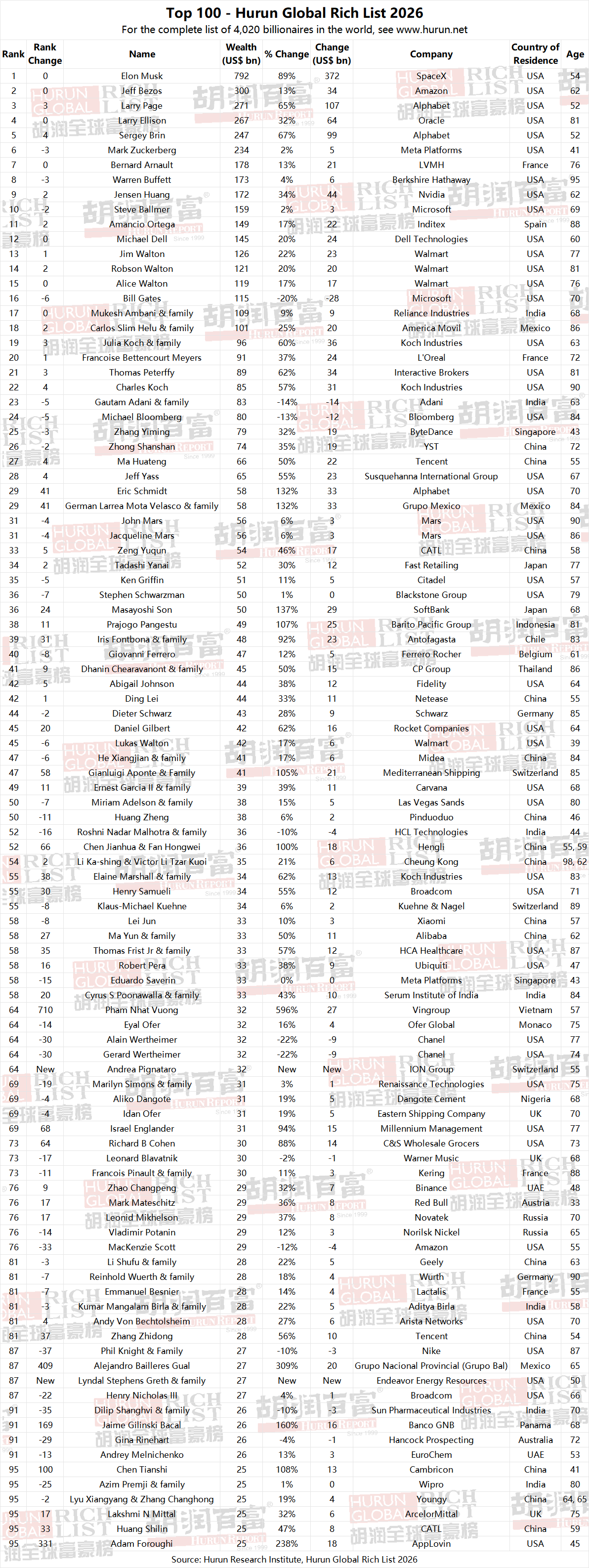
The Top 10 added US$755bn, 19% of total new wealth, and are worth US$2.8 trillion, making up 13% of the total list.
Elon Musk became the first person in history to surpass US$700bn.
The cut-off to make the Hurun Global Rich List Top 10 has doubled every five years, from US$37bn ten years ago to US$80bn five years ago and US$159bn this year.
Table 1: Top 10 Wealthiest in the world
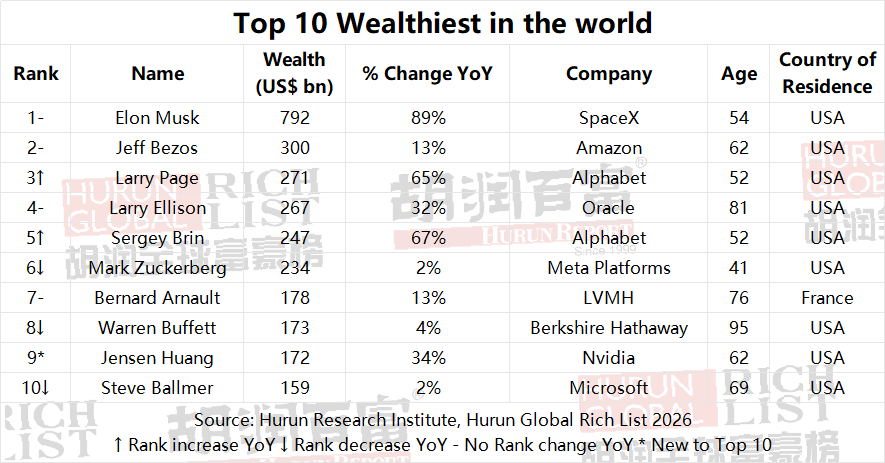
Elon Musk, 54, has reclaimed his title as the world’s wealthiest individual for the fifth time in six years. His net worth soared 89% to a staggering US$792bn, an increase driven by Tesla stock doubling to $411 and SpaceX’s preparations for a world-record IPO. Since leaving his high-profile advisory role in the Trump administration just six months ago, his net worth has shot up by just under US$500 billion, in just six months. SpaceX’ Starlink satellite network has proven to be the ‘essential backbone’ of the Ukraine war effort by providing secure communications.
Jeff Bezos, 62, held onto second place with US$300bn, growing 13% through Amazon's deepening dominance in AI-powered cloud computing and resilient e-commerce ecosystems, while his wealth surge was further accelerated by the "Blue Origin boom" following the orbital debut of the New Glenn rocket and a US$3.4bn NASA contract for the Blue Moon lunar lander.
Larry Page, 52, and Sergey Brin, 52, have surged into the Top 3 and Top 5 wealthiest individuals globally, with US$271bn and US$247bn. Their rapid financial ascent was driven by Alphabet shattering the US$4 trillion market valuation mark. This milestone was heavily fueled by the explosive global adoption of the Gemini 4 AI model and the continued enterprise dominance of Google Cloud. Beyond their finances, both co-founders have shed their hands-off approach to return to the technical trenches, with Brin actively coding alongside AI engineers.
Larry Ellison, 81, remains a dominant force among the world's wealthiest with his net worth surging 32% to US$267bn, driven by Oracle's aggressive expansion into AI and cloud computing. Ellison was briefly the World's Richest Person late last year, following massive OpenAI datacenter contracts, and has committed to donating over US$1bn to Oxford University.
Mark Zuckerberg, 41, dropped out of the Hurun Top 5 after his net worth edged up just 2% to US$234bn. Meta continues its open-source AI strategy and the commercial breakout of its Ray-Ban smart glasses.
Bernard Arnault, 76, retained his 7th place with US$178bn, up 13%. After prolonged weakness in Chinese luxury demand and tariff headwinds impacted LVMH, Arnault personally repurchased a significant stake to demonstrate his confidence in the company.
Warren Buffett, 95, slipped three spots to 8th place despite growing 4% to US$173bn, bolstered by triple-digit insurance profits and high treasury yields on a massive US$382bn cash pile. Amid broader market volatility, his decades-long compounding philosophy continues to demonstrate immense resilience and deliver steady, world-class returns.
Jensen Huang, 62, entered the Hurun Top 10 for the first time, reaching US$172bn on a 34% gain. Nvidia's Blackwell GPU architecture became the indispensable engine powering global AI infrastructure, making the company the most strategically critical technology business on earth and briefly pushing it to a historic US$5 trillion market capitalisation.
Steve Ballmer, 69, rounded out the Hurun Top 10 with US$159bn, up 2%. While growth was modest compared to AI-era peers, Microsoft's steady institutional relevance under its current leadership kept Ballmer's fortune stable, reflecting the enduring value of long-term equity ownership in a world-class technology franchise.
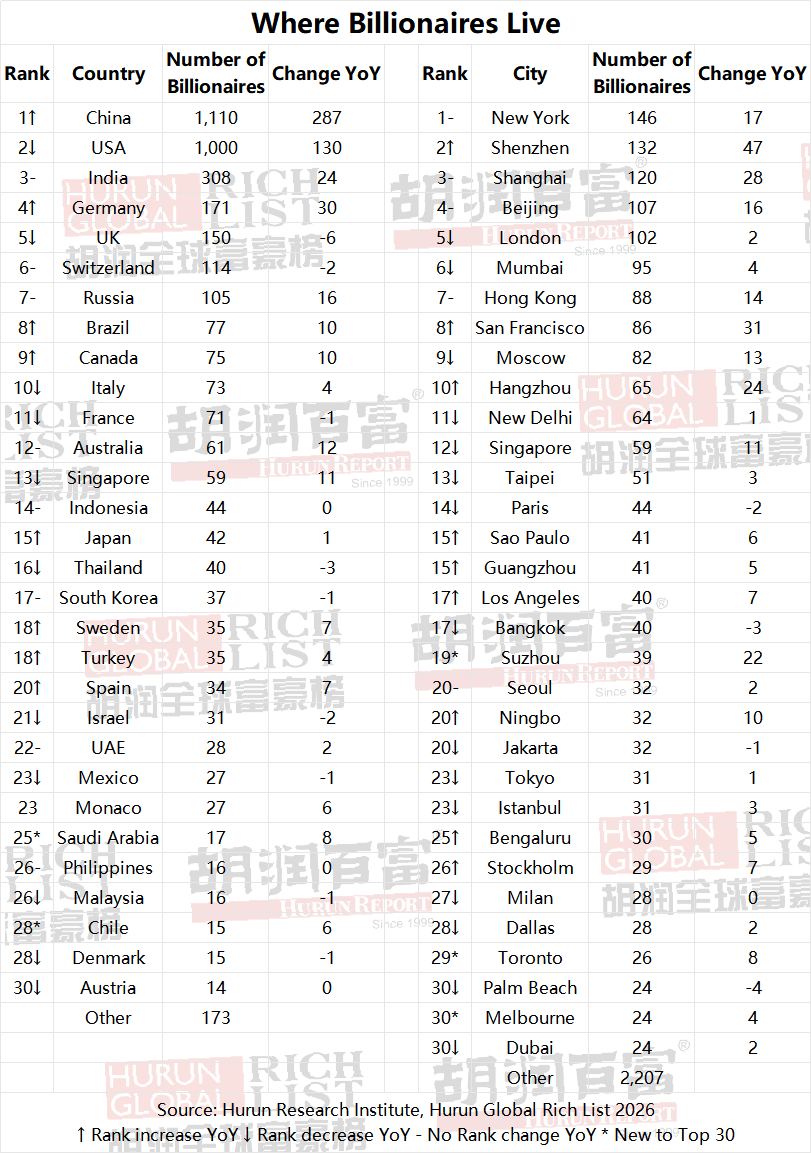
Where Billionaires Live
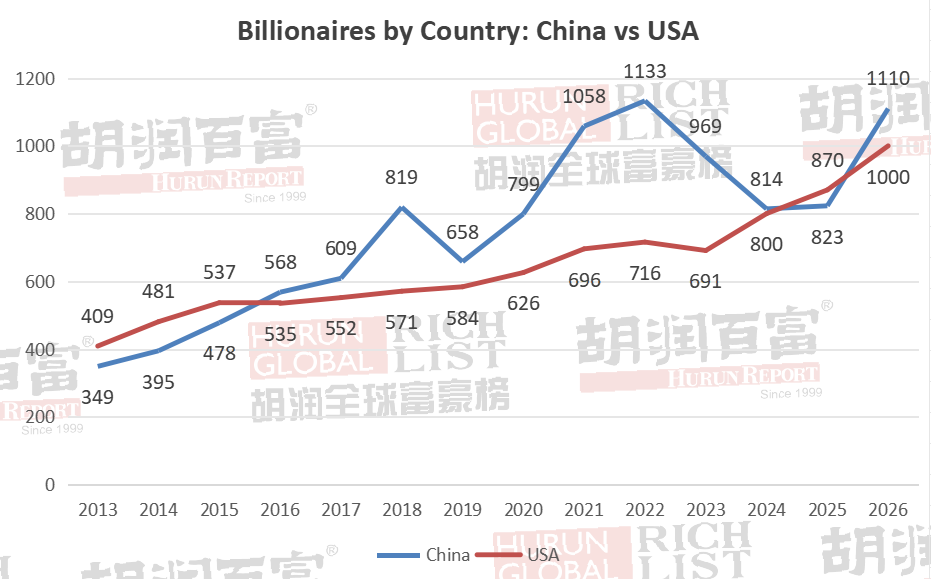
China overtook the US to take back the title of the World’s Billionaire Capital. China led with 1,110 billionaires, adding 287 over the year, whilst the USA was second with 1,000 billionaires, up by 130.
Ranked third, India was home to 308 billionaires, up 24. Germany climbed to fourth with 171 (+30), overtaking the UK. Other countries that grew fast included Russia, Australia, Singapore, Brazil, Canada and Saudi Arabia.
The ‘West’ made up 41% of the 2026 Hurun Global Rich List, with 1,000 from the US, 743 from Europe, 75 from Canada and 61 from Australia.
The EU had 495 led by Germany with 171, Italy with 73, and France with 71. Other top contributors included Sweden (35) and Spain (34).
South East Asia has 181 billionaires, up 7, led by Singapore with 59, Indonesia with 44, and Thailand with 40. Malaysia and the Philippines contributed 16 each, and Vietnam followed with 6.
The GCC grew to 48 entrants, up 9, led by the UAE with 28, Saudi Arabia with 17, Qatar with 2, and Kuwait with 1.
By city, New York remains the Billionaire Capital City of the World with 146 billionaires, up 17. Shenzhen surged into second place adding 47 to 132, Mumbai dropped to sixth with 95. Other cities that grew fast included San Francisco, Shanghai, Hangzhou, Suzhou, Hong Kong and Moscow.
Table 2: Where they live
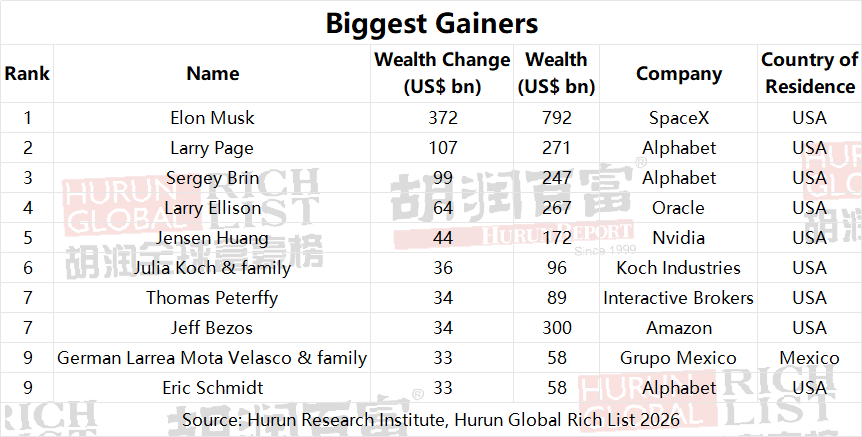
Who’s Up?
3,201 people on the list saw their wealth rise, including 726 new entrants.
AI was the dominant wealth engine globally. The biggest gainer was Elon Musk, followed by Larry Page, Sergey Brin, Larry Ellison and Jensen Huang.
Other notable gainers highlighted: Julia Koch & family (+US$36bn) as her inherited Koch Industries stake appreciated significantly; Thomas Peterffy (+US$34bn) on record retail trading volumes; Germán Larrea (+US$33bn) as copper benefited from electrification and data-centre/AI buildouts. Beyond the top ten, Masayoshi Son more than doubled (US$21bn to US$50bn) on ARM’s AI re-rating; Pham Nhat Vuong surged nearly sevenfold (US$4.6bn to US$32bn) on VinFast/Vingroup re-rating; Amancio Ortega added US$22bn (to US$149bn), driven largely by his real estate platform alongside Inditex strength.
The big risers in China were AI related, led by Zhang Yiming of ByteDance, who added US$19bn to hit US$79bn, and followed by Ma Huateng, reaching US$66bn, Chen Tianshi, 41, of Cambricon, doubling to US$25bn, Wang Weixiu of data center provider Zhongji Innolight, up six-fold to US$15bn, Li Yanhong, to US$12bn, Cai Huabo of Longsys, to US$7.4bn. Consumer goods had a good year, led by Zhong Shanshan of bottled water giant Nongfu Spring, followed by two doing collectable toys, Grant Wang Ning of Pop Mart and Li Qibin of Kayou, and two doing gold jewelry Henry Cheng of Chow Tai Fook and Xu Gaoming of Laopu Gold. Renewables had a good year, led by Robin Zeng of battery maker CATL, Cao Renxian of energy storage maker Sungrow Power and Wang Yanqing of Wuxi Lead. Pharmaceuticals grew fast led by Zhong Huijuan of Hansoh, more than doubling to US$23bn, HK-based Au Yat-Gai of ADHD and autism drug maker Regencell, Zhu Yi of cancer drug maker Biokin Pharmaceutical. Outlier Chen Jianhua of Hengli saw his wealth double to US$36bn, as his new shipping business boomed.
China had a breakout year in AI and semiconductors. New entrants included Chen Weiliang of Metax and Zhang Jianzhong of Moore Thread, as well as new faces Chen Tao & Liu Chunlan of circuit board maker Victory Giant, plus Minimax's Yan Junjie, signalling a fast-growing domestic Chinese AI ecosystem under export-control pressure. China's robotics ‘arrived’ culturally and commercially, with a viral humanoid-robot mass dance performance led by future billionaire Wang Xingxing of Unitree. First-time list representation includes Deng Taihua (Zhiyuan Robot, US$3bn) and Zhou Jian (UBtech, US$2bn), plus multiple Inovance Technology founders, framing a rapid emergence of "physical AI" wealth. Consumer electronics supply chain leaders who had a good year included Zhou Qunfei of Lens, Zeng Fangqin of Lingyi, Yuan Fugen of Dongshan and Wang Laichun of Luxshare Precision. Consumer electronic brands Frank Wang Tao of drone maker DJI and Liu Jingkang of Insta360 both had good years.
Among the 726 new entrants, 194 came from inherited family businesses, led by Julia Koch & family.
Table 3: Biggest Gainers
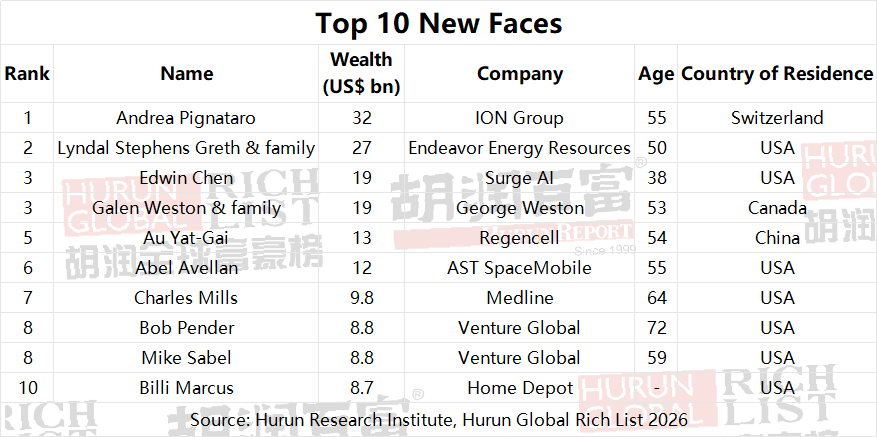
New Faces
As part of the Hurun Global Rich List 2026, 28 individuals joined the billionaire club through inherited family businesses. Notably, four of these inheritors ranked among the Top 10 new entrants.
726 new billionaires joined this year's list, two every single day of the last year, bringing combined wealth of close to US$1.6 trillion and a combined average age of 58. These are not overnight sensations; they are builders whose moment finally arrived.
The country split tells the defining geopolitical story of our era: China produced more than 300 new entrants averaging US$1.5bn each, almost entirely through manufacturing, with Industrial Products alone added nearly 90 new Chinese names, with Semiconductors and Healthcare close behind, as Beijing's self-sufficiency drive translated directly into personal fortunes. The USA produced 148 new entrants at a higher average of US$2.8bn, led by AI (32 new names) and Financial Services (20). Germany produced just 34 new entrants but at the highest average wealth of any major nation at US$4.5bn, anchored by the Boehringer Ingelheim family entering at US$7bn each. The single wealthiest new entrant is Andrea Pignataro of ION Group at US$32bn a reminder that owning the data and workflow infrastructure of global fixed income trading is a business most people have never heard of and almost nobody can disrupt. Second is Lyndal Stephens Greth of Endeavor Energy Resources at US$27bn, with Bob Pender and Mike Sabel of Venture Global entering at US$8.8bn each together making American LNG one of the year's quietly dominant wealth stories.
The top ten new entrants read as a map of where the global economy is placing its bets. Edwin Chen of Surge AI entered at US$19bn, the highest debut of any pure-play AI founder, as the value of proprietary AI training data became starkly apparent. Abel Avellan of AST SpaceMobile entered at US$12bn, his direct-to-device satellite network bringing commercial space one step closer to mass-market infrastructure. Healthcare delivered the newest billionaire wealth of any sector US$247bn across 75 new names with Au Yat-Gai of Regencell entering at US$13bn and Charles Mills of Medline at US$9.8bn leading a cohort that spans pharma, biotech, and medical devices across China, Germany, and the USA. The seven Anthropic co-founders entering simultaneously at US$3.7bn each AI safety turned into one of the most valuable private companies on earth represent the most concentrated single-event debut in the list's history. And then there are Galen Weston of George Weston at US$19bn and Billi Marcus of Home Depot at US$8.7bn: proof that in the right market, reliable cash flows from groceries and home improvement still mint billionaires as surely as any algorithm.
Table 4: Top 10 New Faces
And, Who’s Down?
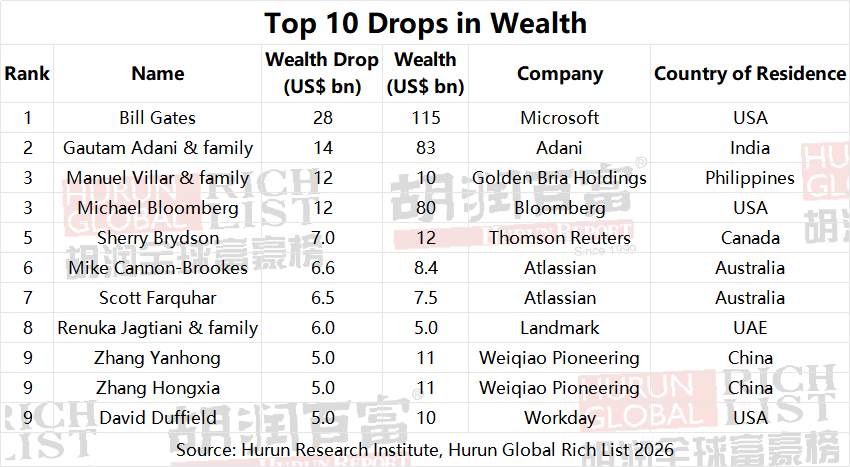
A total of 809 individuals experienced a decline in their net worth, with 96 dropping off the list entirely. Additionally, the report accounts for the passing of 44 individuals.
Bill Gates recorded the list's largest single drop, down US$28bn to US$115bn, of which US$20bn was a donation to the Gates Foundation, the most consequential act of philanthropy on this year's list. Michael Bloomberg was down US$12bn to US$80bn, combining a significant philanthropic distribution with a contraction in Bloomberg LP's implied valuation as generative AI threatened the moats of traditional financial data terminals a fear that also sent Canada's Sherry Brydson down US$7bn to US$12bn as Thomson Reuters shares retreated.
The remaining large declines were involuntary. Gautam Adani lost US$14bn to stand at US$83bn first hit by a November 2024 New York federal indictment alleging bribery and investor fraud, then by a February 2026 US Treasury investigation into alleged Iranian sanctions violations that sent his conglomerate's stocks into freefall and collapsed international deals worth billions. Manuel Villar of the Philippines dropped US$13bn to US$9.9bn as his property empire faced a weaker domestic market. Atlassian co-founders Mike Cannon-Brookes and Scott Farquhar each shed over US$6bn to around US$8bn as AI fears cut their stock by a third. Renuka Jagtiani suffered the sharpest proportional loss down more than half to US$5bn as her Landmark Group retail empire came under severe pressure.
Table 5: Top 10 Drops in Wealth
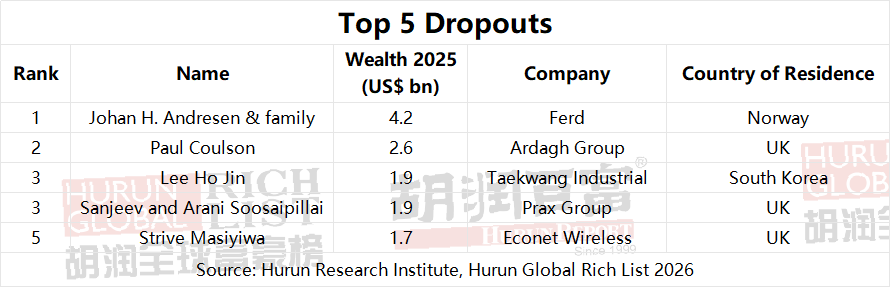
Top 5 Dropouts
Table 6: Top 5 Dropouts
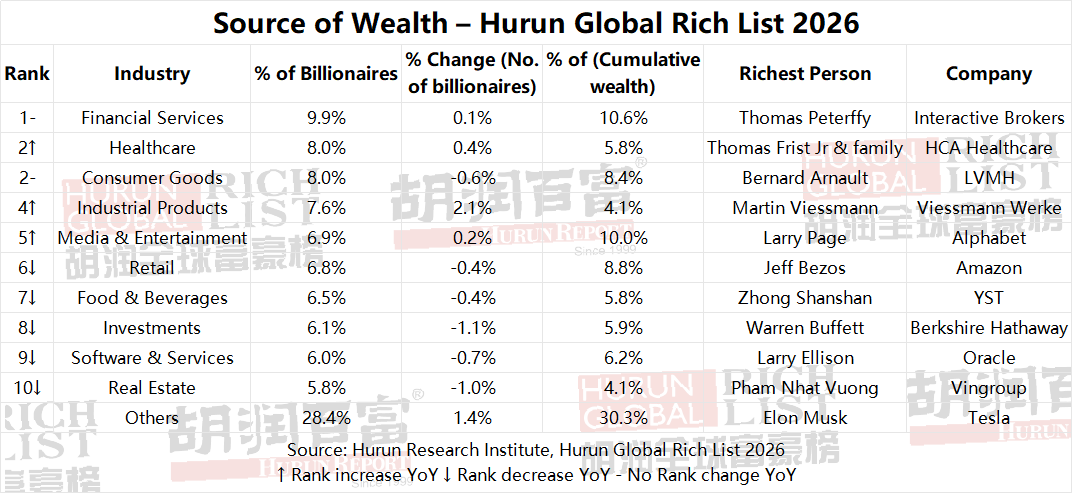
Source of Wealth by Industry - Hurun Global Rich List 2026
By number of billionaires, Financial Services stayed on top with 9.9%, followed by Healthcare and Consumer Goods in second place with 8% while Food & Beverages slipped to seventh with 6.5%. Industrial Products was the biggest climber, moving up to fourth with 7.6%, and the strongest rise in billionaire count (+2.1%).
By cumulative wealth, Financial Services led with 10.6%, while Media & Entertainment was close behind at 10.0%, and Retail contributed 8.8%.
The “Others” category is the biggest block on the list (28.4% of billionaires; 30.3% of total wealth) and captured much of the year’s most dramatic wealth creation, reflecting the major economic shifts underway.
Within “Others”, Semiconductors showed the strongest momentum (68 billionaires; 42 up vs 2 down, led by Jensen Huang; Cai Huabo +311%), Aerospace & Defence remained powerful (48 billionaires; US$955bn, Elon Musk contributing 83% of wealth in this industry), Energy has the largest total wealth powerful (153; US$1,177bn, led by Mukesh Ambani; Ian Lundin +153%), Metals & Mining benefited from copper (139; US$798bn; 95 up),and AI emerged as a new standalone sector with 46 billionaires all new entrants worth US$124bn.
Table 7: Source of Wealth – Hurun Global Rich List 2026
Comparison of China and USA billionaires
The China overtook USA in billionaire numbers again. China has now 1,110 billionaires.
Chart 1: Billionaires by Country
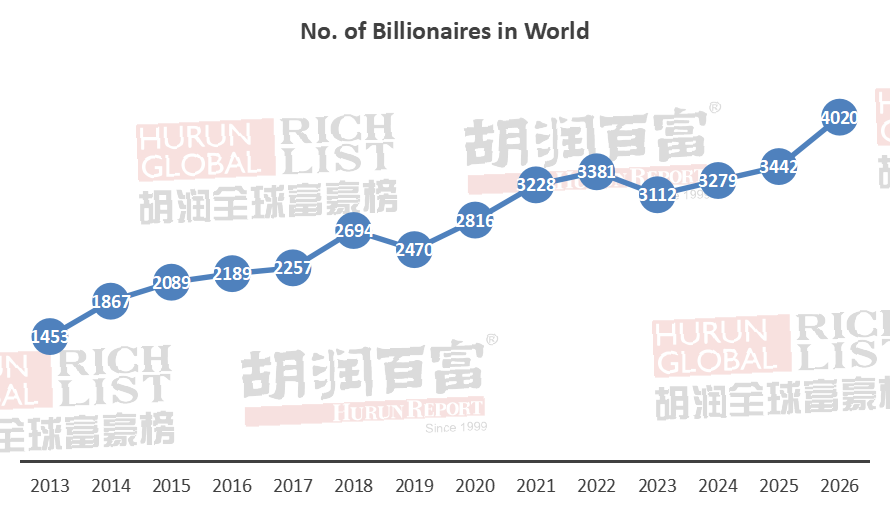
Number of Billionaires through the years
The total number of known billionaires hit a new world record of 4,020 doubling over ten years.
The ‘Ten-zero club’, those with US$10bn or more, more than tripled in a decade to 373.
Meanwhile, the ‘11-zero club’, those with US$100bn or more, has grown from zero to 18 in just eight years.
The cut-off to make the Hurun Global Rich List Top 10 has doubled every five years from US$37bn ten years ago, to US$80bn five years ago, and US$159bn this year.
Table 10: Number of Billionaires by Wealth, and comparison with China, USA & India
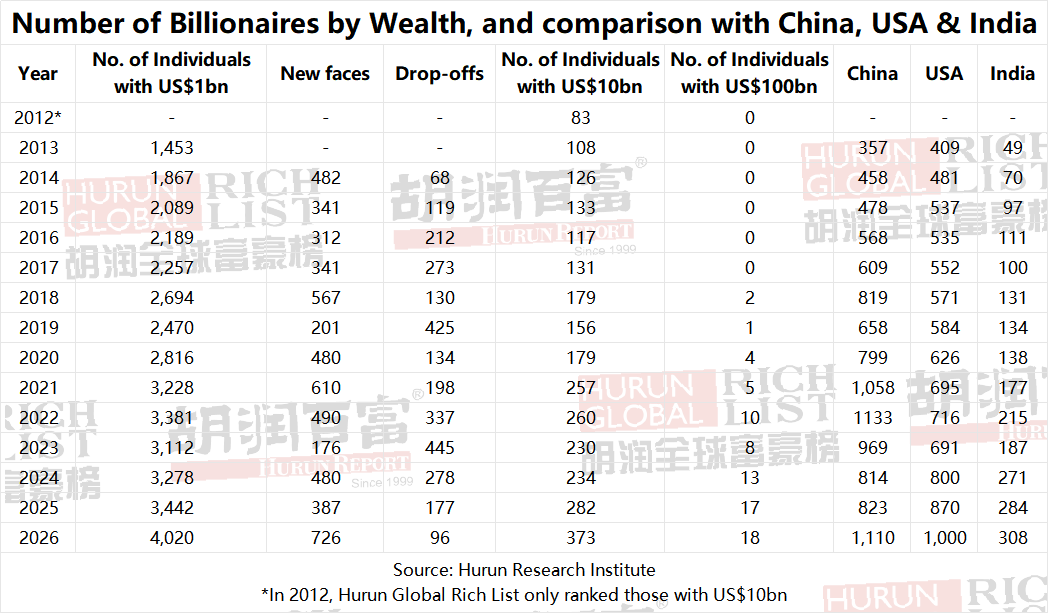
Table 11: Stats – Cut-off through the Years
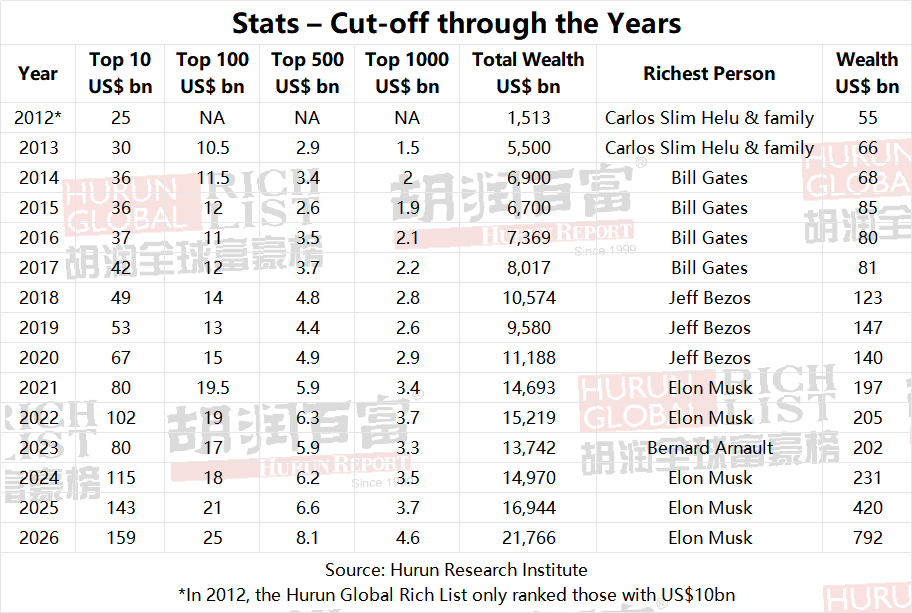
Chart 2: No of Billionaires
Appendix 1 – Comparison of Billionaires in China, USA, and India
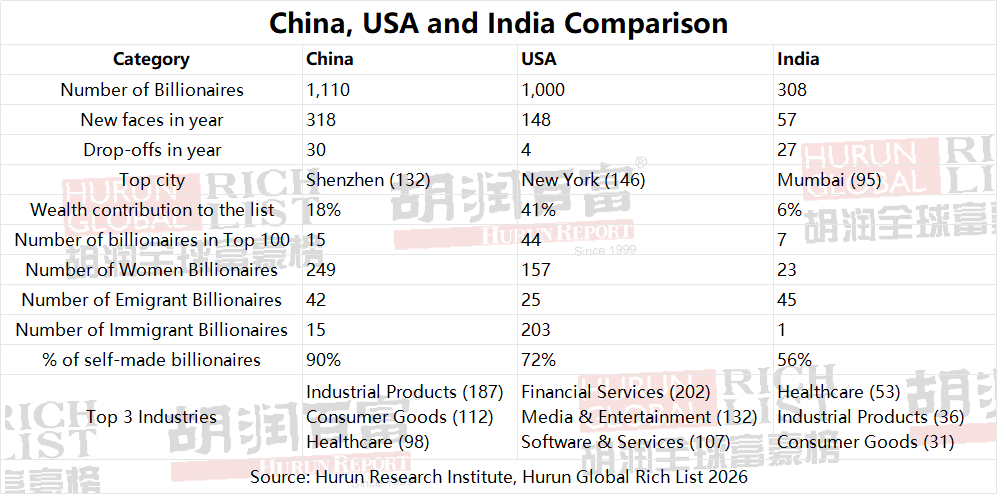
China, the USA, and India remain the world’s three largest billionaire hubs, together accounting for a majority of global billionaire wealth, industry leadership, and entrepreneurial activity.
China and India led the world for emigrant billionaires, whilst the US led with immigrant billionaires. China has the highest percentage of self-made billionaires, whilst India led with the highest percentage of family businesses.
Table 13: USA, China and India Comparison
Appendix 2 - Rest of World Countries
Germany was up one place to fourth, with 171 billionaires with a total net worth of US$857bn. The most prosperous industries are Healthcare with 34 billionaires, followed by Industrial Products with 23 billionaires and Retail with 22 billionaires, and Food and Beverages with 21 billionaires. Munich is the top city, with 21 billionaires, followed by Ingelheim with 15 and Hamburg with 11. The country saw 98 billionaires with their wealth increase and 34 newly joined the list. The average age of German billionaires is 65.
The UK ranked fifth. It has 150 billionaires with a combined wealth of US$710bn and is strong in sectors such as Real Estate (23 billionaires), Retail (19 billionaires), Financial Services (18 billionaires) and Media & Entertainment having 14 billionaires. London is the most popular city, with 102 billionaires living there. 109 saw their wealth grow, 28 fell off, and 12 joined the list. The average age of UK billionaires is 66.
Switzerland was ranked sixth in the world with 114 billionaires, with a total wealth of US$651bn. Geneva and Zurich share the top spot as the most popular cities, with 15 billionaires living there. The industries that dominate in Switzerland are Healthcare (24 billionaires), Financial Services (10 billionaires) and Consumer Goods (9 billionaires). Ninety-three billionaires saw their wealth grow. The average age of Swiss billionaires is 68, and Gianluigi Aponte & Family is the richest at US$41bn.
Russia retained seventh ranking globally with 105 billionaires, with a total wealth of US$493bn. Metals & Mining (20 billionaires), Investments (13 billionaires), and Retail & Energy (10 billionaires each) are the main industries. Moscow is the favoured city, with 82 billionaires living there. Remarkably, 95 billionaires saw their wealth increase, and there were 16 new entries. The average age of Russian billionaires is 61.
Brazil ranked eighth in the world, with 77 billionaires who have a total wealth of US$250bn. The most popular sectors among them are Financial Services with 22 billionaires, Investments with 10, and Industrial Products with 7. The highest number of billionaires comes from Sao Paulo (41). The richest person is David Velez, with US$17bn, linked to the industry giant Nu Holdings. The oldest is Daniel Miguel Klabin, aged 96, with a wealth of US$2.4bn.
Canada has risen to ninth in the rankings with 75 billionaires with a total wealth of US$279bn. The most popular sector is Retail, with 16 billionaires. Toronto is the city with the most billionaires (26). The wealthiest is Galen Weston & family, who has US$19bn. Moreover, there are ten new additions to the billionaire list from Canada.
Italy stands at the 10th place with 73 billionaires with a combined wealth of US$223bn. The most popular sectors among them are Consumer Goods, with 30 billionaires; Food & Beverages, with 7; and Healthcare & Media and Entertainment, with 5 each. Milan is the city with 28 billionaires. Massimiliana Landini Aleotti & family (US$9.3bn) is the wealthiest person. Forty-five billionaires saw their wealth increase, while 21 saw it decrease and 7 new people joined the billionaire list from Italy.
Appendix 3: Self-made degree
Hurun Research’s bespoke measure of the degree to which billionaires are inherited or self-made. The scorecard is out of five, where one is inherited and not active in business, and five is self-made without help from parents. Hoogewerf said, “Many billionaires like to portray themselves as self-made but have inherited significant wealth from their parents.”
69% are Self-made, and 31% are inherited. China remains the world’s engine when it comes to self-made billionaires.
Appendix 4 – Deaths
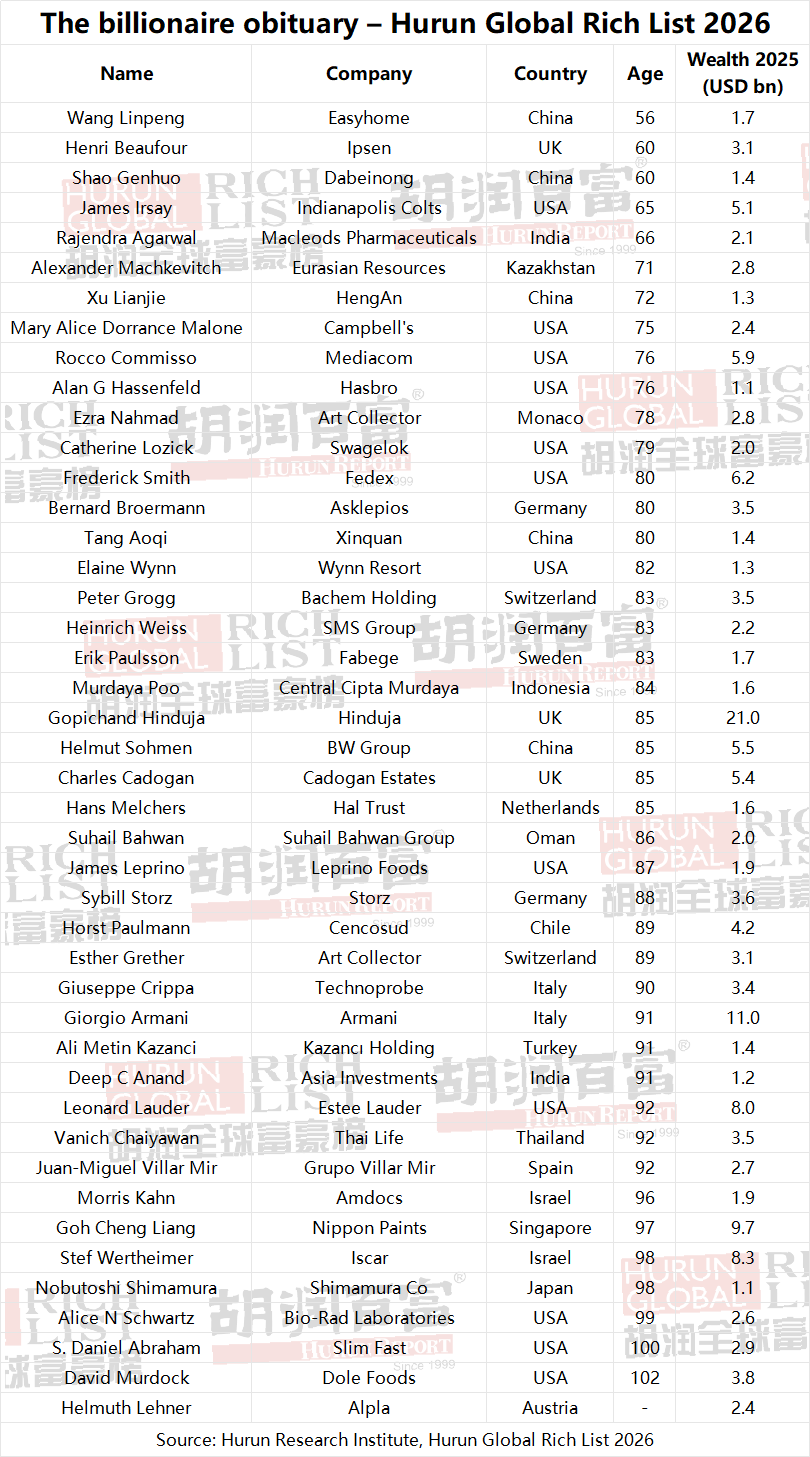
44 billionaires died during the past year.
Of the deaths listed, the youngest were Wang Linpeng of Easyhome aged 56, Shao Genhuo of Dabeinong aged 60, Henri Beaufour of Ipsen aged 60 and James Irsay, owner of Indianapolis Colts, aged 65. Fourteen were aged 90 or above, with US-based David Murdock, Dole Foods (US$3.8bn), aged 102 and Slim-Fast’s S. Daniel Abraham (US$2.9bn), aged 100.
Between them, they passed down more than US$165bn to family members.
Table 14: The billionaire obituary – Hurun Global Rich List 2026
Appendix 5 – By Continent
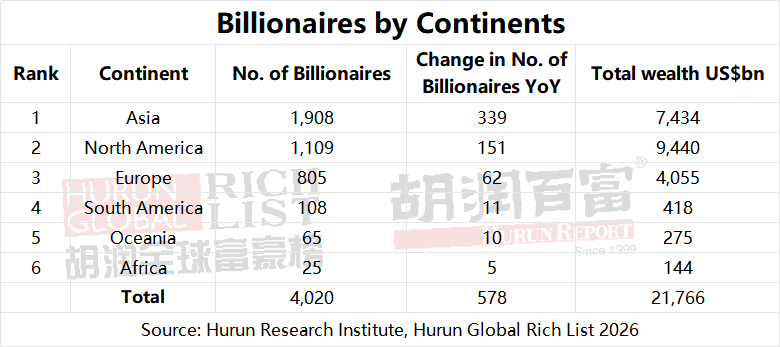
Asia has just under half the world’s known billionaires and is the fastest-growing continent.
Table 9: Billionaires by Continents
Interesting Fact About Billionaires
The Sugar Rush Holds — Just: Rubens Ometto built the world's first ethanol empire, turning Brazilian sugar cane into biofuel before most governments had a climate policy. His wealth rose 30% this year to US$1.3bn — a resilient performance for a business that runs on commodity cycles and political will. As the global energy transition accelerates, Ometto remains the proof of concept: the first billionaire to bet on bioenergy and win.
The AI Copper Boom: Germán Larrea's High-Voltage Fortune Forget silicon the real AI gold rush is copper. Grupo Mexico's Germán Larrea more than doubled his wealth to US$58bn as copper prices shattered records, surging past US$13,000 per tonne. The driver: an insatiable appetite for the power cables wiring AI data centres and renewable energy grids. Larrea is the living proof that the intelligence economy has a physical foundation — and whoever owns what it is built from owns the future.
The Ultimate Rags-to-Riches: Indonesia's Minibus Driver Prajogo Pangestu's biography does not read like a typical billionaire. Before becoming the richest person in Indonesia, he tapped rubber trees and drove a local minibus. He is now worth US$49bn up 107% this year alone through Barito Pacific Group. In a list dominated by tech founders and inherited empires, Pangestu is a reminder that the oldest kind of ambition still works.
About Hurun Inc.
Promoting Entrepreneurship Through Lists and Research
Oxford, Shanghai, Mumbai, Sydney, Paris
Established in the UK in 1999, Hurun is a research, media and investments group, promoting entrepreneurship through its lists and research. Widely regarded as an opinion leader in the world of business, Hurun generated 8 billion views on the Hurun brand in 2025, mainly in China and India, and increasingly in the UK.
Best-known today for the Hurun Rich List series, telling the stories of the world’s successful entrepreneurs in China, India and the world, Hurun’s two other key series include the Hurun Start-up series and the Hurun 500 series, a ranking of the world’s most valuable companies.
The Hurun Start-up series ranks 3000 of the world’s unicorns and future unicorns with the Hurun Global Unicorns Index and the Hurun Future Unicorns Index, split into Gazelles (most likely to ‘go unicorn within 3 years) and Cheetahs (most likely to go unicorn within 5 years). Hurun also encourages founders with the Hurun Under25s, Under30s, Under35s and Under40s, presenting awards to founders who have built businesses worth US$1mn, US$10mn, US$50mn, and US$100mn, respectively.
Other lists include the Hurun Schools List, ranking the best highschools in the world, the Hurun Philanthropy List, ranking the biggest philanthropists, the Hurun Art List, ranking the world’s most successful artists alive today, etc…
Hurun provides research reports co-branded with some of the world’s leading financial institutions, brands and regional governments.
Hurun hosts regular high-profile events in China, India and the UK, as well as Paris, New York, LA, Sydney, Luxembourg, Istanbul, Dubai and Singapore.
For further information, see www.hurun.net.
For media inquiries, please contact:
Hurun Report
Porsha Pan
Email: porsha.pan@hurun.net
Hurun Report Disclaimer
This report has been prepared by the Hurun Report. All the data collection and the research has been done by the Hurun Report. This report is meant for information purposes only. Reasonable care and caution have been taken in preparing this report. The information contained in this report has been obtained from sources that are considered reliable. By accessing and/or using any part of the report, the user accepts this disclaimer and exclusion of liability which operates to the benefit of Hurun Report. Hurun Report does not guarantee the accuracy, adequacy or completeness of any information contained in the report and neither shall it be responsible for any errors or omissions in or for the results obtained from the use of such information. No third party whose information is referenced in this report under the credit to it assumes any liability towards the user with respect to its information. Hurun Report shall not be liable for any decisions made by the user based on this report (including those of investment or divestiture) and the user takes full responsibility for their decisions made based on this report. Hurun Report shall not be liable to any user of this report (and expressly disclaim liability) for any loss, damage of any nature, including but not limited to direct, indirect, punitive, special, exemplary, consequential losses, loss of profit, lost business and economic loss regardless of the cause or form of action and regardless of whether or not any such loss could have been foreseen.
Table 15: Top 100 - Hurun Global Rich List 2026